
Discover the role of accountability in interview prep. Enhance your consulting interview skills through structured feedback and effective practice.
On this page▾
- How accountability transforms interview prep from solo effort to interactive learning
- What does an effective accountability structure look like?
- Session cadence
- Partner diversity
- Structured debriefs
- Why voluntary accountability outperforms mandated accountability
- Practical strategies to build accountability into your consulting prep
- Select and rotate your practice partners
- Use platforms that provide structured feedback
- Track progress with rubrics across sessions
- Balance communication and problem-solving skills
- Use self-reflection as a feedback tool between sessions
- Key Takeaways
- What I have seen accountability actually do for consulting candidates
- Frame-lab's structured tools for accountable consulting prep
- FAQ
- What is the role of accountability in interview prep?
- How often should I schedule mock interviews for consulting prep?
- Why does solo interview prep fall short?
- What debrief framework works best after a mock interview?
- Does voluntary accountability really outperform mandated accountability?
- Recommended
Accountability in interview prep is defined as taking measurable responsibility for your progress through external feedback, structured practice, and consistent review. The role of accountability in interview prep goes far beyond showing up to study sessions. It creates the external pressure and honest feedback loops that solo practice simply cannot replicate. Gallup research shows that teams with well-defined accountability are three times more engaged and produce higher quality work. That same dynamic applies directly to consulting candidates: accountability transforms vague effort into measurable, sustainable performance gains.
How accountability transforms interview prep from solo effort to interactive learning
Solo preparation is an ego-protective echo chamber. Candidates practicing alone often struggle with follow-up questions that deviate from their rehearsed scripts, because no one has ever challenged their assumptions mid-answer. You get comfortable with your own logic. You stop noticing the gaps.
Peer and expert mock interviews break that pattern. A skeptical listener forces you to defend your reasoning in real time, adapt when pushed, and communicate under pressure. These are exactly the conditions McKinsey and BCG interviewers create. True growth in interview prep happens when you move from solitary practice to vulnerable, interactive sessions involving people who will push back.

Social accountability also outperforms solitary routines for a structural reason. When someone else is watching, you prepare more thoroughly, show up more consistently, and take feedback more seriously. The discomfort of being observed is not a side effect. It is the mechanism.
Pro Tip: Schedule your first peer mock before you feel ready. Waiting until you are "prepared enough" is how candidates spend weeks in the echo chamber without realizing it.
What does an effective accountability structure look like?
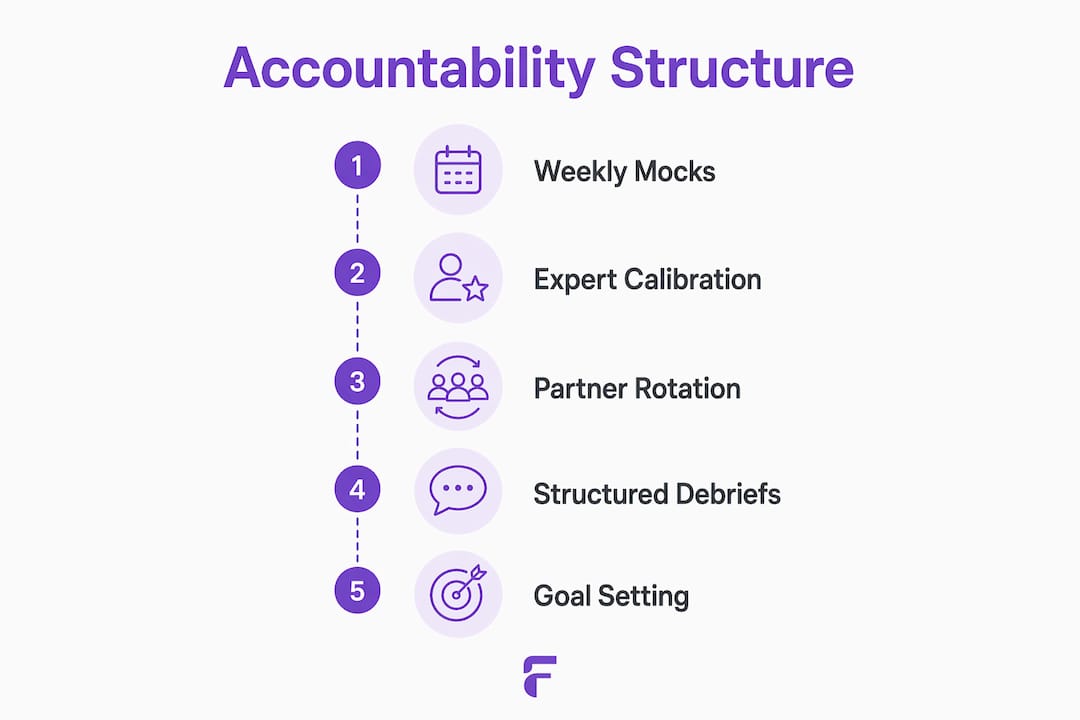
Effective accountability structures for consulting prep have three components: a regular session cadence, diverse partners, and structured debriefs. Each one serves a distinct function.
Session cadence
Weekly peer mock interviews supplemented by expert calibration sessions every 4 - 6 weeks create the optimal accountability rhythm. Weekly sessions build endurance and keep your skills sharp. Expert sessions benchmark your performance against the actual bar set by top-tier firms.
Partner diversity
Rotating your practice partners is not optional. Different partners expose different blind spots. A partner who shares your background will often accept the same logical shortcuts you do. A partner from a different field will question assumptions you have never had to defend.
Structured debriefs
Without a structured debrief format, post-mock self-assessment correlates poorly with actual performance. Two frameworks work particularly well:
- Keep/Stop/Start: Identify one behavior to keep, one to stop, and one to start after every session. This forces specificity and prevents vague feedback like "do better on structuring."
- Situation-Behavior-Impact (SBI): Describe the exact situation, the specific behavior observed, and the impact it had on the interview. SBI converts abstract impressions into concrete drills.
The data behind structured debriefs is clear. Patterns across three consecutive debriefs from different partners reliably identify true preparation gaps. One piece of feedback is an opinion. Three consistent pieces of feedback from different people is a fact about your performance.
| Accountability element | What it does | How often |
|---|---|---|
| Peer mock interviews | Builds endurance, exposes script gaps | Weekly |
| Expert calibration sessions | Benchmarks against real interview standards | Every 4 - 6 weeks |
| Structured debrief (Keep/Stop/Start or SBI) | Converts feedback into specific drills | After every session |
| Partner rotation | Reveals blind spots unique to your background | Every 2 - 4 sessions |
Pro Tip: Log your debrief notes in a single document after every session. Patterns become visible only when you can compare session three to session one side by side.
Why voluntary accountability outperforms mandated accountability
Accountability works best when you choose it. Harvard Business Review identifies a critical distinction: voluntary accountability internalizes goals rather than enforcing checklist behaviors. When accountability is mandated, candidates comply. When it is chosen, candidates commit.
This distinction matters enormously in consulting prep. Compliance looks like showing up to a scheduled mock and going through the motions. Commitment looks like preparing a specific case type you struggled with last week, asking your partner to push harder on your communication, and reviewing the debrief before the next session.
The mindset shift required is straightforward. Stop tracking whether you completed a task. Start tracking whether you improved on a specific, measurable dimension. The difference between "I did three mocks this week" and "My structured communication score improved from a 3 to a 4 on the Keep/Stop/Start rubric this week" is the difference between compliance and commitment.
Voluntary accountability also reduces the anxiety that many candidates associate with being evaluated. When you own the process, feedback stops feeling like judgment and starts feeling like data.
- Reframe feedback as information, not criticism. Every gap your partner identifies is a gap the interviewer would have found instead.
- Set one specific improvement goal per session, not a general goal like "do better."
- Choose partners who will challenge you, not partners who will make you feel comfortable.
- Review your debrief notes before each new session to close the loop on prior feedback.
Pro Tip: Write your improvement goal for the next session at the end of every debrief. Candidates who set session-specific goals improve faster than those who rely on general effort.
Practical strategies to build accountability into your consulting prep
Building a real accountability system requires more than good intentions. These strategies give you a concrete structure to follow.
Select and rotate your practice partners
Use a practice partner checklist to evaluate potential partners before committing. Look for partners who are at a similar or slightly higher preparation level, who will give honest feedback, and who are targeting comparable firms. Rotate partners every 2 - 4 sessions to prevent the echo chamber from re-forming.
Use platforms that provide structured feedback
Generic video calls with friends do not replicate real interview conditions. Platforms that offer anonymous peer matching and expert mock sessions provide the external pressure and calibrated feedback that accountability requires. Frame-lab combines AI-driven mock interviews with over 400 curated experience reports from real McKinsey and BCG interviews, giving you both peer accountability and expert benchmarking in one place.
Track progress with rubrics across sessions
A rubric score from a single session tells you very little. Rubric score patterns across multiple sessions are where the real signal lives. For example, a candidate scoring strong on problem-solving but weak on communication advances at a dramatically different rate than one with the reverse profile. Tracking your scores session by session reveals which dimension is actually holding you back.
Balance communication and problem-solving skills
Analysis of 100,000 interview sessions shows that a 4-4-2 rubric score, meaning strong code and problem-solving with weak communication, advances at roughly 96%. Strong communication with mediocre problem-solving advances at roughly three times worse a rate. That data point tells you where to focus your accountability efforts if you are unsure.
Use self-reflection as a feedback tool between sessions
Self-reflection for interviews is most effective when it is structured. After each session, write three sentences: what you did well, what broke down, and what you will do differently next time. This practice builds the self-awareness that separates candidates who plateau from candidates who keep improving.
- Schedule your next mock before you leave the current one. Open calendar, set the date.
- Keep a prep log with rubric scores, partner names, and debrief notes from every session.
- Review your log weekly to spot patterns across sessions, not just within them.
- Treat expert sessions as calibration checkpoints, not as practice runs.
Key Takeaways
Accountability in consulting interview prep is the single most reliable factor separating candidates who plateau from those who reach offer stage.
| Point | Details |
|---|---|
| Define accountability clearly | Accountability means measurable responsibility for progress, not just showing up to practice. |
| Use a structured session cadence | Weekly peer mocks and expert sessions every 4 - 6 weeks create the optimal improvement rhythm. |
| Debrief with a framework | Keep/Stop/Start and SBI convert vague impressions into specific, repeatable drills. |
| Choose accountability voluntarily | Voluntary commitment internalizes goals; compliance only checks boxes without real growth. |
| Track rubric scores across sessions | Patterns across three or more sessions reliably identify the gaps that matter most. |
What I have seen accountability actually do for consulting candidates
Candidates who build real accountability systems do not just perform better. They carry themselves differently in the room. I have watched candidates go from stumbling through basic case structures to fielding sharp follow-up questions with composure, and the turning point is almost always the same. It is not a new framework they learned. It is the moment they stopped practicing alone and started being accountable to someone else.
The most common mistake I see is candidates who treat accountability as a scheduling problem. They think booking more mocks will fix their prep. It will not, unless those mocks include honest feedback and structured debriefs. A mock without a debrief is just performance without learning.
The second mistake is avoiding partners who will challenge them. Candidates gravitate toward people who are kind, supportive, and unlikely to make them feel bad. That instinct is understandable. It is also the reason many candidates walk into their final McKinsey interview without ever having been pushed on their assumptions.
Vulnerability in practice is not a weakness. It is the fastest path to confidence in the real interview. The candidates I have seen succeed at top-tier firms are not the ones who practiced the most. They are the ones who practiced with the most honesty.
Choose accountability not because someone told you to, but because you understand what it actually does for your performance. That choice is what makes it work.
Frame-lab's structured tools for accountable consulting prep
Accountability in consulting prep requires more than motivation. It requires the right structure, the right feedback, and the right benchmarks.
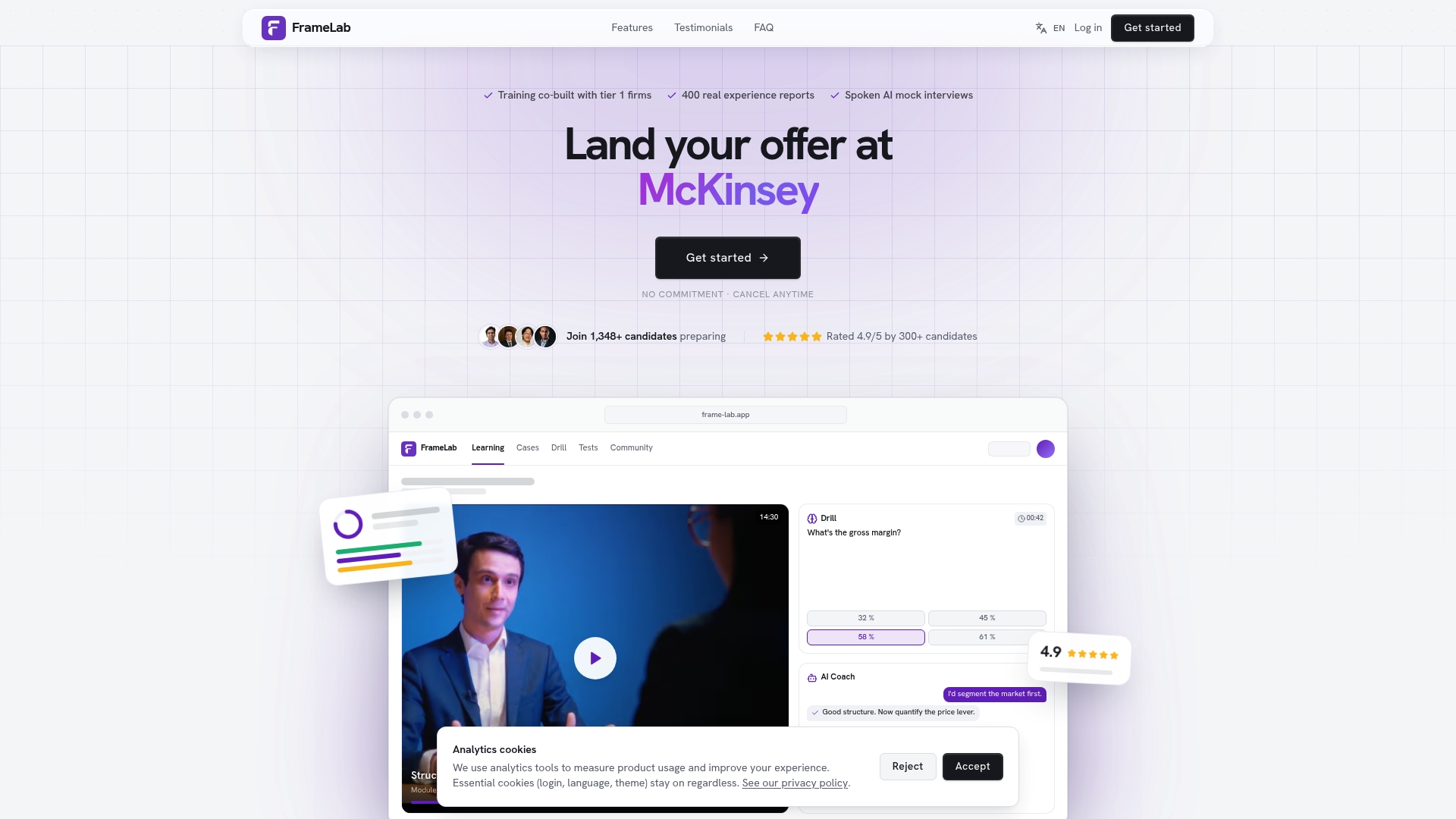
Frame-lab is built specifically for candidates targeting McKinsey, BCG, and peer firms. The platform combines AI-driven mock interview sessions with over 400 real experience reports, giving you both peer accountability and expert calibration in one place. Rubric-aligned feedback and structured debrief tools are built into every session, so your progress is always measurable. Whether you are starting your prep or refining your performance before final rounds, Frame-lab gives you the accountability structure that lands consulting offers.
FAQ
What is the role of accountability in interview prep?
Accountability in interview prep means taking measurable responsibility for your progress through external feedback and structured practice. It replaces ego-protective solo routines with honest, rubric-aligned sessions that expose real gaps.
How often should I schedule mock interviews for consulting prep?
Weekly peer mocks combined with expert calibration sessions every 4 - 6 weeks create the optimal preparation rhythm. This cadence builds endurance while benchmarking your performance against real interview standards.
Why does solo interview prep fall short?
Solo prep creates an echo chamber where candidates rehearse scripts without facing skeptical follow-up questions. Without an external listener, candidates rarely discover the gaps that interviewers at McKinsey and BCG will find immediately.
What debrief framework works best after a mock interview?
Keep/Stop/Start and Situation-Behavior-Impact (SBI) are the two most effective debrief frameworks. Both convert vague impressions into specific behaviors you can drill before your next session.
Does voluntary accountability really outperform mandated accountability?
Harvard Business Review identifies voluntary accountability as significantly more effective because it internalizes goals rather than enforcing checklist behaviors. Candidates who choose accountability commit to improvement; those who comply with it simply complete tasks.