
Prepare effectively with interview readiness benchmarks examples. Learn key metrics like ATS scores to boost your consulting interview success.
On this page▾
- 1. ATS score: the first readiness threshold
- 2. Structured response scoring on three dimensions
- 3. Completeness as the deciding dimension
- 4. Behavioral STAR story readiness
- 5. Company-specific preparation benchmarks
- 6. Self-assessment score frameworks
- 7. Mock interview stamina benchmarks
- 8. Readiness distribution tracking over time
- 9. Calibrated output prompts for skill exposure
- 10. Using AI and human mock tools to measure readiness
- 11. Common pitfalls in self-assessment and how to fix them
- 12. Strategies to fine-tune prep based on your readiness profile
- Key takeaways
- Why benchmarks changed how I think about consulting prep
- Frame-lab's approach to measurable consulting interview readiness
- FAQ
- What is a good interview readiness score?
- How many STAR stories do I need for consulting interviews?
- How long should I simulate for stamina training?
- When should I use AI tools versus human mock interviews?
- What ATS score do I need to get a consulting interview?
- Recommended
Interview readiness benchmarks are defined as measurable criteria that tell you exactly how prepared you are before stepping into a consulting interview. Generic self-assessment fails here. Top firms like McKinsey and BCG use multidimensional evaluation standards covering structured communication, company-specific knowledge, behavioral delivery, and stamina. Candidates who track concrete interview readiness benchmarks examples, such as ATS scores above 85%, structured response scores of 8.0/10 or higher, and six to eight rehearsed STAR stories, give themselves a real, data-backed picture of where they stand.
1. ATS score: the first readiness threshold
An 85% or higher ATS score is the emerging competitive benchmark for serious candidates, correlating with 3% - 5% employer response rates. Candidates scoring below 50% have serious alignment issues. Scores in the 70% - 84% range are solid but fall short of the top tier that consulting firms expect. Your resume must mirror the exact language in the job description, including role titles, skill keywords, and framework names.
Pro Tip: Run your resume through an ATS checker before every application. A single keyword mismatch can drop your score by 10 or more points.

2. Structured response scoring on three dimensions
The industry standard for interview answer quality uses three dimensions: Structure, Conciseness, and Completeness. According to PrepTo's 2026 benchmarks, the "ready" threshold sits at 8.0/10 or higher. Completeness averages 6.9/10 across candidates, which is harder to achieve than Structure (7.4) or Conciseness (7.7). That gap tells you where most candidates lose points.
3. Completeness as the deciding dimension
Completeness score deficiencies cause more final-round failures than any other dimension. Candidates structure their answers well but omit explicit outcomes and quantifiable data. A complete answer names the action taken, the result achieved, and the number that proves it. Prioritize completeness in every practice session before worrying about polish or brevity.
Pro Tip: After every mock answer, ask yourself: "Did I state a specific outcome with a number?" If not, your completeness score is below benchmark.
4. Behavioral STAR story readiness
A ready candidate has six to eight rehearsed STAR stories, each running two to three minutes, each ending with a quantifiable outcome. That is not a suggestion. It is the preparation criteria used by top consulting firms to evaluate behavioral fit. Stories covering leadership, conflict resolution, failure, and cross-functional collaboration give you full coverage of the most common behavioral prompts. Each story should be tested against at least three different question framings to confirm it holds up.
5. Company-specific preparation benchmarks
Generic prep does not survive company-specific screens. Candidates who misunderstand formats like Meta's coding bar or Amazon's Leadership Principles risk early elimination. For McKinsey, that means mastering the Problem Driven Structure. For BCG, it means comfort with hypothesis-led case work. Your readiness benchmark here is binary: you either know the firm's format cold, or you do not. Build a firm-specific checklist and check off each item before your interview date.
6. Self-assessment score frameworks
A structured self-assessment uses a 10-point or 0 - 20 scale across defined competency areas. One targeted preparation approach showed a 10-point score improvement within a week through specific efforts: 3 minutes on resume formatting, 45 minutes on cover letter work, 45 minutes on STAR story mapping, and 30 minutes of company research. That improvement directly reduced interview failure risk and led to a job offer. The lesson is that time spent on the right tasks moves your score faster than unfocused practice hours.
7. Mock interview stamina benchmarks
Typical onsite consulting interviews last 4 - 6 hours, but most candidates never simulate that length. Performance drops sharply in later rounds when stamina has not been trained. The benchmark is simple: practice back-to-back mock sessions until you can maintain the same answer quality in hour six as in hour one. Schedule at least two full-day simulations in the four weeks before your interview date.
8. Readiness distribution tracking over time
Tracking your readiness distribution over sessions is more informative than any single performance snapshot. A healthy benchmark is 80% mock completion four weeks before your target interview date. That means four out of every five practice answers meet your readiness threshold, not just your best answers on your best days. Use a simple spreadsheet to log your scores by dimension after every session.
9. Calibrated output prompts for skill exposure
Calibrated prompts are specific tasks that reveal real skill gaps. Examples include sketching a system design in eight minutes, delivering a behavioral story in under two minutes, or solving a market-sizing case without notes. The Dunning-Kruger effect peaks after eight weeks of solo prep, meaning subjective confidence becomes a poor readiness indicator. Concrete output prompts cut through that false confidence and expose blind spots in completeness and conciseness that self-perception misses entirely.
10. Using AI and human mock tools to measure readiness
Preparation stage dictates tool choice. AI tools suit iterative daily practice. Live human mocks are the gold standard for final-stage realistic pressure. AI platforms with scored feedback, voice interaction, and role-specific question generation work well for building baseline competency. Human mock platforms with real interviewers and session feedback artifacts, such as Interviewing.io, add the pressure and unpredictability that AI cannot fully replicate.
Pro Tip: Use AI mocks for daily reps on structure and conciseness. Reserve human mocks for the final two weeks when stamina and pressure matter most.
For a deeper look at what good feedback actually looks like in consulting prep, the types of mock interview feedback that move the needle are worth reviewing before you book your first session.
11. Common pitfalls in self-assessment and how to fix them
Self-assessed readiness is unreliable without external calibration. The most common pitfalls are:
- Overestimating structure. Candidates feel organized but skip the "so what" conclusion that interviewers expect.
- Ignoring completeness. Answers end before stating the outcome or the lesson learned.
- Skipping stamina training. Candidates practice individual answers but never simulate a full interview day.
- Using snapshots instead of trends. One strong session feels like readiness. A trend of strong sessions actually is readiness.
- Neglecting company-specific formats. Fluency in general case frameworks does not transfer to firm-specific protocols without deliberate practice.
Fixing these gaps requires signs of unpreparedness to be identified early, not the week before your interview.
12. Strategies to fine-tune prep based on your readiness profile
Once you have scored yourself across dimensions, your next steps depend on where your gaps are.
- If completeness is below 7.0/10, spend the next week adding explicit outcomes and numbers to every STAR story before practicing anything else.
- If structure scores are strong but conciseness is weak, set a two-minute timer on every answer and cut until you hit it.
- If company-specific knowledge is incomplete, block two hours per firm to study their published frameworks, recent cases, and interview format guides.
- If stamina is untested, schedule a four-hour mock block this weekend. Do not wait until the final week.
- If your readiness distribution is below 60%, you are not ready to apply. Add two more weeks of deliberate practice before submitting applications.
- If you are four weeks out, aim for 80% of your mock answers hitting the 8.0/10 threshold across all three dimensions.
- If budget is limited, use free AI tools for daily reps and peer practice partners for pressure simulation. The role of community support in sustaining motivation and accountability is well documented among successful consulting candidates.
Key takeaways
The most effective interview readiness assessment combines ATS score tracking, structured response scoring across three dimensions, stamina simulation, and company-specific preparation benchmarks.
| Point | Details |
|---|---|
| ATS score threshold | Aim for 85% or higher to reach the competitive response rate tier. |
| Completeness first | Score completeness before structure; it fails more candidates in final rounds. |
| Stamina simulation | Practice 4 - 6 hour mock days to maintain answer quality in later rounds. |
| Track trends, not snapshots | Aim for 80% of mock answers hitting 8.0/10 four weeks before your interview. |
| Company-specific prep | Know each firm's exact format; generic fluency does not transfer. |
Why benchmarks changed how I think about consulting prep
Candidates who struggle most with consulting interviews are rarely the ones who lack intelligence. They are the ones who practiced without a measuring stick. I have seen candidates log 60 hours of prep and still fail first rounds because they never tested completeness, never simulated a full interview day, and never checked whether their answers actually met the 8.0/10 threshold.
The shift that matters is moving from "I feel ready" to "my scores show I am ready." AI tools have made calibrated feedback accessible at a fraction of the cost of traditional coaching. That is a genuine change in how candidates can prepare. But the tools only work if you use them to track trends, not to feel good after one strong session.
Multidimensional readiness is the standard in 2026 consulting interviews. Firms evaluate structure, completeness, conciseness, stamina, and company-specific knowledge in the same interview day. Preparing for only two of those dimensions and hoping the rest falls into place is the most common and most avoidable mistake I see.
The candidates who secure offers treat preparation like a measurement problem. They identify their weakest dimension, target it deliberately, and track improvement over weeks, not days. That approach is not complicated. It just requires honesty about where you actually stand.
Frame-lab's approach to measurable consulting interview readiness
Frame-lab is built specifically for candidates targeting McKinsey, BCG, and peer firms. The platform combines AI-driven mock interviews, over 400 curated experience reports, and structured feedback aligned with the readiness dimensions covered in this article.
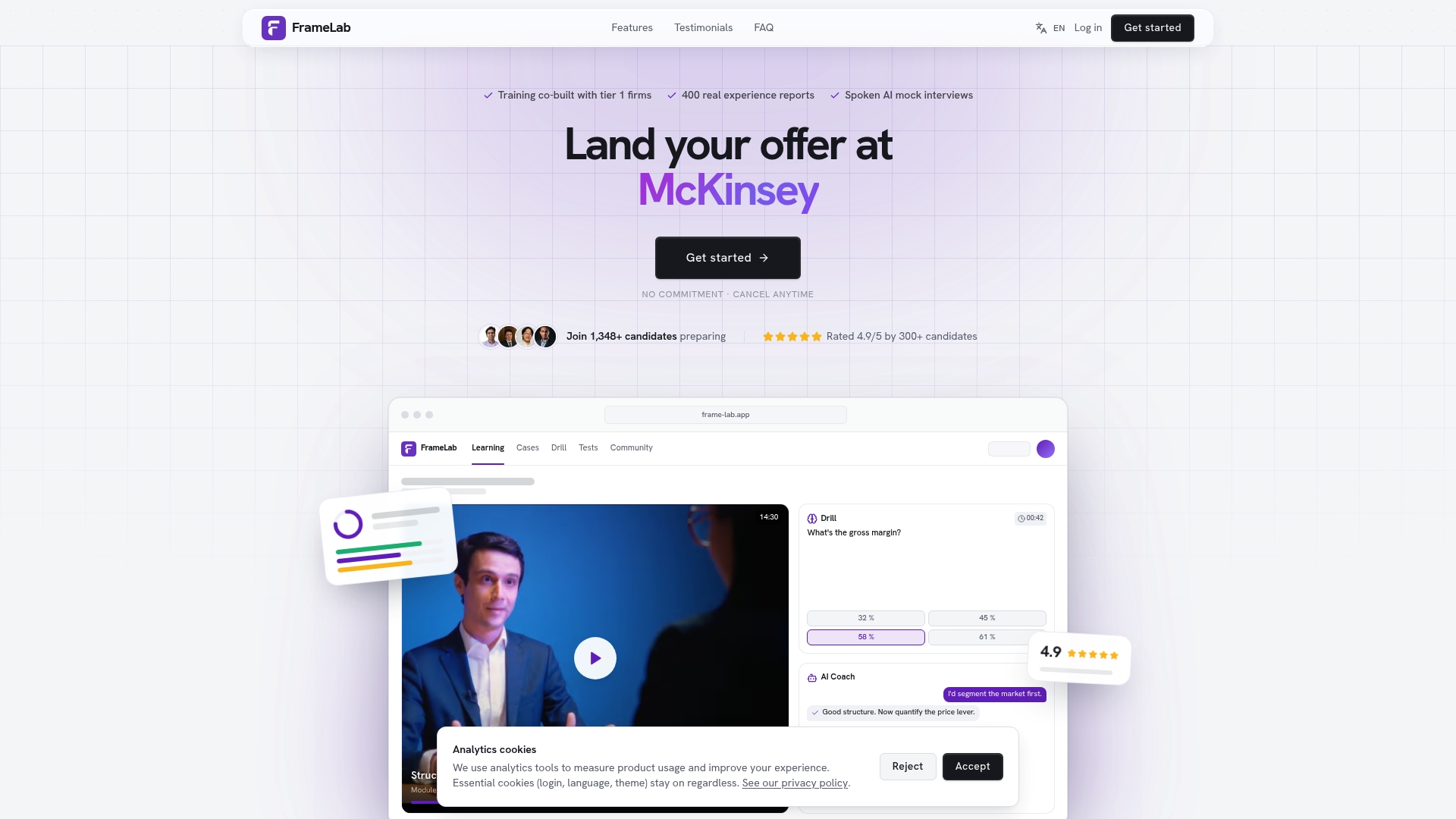
Frame-lab's FIT Interview learning path maps directly to behavioral readiness benchmarks, covering STAR story construction, completeness scoring, and company-specific preparation. Candidates who want a full preparation program, from foundational frameworks to stamina-building simulations, can access consulting interview training built around 2026 firm standards. The platform tracks your progress across sessions so your readiness distribution, not just your best day, guides your preparation decisions.
FAQ
What is a good interview readiness score?
A score of 8.0/10 or higher across Structure, Conciseness, and Completeness dimensions is the standard "ready" threshold. Completeness is the hardest dimension, averaging 6.9/10 across candidates.
How many STAR stories do I need for consulting interviews?
Six to eight rehearsed STAR stories, each two to three minutes long with a quantifiable outcome, cover the full range of behavioral prompts used by top consulting firms.
How long should I simulate for stamina training?
Consulting onsites typically run 4 - 6 hours. Candidates should complete at least two full-day mock simulations in the four weeks before their interview date.
When should I use AI tools versus human mock interviews?
Use AI tools for daily iterative practice on structure and delivery. Switch to live human mocks in the final two weeks for realistic pressure and unpredictable follow-up questions.
What ATS score do I need to get a consulting interview?
An ATS score of 85% or higher correlates with the 3% - 5% employer response rate that puts you in the competitive tier. Scores below 70% signal serious keyword alignment issues.