
Discover why over-preparation backfires in interviews. Learn to be present and adaptable to impress consulting firms like McKinsey and BCG.
On this page▾
- Why over-preparation backfires in consulting interviews
- How does cognitive overload hurt your interview performance?
- Why do scripted answers damage your rapport with interviewers?
- Does focusing only on answers hurt your consulting interview?
- How to prepare for consulting interviews without over-preparing
- Key Takeaways
- The brittleness problem nobody talks about
- Frame-lab's approach to smart consulting interview prep
- FAQ
- What is over-preparation in a consulting interview?
- Does over-preparing hurt your chances at McKinsey or BCG?
- How do I know if I am overthinking my interview prep?
- What is informed spontaneity in interview preparation?
- How much time should I spend preparing questions to ask the interviewer?
- Recommended
Over-preparation in interviews is defined as rehearsing so extensively that it replaces genuine thinking with scripted performance. Consulting interviews at firms like McKinsey and BCG demand real-time judgment, not recitation. Candidates who over-prepare often arrive with polished answers but lose the adaptability and presence that interviewers actually measure. Understanding why over-preparation backfires interviews is the first step toward fixing the problem before it costs you an offer.
Why over-preparation backfires in consulting interviews
The core problem is a shift in focus. Instead of being present and responsive, over-prepared candidates spend mental energy managing a rigid script. Candidates rated lower on cultural fit and emotional regulation in 2026 assessments share one common trait: they appear over-rehearsed. That rating drop is not a minor penalty. Cultural fit and emotional regulation are two of the most weighted criteria in consulting hiring panels.
Over-preparation also creates a false sense of security. You feel ready because you have covered every possible question. But consulting interviewers do not follow your script. They probe, redirect, and test your reasoning in real time. A candidate who has memorized answers for 50 questions is often less ready than one who has internalized five core frameworks and practiced thinking out loud.

The industry term for what you are trying to build is "informed spontaneity." It means knowing your material deeply enough that you can respond naturally, without retrieving a memorized line. That is the standard consulting firms apply, and it is the standard this article helps you meet.
How does cognitive overload hurt your interview performance?
Cognitive load is the total mental effort your working memory carries at one moment. Over-preparation adds to that load rather than reducing it. When you enter an interview trying to recall exact phrasing, you consume the mental bandwidth you need for actual reasoning. The result is slower thinking, shorter answers, and visible stress.
The consequences of excessive interview prep are measurable. Over-prepared candidates show a 30% higher rate of failure when answering follow-up questions. That number matters because follow-up questions are exactly how consulting interviewers test whether your answer was genuine or rehearsed.
Physiological signs of cognitive overload are visible to interviewers. Watch for these in your mock sessions:
- Rambling answers that circle back without landing on a point
- Long pauses before responses, followed by a sudden shift in tone
- Tension in the jaw or shoulders that reads as discomfort rather than confidence
- Answers that do not match the specific question asked
- A drop in eye contact when the question deviates from an expected format
Pro Tip: Record a mock interview and watch it back without sound. If your body language looks stiff or your pacing is uneven, cognitive overload is likely the cause, not nerves.
Anxiety compounds the problem. Over-prepared candidates set an internal standard of perfection. When the interview deviates from that standard, even slightly, anxiety spikes. That spike is visible to panels as tension and overlong answers, both of which reduce hireability scores. Managing case interview stress starts with recognizing that perfection is not the goal. Judgment is.
Why do scripted answers damage your rapport with interviewers?
Scripted answers produce what communication researchers call the "uncanny valley" effect. The response sounds almost right but feels off. Interviewers instinctively withdraw from candidates who appear to be reciting rather than conversing. That withdrawal is not a conscious decision. It is a social reflex triggered by unnatural cadence, flat intonation, and answers that do not quite respond to what was actually asked.
The contrast between scripted and authentic delivery is stark in practice.
| Scripted delivery | Authentic delivery |
|---|---|
| Fixed opening phrase regardless of question | Opening that directly addresses the specific question asked |
| Identical story used for multiple competencies | Story selected and shaped to fit the competency being tested |
| Flat pacing with memorized transitions | Natural pauses and adjusted emphasis based on interviewer reaction |
| Collapses under follow-up questions | Expands naturally when probed because the experience is real |
| Sounds polished but feels rehearsed | Sounds considered and feels genuine |
The fix is treating your career stories as maps, not tracks. A map gives you the territory. A track locks you into one route. Know the key facts, the decision you made, and the outcome. Then let the delivery adapt to where the conversation goes. This approach is what effective candidates use to maintain credibility under pressure.
AI-generated answers make this worse. Recruiters recognize AI-scripted responses through unnatural cadence and a lack of spontaneity. When multiple candidates deliver nearly identical answers, suspicion rises and credibility drops for all of them.
Pro Tip: Practice telling your three strongest career stories to a friend who can ask random follow-up questions. If you stumble when the follow-up deviates from your script, your story is a track, not a map.
Does focusing only on answers hurt your consulting interview?
The "question-and-answer trap" is one of the most common interview preparation pitfalls for consulting candidates. You spend weeks rehearsing responses and almost no time preparing to ask good questions. One in four over-prepared candidates fail to ask insightful questions because they allocated all their prep time to answering.
That failure matters more than most candidates realize. Interviewers at McKinsey and BCG use the questions you ask to assess your problem-solving instincts and your genuine interest in the firm. A generic question signals that you researched the role but not the firm. A specific, informed question signals that you think like a consultant.
Firm-specific research and cultural understanding are areas where scripted candidates fall short. They know their own stories but cannot speak to the firm's current priorities, recent engagements, or practice area shifts. That gap is visible and costly.
Rebalance your prep time with these priorities:
- Identify two or three firm-specific topics you can reference in your questions
- Read recent publications, case studies, or press releases from the firm
- Prepare questions that show you understand the firm's positioning, not just its reputation
- Practice asking questions that invite a real conversation, not a yes-or-no answer
- Treat the question period as a two-way evaluation, not a formality
Asking thoughtful questions also demonstrates self-awareness. It signals that you know what you are looking for in a firm, which is exactly the kind of judgment consulting panels want to see.
How to prepare for consulting interviews without over-preparing
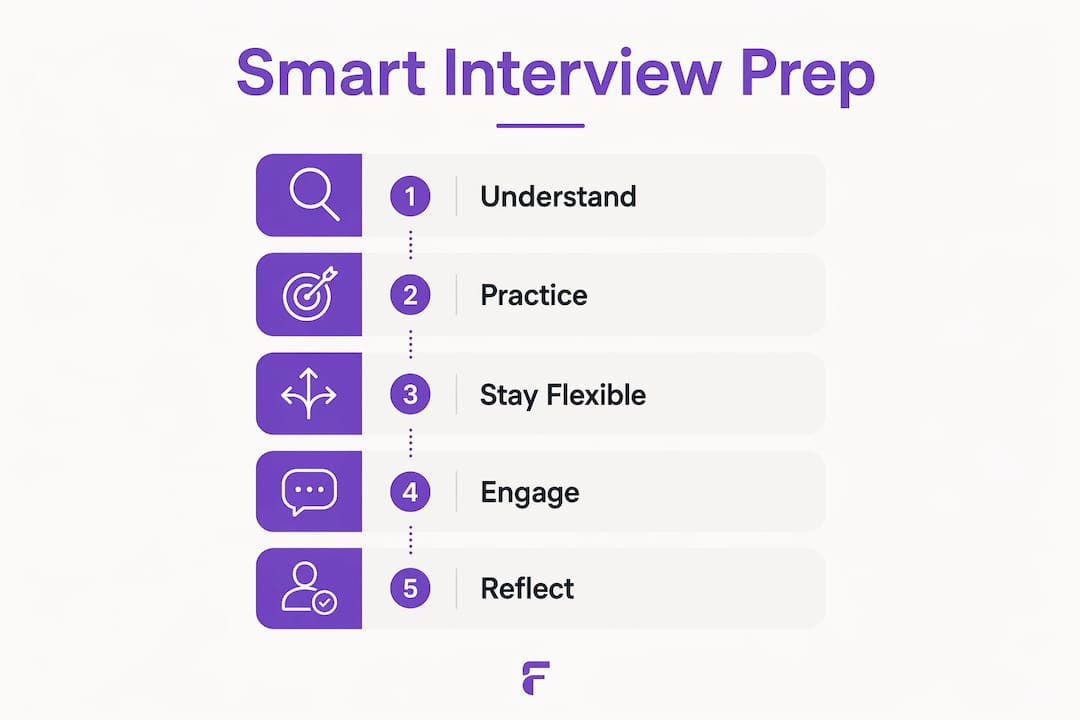
Informed spontaneity is the goal. It means building deep familiarity with your material while keeping your delivery flexible. The best interview strategy is knowing your core stories but adapting how you tell them based on what the interviewer actually asks.
Here is a framework for balanced consulting interview preparation:
- Identify your five core career stories. Each story should cover a clear decision, a measurable outcome, and a lesson. Do not memorize the wording. Memorize the structure.
- Map each story to multiple competencies. A single leadership story can address conflict resolution, stakeholder management, and decision-making under uncertainty. Practice switching the emphasis.
- Learn three to five consulting frameworks deeply. Understand when to apply them and why, not just how to recite them. Frameworks like MECE, issue trees, and profitability analysis are tools, not scripts.
- Practice with live partners, not just notes. Practicing with a partner who asks unpredictable follow-ups builds the responsiveness that scripted prep cannot.
- Calibrate your prep to the interview format. A fit interview requires different flexibility than a case interview. Adjust your emphasis accordingly.
- Set a prep cutoff. Stop adding new material 48 hours before the interview. Use that time to rest and reset, not to review more notes.
| Prep element | Recommended approach |
|---|---|
| Career stories | Know the facts and outcome; keep delivery flexible |
| Consulting frameworks | Understand application logic, not just structure |
| Firm research | Prepare two to three specific, informed questions |
| Mock interviews | Prioritize responsiveness over polished delivery |
| Final 48 hours | Rest and mental reset, no new material |
Pro Tip: After each mock session, ask your partner which answers felt most natural. Those are the ones closest to informed spontaneity. Build from them, not from your most polished scripts.
Common pitfalls to avoid include over-rehearsing opening lines, memorizing transitions between points, and treating every question as an opportunity to deliver a prepared story. Interviewers test for judgment and composure, not recall. The candidate who adapts wins over the candidate who recites.
Key Takeaways
Over-preparation in consulting interviews reduces hireability by replacing genuine judgment with rigid scripts, increasing cognitive load, and eliminating the adaptability that interviewers directly measure.
| Point | Details |
|---|---|
| Authenticity over scripts | Treat career stories as flexible maps, not memorized tracks, to maintain rapport. |
| Cognitive load is real | Excessive prep consumes the mental bandwidth needed for real-time reasoning. |
| Follow-up questions expose over-prep | Over-prepared candidates fail follow-up questions at a significantly higher rate. |
| Balance your prep time | Allocate time to firm research and insightful questions, not just rehearsed answers. |
| Informed spontaneity wins | Deep familiarity with material plus flexible delivery is the standard consulting firms apply. |
The brittleness problem nobody talks about
I have watched candidates walk into consulting interviews with color-coded prep binders, 80-question answer banks, and near-perfect mock scores. Most of them do not get offers. The ones who do are rarely the most prepared. They are the most present.
Over-rehearsing creates what I call brittleness. You build a structure so rigid that any unexpected question cracks it. When an interviewer asks something slightly off-script, a brittle candidate either freezes or delivers an answer to the question they wished they had been asked. Interviewers notice both. Neither reads as composure.
The uncomfortable truth is that controlled vulnerability is more persuasive than polished perfection. Saying "that is a good angle I had not considered" and then reasoning through it out loud is a stronger signal than a flawless but robotic answer. Consulting firms hire people who think well under uncertainty, not people who recall well under pressure.
Trust your experience more than your prep materials. You have done real work, made real decisions, and handled real pressure. That is what the interviewer wants to access. Your job is to stay present enough to let them.
Frame-lab's approach to smart consulting interview prep
Excessive rehearsal is a preparation trap that Frame-lab is built to help you avoid. The platform combines AI-driven mock interviews, over 400 real experience reports from McKinsey and BCG processes, and a peer community that pushes you to respond, not recite.
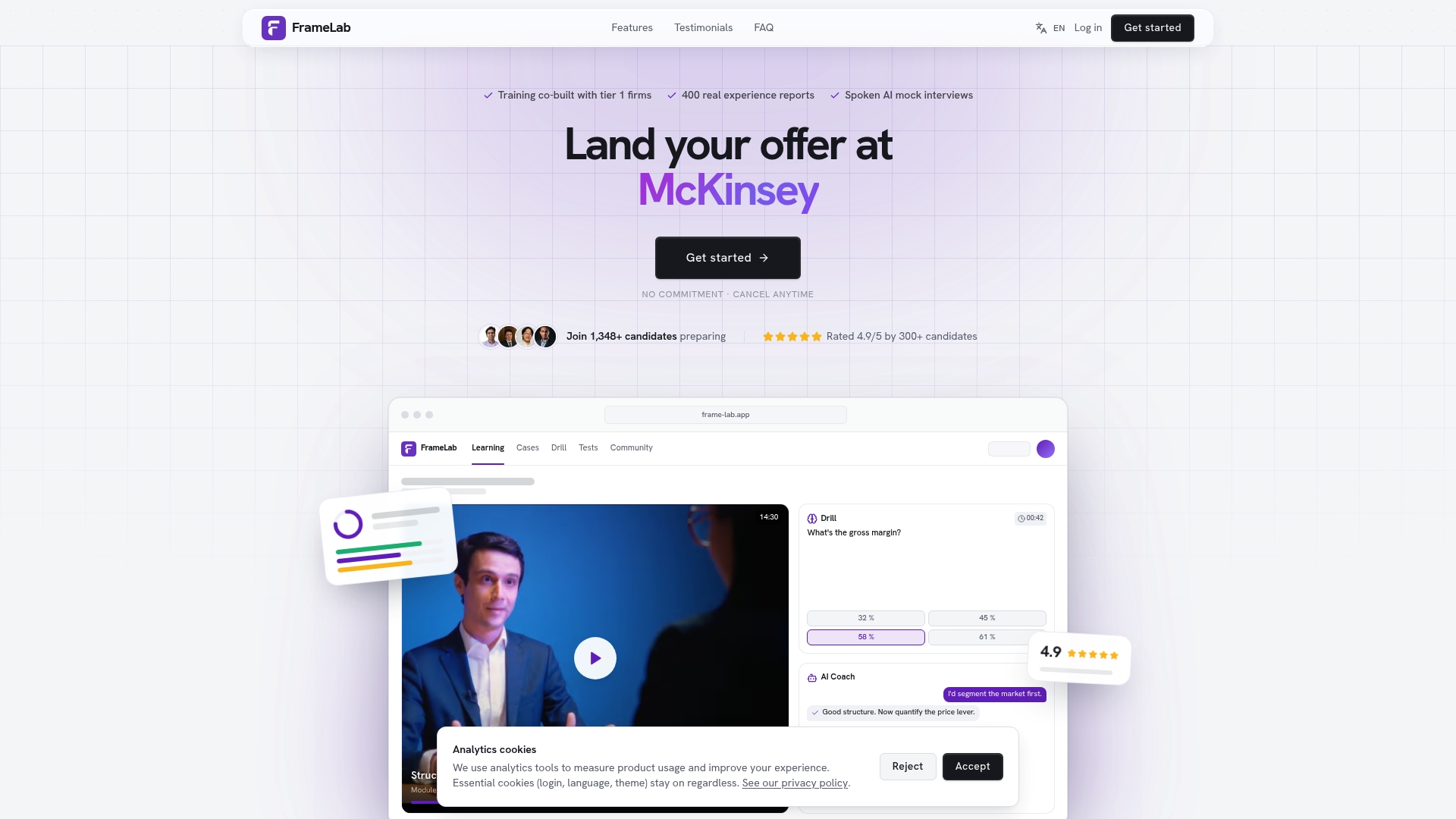
Frame-lab's FIT Interview course trains you to deliver career stories with the flexibility that consulting panels reward. The Core Frameworks module builds the kind of deep framework understanding that lets you adapt in real time rather than retrieve a memorized answer. If you want to build the full picture, Frame-lab's consulting training program covers technical skills, fit preparation, and mental readiness in one structured path. Preparation that builds judgment is preparation that actually works.
FAQ
What is over-preparation in a consulting interview?
Over-preparation means rehearsing so extensively that you replace real-time thinking with scripted performance. It reduces authenticity, increases cognitive load, and lowers scores on cultural fit and emotional regulation.
Does over-preparing hurt your chances at McKinsey or BCG?
Yes. Candidates who appear over-rehearsed are rated lower on cultural fit in 2026 assessments. Consulting firms prioritize judgment and composure over polished recitation.
How do I know if I am overthinking my interview prep?
Signs include rambling answers, freezing on follow-up questions, and delivering answers that do not match what was actually asked. If your mock sessions feel like performances rather than conversations, you have likely over-prepared.
What is informed spontaneity in interview preparation?
Informed spontaneity means knowing your core stories and frameworks deeply while keeping your delivery flexible. It is the standard that allows candidates to adapt when interviewers probe or redirect.
How much time should I spend preparing questions to ask the interviewer?
Allocate a meaningful portion of your prep time to firm-specific research and preparing two to three insightful questions. One in four over-prepared candidates neglect this entirely, which signals low genuine interest to the panel.