
Discover the role of positive self-talk in interviews. Learn how it enhances performance, reduces stress, and boosts your confidence in 2026.
On this page▾
- How does positive self-talk influence interview outcomes?
- What are the most effective self-talk techniques for consulting prep?
- What mistakes do candidates make with self-talk?
- How to integrate self-talk into your full consulting prep strategy
- Pairing self-talk with visualization and growth mindset
- Using mock interviews to normalize pressure
- Mental preparation the night and morning before
- Key Takeaways
- Why I think most candidates misuse self-talk entirely
- Frame-lab's approach to interview mental preparation
- FAQ
- What is positive self-talk in the context of interviews?
- How does self-talk reduce interview anxiety?
- What is third-person self-talk and why does it work?
- How often should I practice affirmations before a consulting interview?
- Can self-talk replace case practice for consulting interviews?
- Recommended
Positive self-talk is defined as realistic, evidence-based internal dialogue that reduces anxiety and builds genuine confidence before high-stakes evaluations. The role of positive self-talk in interviews goes far beyond motivation. It directly shapes your cortisol levels, your vocal delivery, and how interviewers perceive your composure. For graduate students and job seekers preparing for consulting interviews at firms like McKinsey and BCG, this is not a soft skill. It is a performance tool backed by neuroscience and meta-analytic research. This guide covers the science, the techniques, and the common mistakes that separate candidates who project executive presence from those who freeze under pressure.
How does positive self-talk influence interview outcomes?
Positive self-talk reduces cortisol, the primary stress hormone that impairs working memory and clear thinking under pressure. Affirmations practiced for 10 - 15 minutes before a high-stakes evaluation reduce cortisol levels by 50%. That reduction matters because lower cortisol directly improves your ability to structure arguments, recall examples, and stay composed when an interviewer pushes back on your logic.
The neuroscience behind this is grounded in prefrontal cortex function. When you rehearse realistic, positive statements about your past performance, you activate the prefrontal cortex, the brain region responsible for emotional regulation and rational decision-making. This suppresses the amygdala's threat response, which is what causes your mind to go blank mid-case.
"Positive self-talk works not because it makes you feel good, but because it keeps the thinking part of your brain in charge when pressure spikes."
A comprehensive meta-analytic review found effect sizes ranging from d=0.14 to d=0.48 across performance domains, with the strongest results in high-pressure, identity-threat situations. Consulting interviews are exactly that kind of situation. The effect is not marginal. It is the difference between a candidate who recovers from a wrong assumption and one who spirals.
The critical distinction here is between realistic positive self-talk and toxic positivity. Telling yourself "I will definitely get this offer" is not self-talk. It is wishful thinking. Effective self-talk stays anchored to verifiable facts: "I solved a structurally similar problem in my internship and the client adopted my recommendation." That specificity is what makes the statement credible to your own brain.

What are the most effective self-talk techniques for consulting prep?
The following techniques are grounded in research and specifically adapted for the consulting interview context. Each one addresses a distinct performance challenge.
-
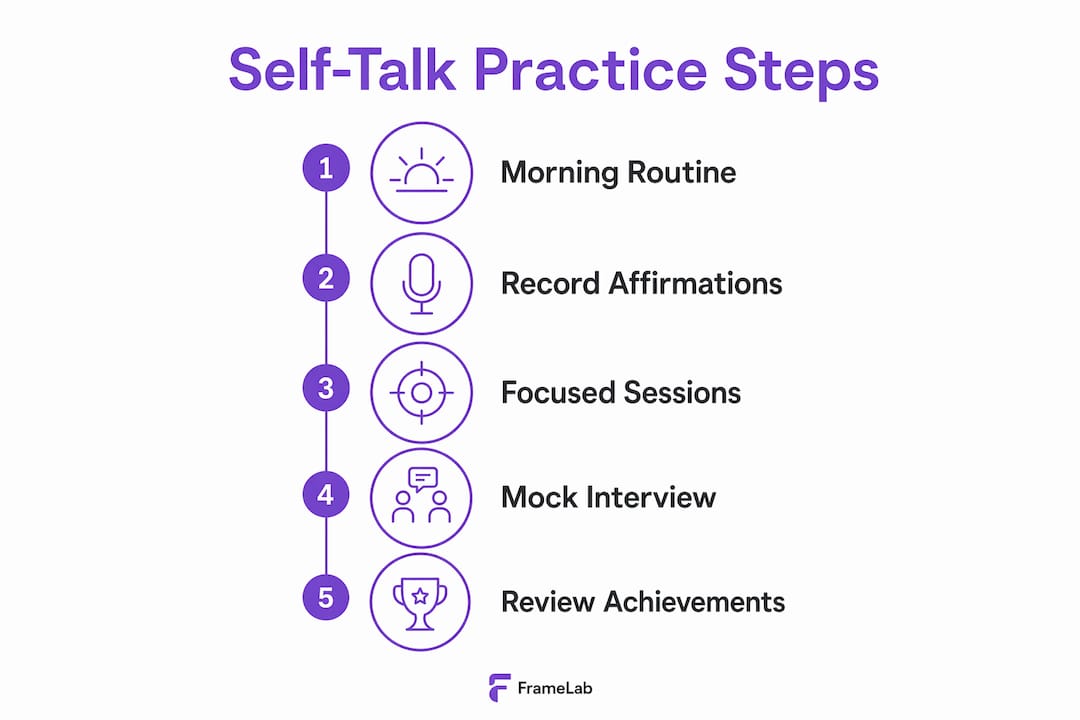
Evidence-based affirmations. Anchor every affirmation in a specific past achievement. "I am capable" is vague and your brain dismisses it. "I led a three-person team through a market entry analysis under a two-week deadline" is concrete. Top candidates who recall specific problem-solving successes build authentic confidence that interviewers read as executive presence.
-
Third-person self-talk. Refer to yourself by name when preparing. "Alex, you have handled ambiguous data before and found a clear path forward." This technique creates psychological distance from the anxiety and reduces emotional distress under pressure. It works because it mirrors the perspective you use when advising a peer, which is calmer and more analytical.
-
Speaking affirmations aloud. Silent repetition is less effective than vocalization. Speaking affirmations aloud before mock interviews produces 22% higher interviewer favorability ratings compared to silent practice. Saying your affirmations out loud also functions as a vocal warm-up, improving articulation and natural delivery from the first sentence of your interview.
-
If-Then statements. Structure your self-talk around contingencies: "If the interviewer challenges my market sizing, then I will acknowledge the assumption, adjust, and move forward." This format prepares your mind for adversity without catastrophizing it.
-
Connecting statements. Link your past directly to the future: "I have done this before, and I will do it again today." This structure reinforces continuity between your track record and your current readiness.
-
Posture integration. Combine your verbal self-talk with physical posture. Power posing paired with affirmations enhances subjective confidence and has measurable effects on interview performance. Stand tall, shoulders back, and run through your affirmations aloud for two minutes before entering the room.
Practice schedule: Run your full affirmation set each morning for two to three weeks before your interview. Add a focused five-minute session immediately before each mock interview. Repeated, fact-backed affirmations become automatic under pressure within a few weeks of consistent practice.
Pro Tip: Record yourself saying your affirmations aloud and play it back. If you sound unconvinced, your affirmation lacks a specific factual anchor. Revise until you hear certainty in your own voice.
What mistakes do candidates make with self-talk?
Most candidates who try self-talk give up because they do it wrong. The errors are predictable and correctable.
-
Generic affirmations with no factual basis. "I am confident and capable" tells your brain nothing it can verify. Vague statements produce no cortisol reduction and no performance benefit. Every affirmation needs a specific, real example attached to it.
-
The Fake Realism Trap. This is when candidates confuse brutal self-criticism with honest preparation. Telling yourself "I always freeze on market sizing" is not realistic. It is a distorted narrative. Realistic self-talk acknowledges a weakness and pairs it with a concrete plan: "Market sizing is my weakest area, and I have practiced five cases this week to close that gap."
-
Treating the interview as an interrogation. Candidates who enter with a "prove myself" mindset elevate their stress response before the first question. Reframing the interview as a professional partnership evaluation lowers anxiety and shifts body language toward confidence. You are assessing fit as much as they are.
-
Imposter syndrome amplified by vague self-talk. Imposter syndrome thrives on abstraction. When your inner voice says "I don't belong here," the counter must be specific: "I ranked in the top 10% of my cohort and completed a strategy project for a Fortune 500 client." Specificity is the antidote to imposter syndrome.
Pro Tip: Before your interview, write down three verifiable achievements that directly relate to consulting skills: structured problem-solving, data interpretation, or client communication. These become the factual backbone of every affirmation you use.
How to integrate self-talk into your full consulting prep strategy
Self-talk does not work in isolation. It performs best when embedded in a broader mental preparation framework.
Pairing self-talk with visualization and growth mindset
Visualization means mentally rehearsing a specific scenario: walking into the room, greeting the interviewer calmly, structuring your first case response clearly. When you combine this with your affirmations, you give your brain both the emotional signal and the procedural script. A growth mindset, the belief that skills improve through effort, reinforces self-talk by making setbacks feel like data rather than verdicts. Candidates who prepare systematically report significantly lower interview anxiety than those who rely on talent alone.
Using mock interviews to normalize pressure
Self-talk reduces anxiety in theory. Mock interviews test it under real conditions. Each mock session exposes you to the discomfort of being evaluated, and your self-talk practice trains you to stay regulated during that discomfort. Over time, the pressure of a live interview feels familiar rather than threatening. Frame-lab's AI-driven mock interviews provide this exposure with structured feedback, so you can track whether your composure is actually improving across sessions.
Mental preparation the night and morning before
The night before: review your three core affirmations, confirm your preparation is complete, and stop adding new material. The morning of: mental preparation on interview day includes a five-minute affirmation session, a physical warm-up, and a deliberate decision to enter the room as a peer, not a supplicant. Candidates who manage interview nerves with structured routines perform more consistently than those who rely on adrenaline alone.
| Mental preparation method | Primary benefit | Best timing |
|---|---|---|
| Evidence-based affirmations | Cortisol reduction, confidence | Daily + pre-interview |
| Third-person self-talk | Psychological distance, clarity | During practice sessions |
| Visualization | Procedural readiness, calm | Night before interview |
| Mock interview exposure | Pressure normalization | 2 - 3 weeks before |
| Power posing with affirmations | Physical confidence signal | 5 minutes pre-interview |
Key Takeaways
Positive self-talk works in consulting interviews when it is specific, fact-based, and practiced consistently enough to become automatic under pressure.
| Point | Details |
|---|---|
| Anchor affirmations in facts | Vague statements fail; tie every affirmation to a real, verifiable achievement. |
| Speak affirmations aloud | Vocalization produces 22% higher favorability ratings and warms up your delivery. |
| Use third-person self-talk | Referring to yourself by name creates distance from anxiety and sharpens thinking. |
| Reframe the interview dynamic | Treating the interview as a partnership lowers stress and improves body language. |
| Practice consistently | Fact-backed affirmations become automatic within a few weeks of daily repetition. |
Why I think most candidates misuse self-talk entirely
Candidates who dismiss self-talk usually tried it once with a generic phrase and felt nothing. That is not a failure of the technique. It is a failure of specificity. The candidates I have seen perform best in consulting interviews are not the ones who walk in most confident by nature. They are the ones who have built a precise internal narrative about why they belong in that room, and they can recite it under pressure without flinching.
The signal interviewers at top firms actually look for is emotional control under challenge. When a partner pushes back on your recommendation, your self-talk is what keeps your voice steady and your logic clear. Candidates who demonstrate calm composure sustained by fact-based self-talk signal senior-level potential. That is not a soft observation. It is a documented evaluation criterion.
The uncomfortable truth is that most candidates spend 95% of their prep time on frameworks and almost none on the mental layer that determines whether those frameworks come out cleanly under pressure. Self-talk is not a replacement for case practice. It is the system that makes your case practice accessible when it counts.
Start with three specific achievements. Build one affirmation from each. Say them aloud every morning for two weeks. Then walk into your mock interview and notice the difference.
Frame-lab's approach to interview mental preparation
Building the mental side of your consulting interview prep requires more than reading about self-talk.
Frame-lab's FIT Interview program is built specifically for candidates preparing for behavioral and fit interviews at firms like McKinsey and BCG. The program integrates the mental preparation principles covered in this article, including structured self-reflection, authentic communication, and composure under pressure, into interactive drills with direct feedback. Over 400 curated experience reports give you a realistic picture of what top-firm interviews actually feel like, so your self-talk is grounded in real context. If you want a complete path from preparation to offer, Frame-lab's consulting prep program covers every layer of readiness.
FAQ
What is positive self-talk in the context of interviews?
Positive self-talk is realistic, evidence-based internal dialogue that reduces anxiety and builds confidence before and during interviews. It differs from generic motivation by anchoring statements in specific, verifiable past achievements.
How does self-talk reduce interview anxiety?
Affirmations practiced for 10 - 15 minutes before an interview reduce cortisol by 50%, which directly improves working memory and emotional regulation under pressure.
What is third-person self-talk and why does it work?
Third-person self-talk means referring to yourself by name during preparation, such as "Alex, you have solved this type of problem before." It creates psychological distance from anxiety and mirrors the calmer perspective you use when advising others.
How often should I practice affirmations before a consulting interview?
Practice your affirmations daily for two to three weeks before your interview, then add a focused five-minute session immediately before each mock or live interview. Consistent repetition makes the habit automatic under pressure.
Can self-talk replace case practice for consulting interviews?
Self-talk does not replace case practice. It is the mental layer that makes your case practice accessible when pressure spikes. The two work together: frameworks give you the structure, and self-talk keeps your brain regulated enough to use them.