
Discover the role of prior expertise in consulting interviews. Learn how your industry knowledge can boost your performance and impress top firms.
On this page▾
- How does prior expertise impact consulting interview performance?
- What types of prior expertise best enhance consulting interviews?
- How can candidates strategically showcase prior expertise during interviews?
- What are common pitfalls when leveraging prior expertise in consulting interviews?
- Key Takeaways
- What I've learned about expertise and consulting interviews
- Frame-lab's approach to expertise-driven interview prep
- FAQ
- What is prior expertise in consulting interviews?
- How does prior experience improve consulting interview outcomes?
- What types of experience matter most for consulting interviews?
- How should candidates present prior expertise without sounding inflexible?
- Can candidates without consulting experience still use prior expertise effectively?
- Recommended
Prior expertise is defined as the domain knowledge, industry experience, and transferable skills a candidate brings into a consulting interview before any preparation begins. The role of prior expertise in consulting interviews goes far beyond padding a resume. It shapes how you frame problems, how quickly you identify the right levers, and how credibly you communicate with interviewers who have seen hundreds of generic answers. Firms like McKinsey and BCG evaluate candidates not just on structured thinking but on whether their responses reflect real business understanding. Demonstrating relevant experience early signals that you can add value from day one, not after a lengthy onboarding period.
How does prior expertise impact consulting interview performance?
Prior expertise shortens the distance between a question and a useful answer. Deep industry knowledge acts as a foundation that eliminates lengthy ramp-up periods, letting candidates move directly into analysis rather than spending time orienting themselves to the problem. That speed is visible to interviewers and reads as confidence.
Expertise also changes the quality of your questions. Candidates with relevant background ask more targeted, probing questions during case discussions. They identify risks and constraints that generalist candidates miss entirely. This matters because interviewers are not just evaluating your final answer. They are watching how you think through the problem in real time.
Communication clarity improves as well. Industry knowledge improves communication with leadership teams, enabling smoother and more productive exchanges. In an interview context, this means your explanations land faster, your recommendations feel grounded, and you avoid the vague language that signals surface-level preparation.

The practical result is that expertise-backed candidates give fewer generic answers. They connect their responses to real business conditions rather than abstract frameworks. That distinction is what separates a good interview from a great one.
Key benefits of prior expertise in consulting interviews:
- Faster problem identification and root cause analysis
- More targeted clarifying questions that impress interviewers
- Greater confidence in structuring unfamiliar case types
- Ability to ground recommendations in real-world constraints
- Reduced reliance on memorized frameworks as a crutch
Pro Tip: Before your interview, write down three specific situations from your past work or research where you identified a business problem and proposed a solution. These become your go-to examples when the case touches your area of experience.
What types of prior expertise best enhance consulting interviews?
Not all experience carries equal weight in a consulting interview. The most useful forms of prior expertise fall into two broad categories: industry-specific knowledge and transferable skills.
| Type of expertise | How it helps in interviews |
|---|---|
| Industry-specific knowledge | Enables faster problem framing and credible recommendations in sector-specific cases |
| Client-facing or consulting roles | Builds comfort with structured communication and stakeholder management |
| Analytical or quantitative experience | Supports math-heavy cases and data interpretation under pressure |
| Leadership and project management | Demonstrates ability to coordinate across functions, a core consulting skill |
| Cross-sector transferable skills | Shows adaptability and broad business understanding beyond one domain |
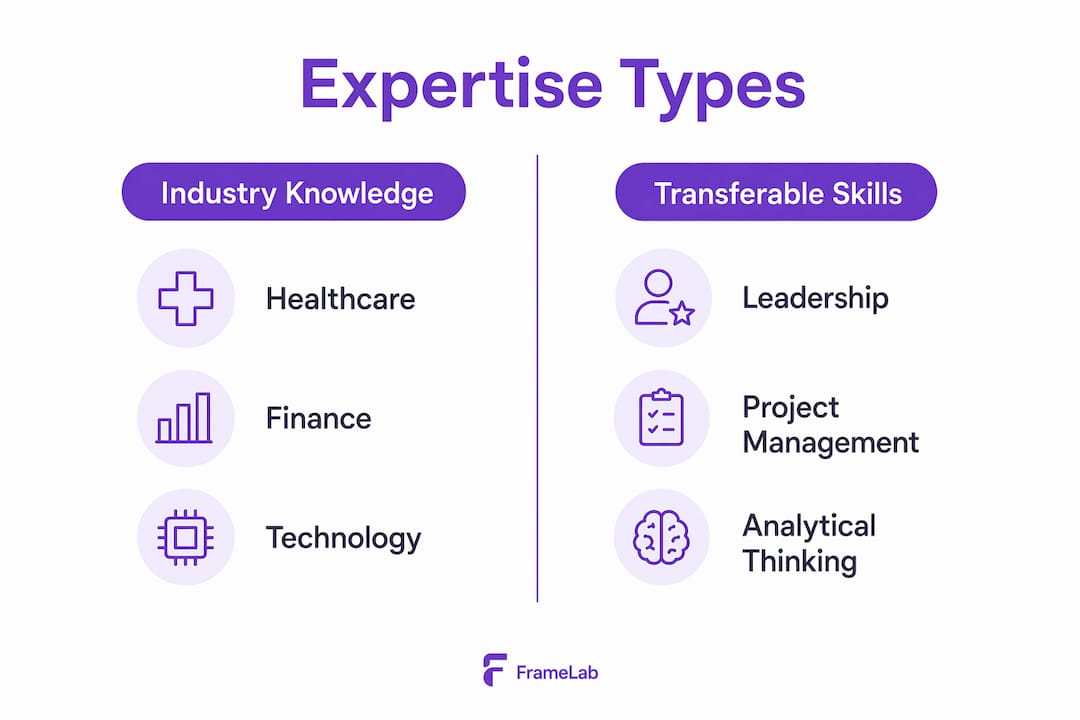
Industry-specific knowledge is the most direct asset. A candidate with a background in healthcare can spot regulatory constraints in a pharma case that a generalist would overlook. A finance professional recognizes capital structure implications that others might miss. Consultants with strong industry expertise deliver solutions that align with real business conditions rather than abstract ideas. Interviewers notice that alignment immediately.
Transferable skills matter just as much for candidates switching fields. Leadership experience, cross-functional project work, and client communication all translate directly into consulting competencies. The key is knowing how to frame them. Consulting firms value candidates who can highlight transferable skills clearly and connect them to the demands of the role.
Pro Tip: Review the firm's recent published case studies or sector reports before your interview. Identify which industries appear most frequently and match them to your own background. Then prepare one specific example per relevant sector.
How can candidates strategically showcase prior expertise during interviews?
Knowing your background is not enough. You need a method for presenting it that fits the consulting interview format without overwhelming the conversation with irrelevant detail.
-
Use the STAR method for fit questions. The STAR method structures your answer around Situation, Task, Action, and Result. This format keeps your response focused and prevents the common mistake of narrating your entire career history. Each story should take 90 seconds or less.
-
Align your examples to the firm's focus areas. Crafting responses that relate experience back to position responsibilities using the job listing as a guide produces stronger answers. If the firm specializes in operations or digital transformation, pull examples from your background that touch those areas directly.
-
Integrate terminology without jargon overload. Use industry language to signal fluency, but explain your reasoning in plain terms. The goal is to show that you understand the concept, not just the vocabulary. An interviewer who has to decode your answer is an interviewer who has stopped evaluating your thinking.
-
Balance technical depth with framework thinking. Your expertise should complement consulting frameworks, not replace them. A candidate who solves every case purely from domain knowledge without structuring their approach misses the point of the exercise. Use your experience to enrich the framework, not bypass it.
-
Rehearse your key stories out loud. Silent preparation is not enough. Preparation that includes storytelling and expertise articulation builds the kind of confidence that shows up in your voice and pacing during the actual interview. Practice with a peer or record yourself to catch filler words and unclear transitions.
-
Tailor each story to the specific case type. A market entry case calls for different experience examples than a cost reduction case. Map your three to five strongest stories to the most common case categories before interview day. That mapping saves you time and prevents you from reaching for an irrelevant example under pressure.
What are common pitfalls when leveraging prior expertise in consulting interviews?
Prior experience becomes a liability when candidates present it without adapting to the interview context. The most common mistakes are predictable and avoidable.
-
Overusing jargon. Candidates who rely excessively on jargon risk appearing inflexible or irrelevant. Technical fluency impresses interviewers only when paired with clear business framing. If your answer requires the interviewer to ask three follow-up questions just to understand your point, you have lost the thread.
-
Treating past frameworks as universal solutions. Experience from one industry does not transfer automatically to every case. A candidate who applies the same mental model to every problem signals rigidity, not expertise. Consulting firms want candidates who adapt their thinking to the specific context in front of them.
-
Failing to connect experience to the client's perspective. Consultants lacking basic industry understanding lose credibility by turning clients into teachers instead of partners. In an interview, the equivalent mistake is narrating your own accomplishments without explaining what they mean for the client or the business problem at hand.
-
Neglecting soft skills. Expertise in a technical domain does not substitute for communication, empathy, and structured thinking. Interviewers at top firms evaluate both. A candidate who is technically sharp but struggles to explain their reasoning clearly will not advance.
-
Underpreparing fit and behavioral questions. Many candidates spend all their time on case practice and arrive unprepared for questions about their background, motivations, and leadership experiences. These questions are where your prior expertise should shine most naturally. Skipping this preparation wastes your biggest advantage.
Key Takeaways
Prior expertise in consulting interviews creates a measurable edge when candidates know how to present it with structure, relevance, and clarity.
| Point | Details |
|---|---|
| Expertise accelerates credibility | Industry knowledge eliminates ramp-up time and signals value from the first exchange. |
| Transferable skills count | Leadership, analytics, and client-facing experience translate directly into consulting competencies. |
| STAR method structures stories | Use Situation, Task, Action, Result to keep expertise examples focused and under 90 seconds. |
| Jargon without framing backfires | Balance technical language with plain business reasoning to stay credible and clear. |
| Fit questions need preparation | Behavioral questions are where prior expertise lands most naturally. Prepare them with the same rigor as cases. |
What I've learned about expertise and consulting interviews
Watching candidates prepare for McKinsey and BCG interviews over time, the pattern is consistent. The candidates who struggle most are not the ones with the least experience. They are the ones who cannot connect their experience to the problem in front of them.
Deep industry knowledge transforms a smart outsider into a trusted partner. That transformation does not happen automatically in an interview room. It requires deliberate practice in translating what you know into what the interviewer needs to hear. Authentic industry knowledge builds trust from the first conversation, and that trust is what separates candidates who get offers from those who get polite rejections.
The candidates who perform best treat their background as a lens, not a script. They use their experience to ask sharper questions, spot hidden risks, and ground their recommendations in reality. They do not lead with credentials. They let their thinking reveal the depth of their knowledge naturally.
My advice is to invest in continuous learning even after you feel prepared. The consulting world moves fast. Keeping your expertise current, whether through reading sector reports, talking to practitioners, or working through real case scenarios, keeps your answers fresh and specific. Generic preparation produces generic answers. Your unique background is your competitive advantage. Use it with intention.
Frame-lab's approach to expertise-driven interview prep
Preparing for a consulting interview means more than memorizing frameworks. It means knowing how to present who you are and what you know in a way that resonates with top-tier interviewers.
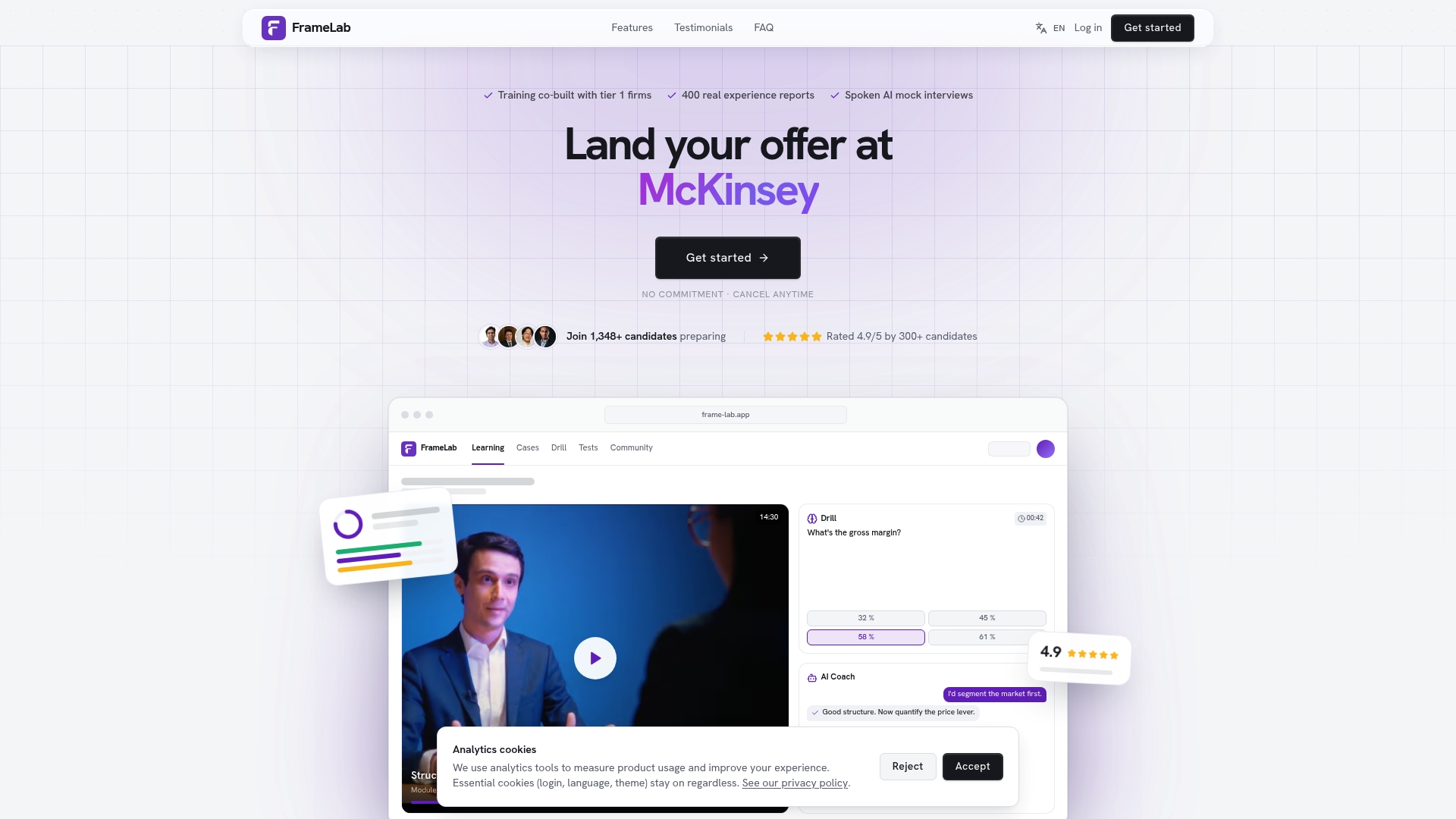
Frame-lab is built specifically for this. The platform combines AI-driven mock interviews, over 400 real interview experience reports, and a peer community that reflects the actual recruiting process at firms like McKinsey and BCG. The FIT interview module helps you build and rehearse the personal stories that showcase your background most effectively. For candidates who want a full preparation path, the consulting interview training program integrates expertise framing with case practice and framework training in one place.
FAQ
What is prior expertise in consulting interviews?
Prior expertise refers to the domain knowledge, industry experience, and transferable skills a candidate brings to a consulting interview. It shapes how candidates frame problems, ask questions, and communicate recommendations.
How does prior experience improve consulting interview outcomes?
Candidates with relevant experience identify key issues faster, ask more targeted questions, and deliver recommendations grounded in real business conditions. This signals value to interviewers and reduces reliance on generic frameworks.
What types of experience matter most for consulting interviews?
Industry-specific knowledge, client-facing roles, analytical experience, and cross-functional leadership all carry weight. The most effective candidates connect these directly to the case or firm's focus areas.
How should candidates present prior expertise without sounding inflexible?
Use the STAR method to structure stories, balance technical language with plain business reasoning, and always connect your experience to the client's perspective rather than your own accomplishments.
Can candidates without consulting experience still use prior expertise effectively?
Transferable skills from any professional or academic background can be framed as consulting-relevant competencies. The key is identifying which skills align with consulting demands and practicing how to articulate that connection clearly.