
Master professional storytelling consulting interviews with our guide. Learn key frameworks and strategies to impress top-tier firms.
On this page▾
- 1. What are the key storytelling frameworks for consulting interviews?
- 2. Which storytelling consultation services prepare candidates most effectively?
- 3. What common storytelling mistakes hurt candidates in consulting interviews?
- 4. How to tailor your storytelling for different consulting interview phases
- Fit and behavioral questions
- Case interview narratives
- Key Takeaways
- What I've learned about storytelling that most guides won't tell you
- Frame-lab's approach to narrative preparation for consulting
- FAQ
- What is narrative architecture in consulting interviews?
- How long does it take to develop strong consulting interview stories?
- Why do polished stories hurt candidates in consulting interviews?
- What is the one-word test for storytelling?
- How does storytelling apply to the case interview, not just fit questions?
- Recommended
Professional storytelling in consulting interviews is the strategic practice of crafting structured narratives that demonstrate your leadership, judgment, and fit for top-tier firms. Candidates who treat their experiences as raw data to recite consistently underperform against those who transform facts into compelling narratives. This guide covers the core frameworks, common pitfalls, and practical strategies you need to make your stories land with McKinsey, BCG, and similar firms. Whether you are a graduate student entering the field or a professional making a lateral move, professional storytelling consulting interviews require a fundamentally different skill set than standard interview preparation.
1. What are the key storytelling frameworks for consulting interviews?
Narrative architecture is the foundational concept that separates strong candidates from forgettable ones. A story is a closed loop with a beginning, middle, and end. A narrative is an open architecture that links multiple stories under a single, coherent identity thesis.
Think of it this way: your individual stories about leadership, failure, and collaboration are the bricks. Your narrative architecture is the building. Without the architecture, interviewers receive a pile of disconnected bricks.
"A story is a closed loop; a narrative is an architecture linking individual stories. Building that architecture before your interview is what creates a coherent and memorable identity."
Three frameworks give you the most traction in consulting interviews:
- The beginning-middle-end loop. Every story you tell must have a clear transformation from point A to point B. Avoid exhaustive chronology; focus on what changed and why it mattered.
- The hero story. Build one versatile master story per core theme (leadership, resilience, collaboration) that you can adapt to different question types without sounding rehearsed.
- The one-word test. Before finalizing any story, ask yourself: what is the single word that captures the transformation this story demonstrates? If you cannot name it, the story is unfocused. Distilling your goal into one word, such as "ownership" or "clarity," forces you to cut everything that does not serve that transformation.
Pro Tip: Write your one-word test result at the top of each story outline. If a detail in the story does not connect to that word, cut it.
2. Which storytelling consultation services prepare candidates most effectively?

Professional narrative consulting ranges widely in scope and price. Entry-level perspective sessions start at $100 per hour, while full storytelling system engagements cost $3,000 to $5,000 or more. That price gap reflects a real difference in what you receive.
Short-term sessions (one to three hours) are useful for testing whether a specific story lands. They give you outside perspective on clarity and emotional resonance. They do not give you a system.
Structured coaching engagements typically run 6 - 12 months and deliver concrete tools like a POV Matrix, a messaging architecture, and a bank of refined stories. That timeline matters because narrative identity does not solidify in a single session. You need repetition, feedback, and iteration.
| Engagement type | Typical duration | Key deliverable |
|---|---|---|
| Perspective session | 1 - 3 hours | Story feedback and focus |
| Narrative sprint | 4 - 8 weeks | Core story bank and messaging |
| Full narrative system | 6 - 12 months | POV Matrix and full architecture |
When evaluating storytelling consultation services, prioritize coaches who give you structured frameworks, not just encouragement. The best engagements produce written deliverables you can review and refine independently.
- Ask whether the coach has experience with consulting interview formats specifically.
- Confirm that sessions include recorded practice and written feedback.
- Check whether the engagement produces a POV Matrix or equivalent messaging document.
Pro Tip: Before committing to a full engagement, book a single perspective session to assess whether the coach's feedback style matches how you process criticism.
3. What common storytelling mistakes hurt candidates in consulting interviews?
Data dumping is the most widespread mistake in corporate storytelling interviews. Candidates list facts, dates, and outcomes without revealing the human experience behind them. Interviewers at top firms are trained to probe for judgment and character. A timeline of events does not show either.
The second mistake is over-polishing. Candidates remove conflict and struggle from their stories to appear competent. This backfires. Admitting to struggles or mistakes increases trust and distinguishes candidates in high-stakes interviews. Sanitized stories signal a lack of self-awareness, not professionalism.
The third mistake is emotional flatness. A story can be technically correct (clear structure, specific outcome, relevant theme) and still fail to connect. Emotional resonance is not about being dramatic. It is about letting the interviewer feel the weight of the decision you faced.
Common mistakes to eliminate before your next interview:
- Reciting a chronology instead of a transformation
- Removing all conflict to appear polished
- Using vague language ("I helped the team") instead of specific actions ("I restructured the weekly reporting process")
- Ending stories without a clear lesson or reflection
- Telling the same story for every question without adapting the emphasis
Pro Tip: Record yourself answering a behavioral question, then watch it back with the sound off. If your body language and expression do not change across the story, you are not emotionally present in the telling.
4. How to tailor your storytelling for different consulting interview phases
Consulting interviews have two distinct phases that require different narrative approaches: the fit interview and the case interview. Most candidates prepare stories only for fit questions and then lose narrative control during the case.
Fit and behavioral questions
Fit questions are where professional narrative consulting pays off most directly. The interviewer is assessing whether you belong in the firm's culture. Your story must demonstrate the specific value the firm prizes, whether that is structured thinking, client empathy, or comfort with ambiguity.
Select stories that show a genuine decision point, not just a positive outcome. The best fit stories reveal how you think under pressure, not just what you achieved.
Case interview narratives
The case interview is not story-free. Your framing of a hypothesis, your synthesis of findings, and your recommendation all benefit from narrative structure. A candidate who presents a recommendation as a story ("We started with three possible causes, eliminated two through data, and found one root issue that the client had not considered") is far more persuasive than one who lists bullet points.
| Interview phase | Narrative goal | Key technique |
|---|---|---|
| Fit/behavioral | Demonstrate character and judgment | Hero story with clear conflict |
| Case framing | Show structured thinking | Beginning-middle-end hypothesis arc |
| Case synthesis | Persuade with a recommendation | One-word transformation test |
| Closing questions | Reinforce cultural fit | Narrative architecture callback |
Tips for adapting your stories across phases:
- Prepare three to five core stories that cover leadership, failure, collaboration, and impact.
- For each story, identify which one-word transformation it demonstrates.
- Practice pivoting the emphasis of the same story depending on the question. A story about a failed project can emphasize resilience for one question and analytical rigor for another.
- Align your story themes with the firm's published values. McKinsey emphasizes personal impact; BCG emphasizes collaborative problem-solving. Your story selection should reflect that.
Reducing interview anxiety through structured preparation also improves your in-the-moment narrative flexibility. Candidates who know their stories deeply can adapt them without losing coherence.
Key Takeaways
Structured narrative architecture, not isolated story memorization, is the single most effective approach to professional storytelling in consulting interviews.
| Point | Details |
|---|---|
| Build narrative architecture | Link your individual stories under one coherent identity thesis before the interview. |
| Use the one-word test | Distill each story's transformation into one word to eliminate unfocused details. |
| Include conflict and vulnerability | Authentic struggle builds trust and signals leadership potential to consulting interviewers. |
| Adapt stories across phases | The same core story can serve fit questions and case synthesis with a shift in emphasis. |
| Invest in structured coaching | Engagements that produce a POV Matrix and story bank deliver more than single feedback sessions. |
What I've learned about storytelling that most guides won't tell you
The most common advice candidates receive is to "be authentic." That advice is correct and almost completely useless without a framework. Authenticity without structure produces rambling. Structure without authenticity produces a performance. The real work is building both at the same time.
What I have observed across hundreds of interview preparation cycles is that candidates fear vulnerability more than they fear failure. They will readily discuss a project that went wrong, but they will soften every edge, remove every moment of genuine doubt, and wrap it in a tidy lesson. The interviewer sees through it immediately. Consulting interviewers seek conflict and vulnerability because sanitized stories reduce perceived leadership potential.
The shift that produces real results is treating your stories as living assets, not fixed scripts. A story you told six months ago should be sharper today because you have practiced it, received feedback, and refined the emotional arc. Community-based practice accelerates this process faster than solo rehearsal because other candidates surface the moments where your story loses them. That feedback is irreplaceable.
The candidates who land offers at top firms are not the ones with the most impressive experiences. They are the ones who have done the work to make their experiences legible, human, and persuasive.
Frame-lab's approach to narrative preparation for consulting
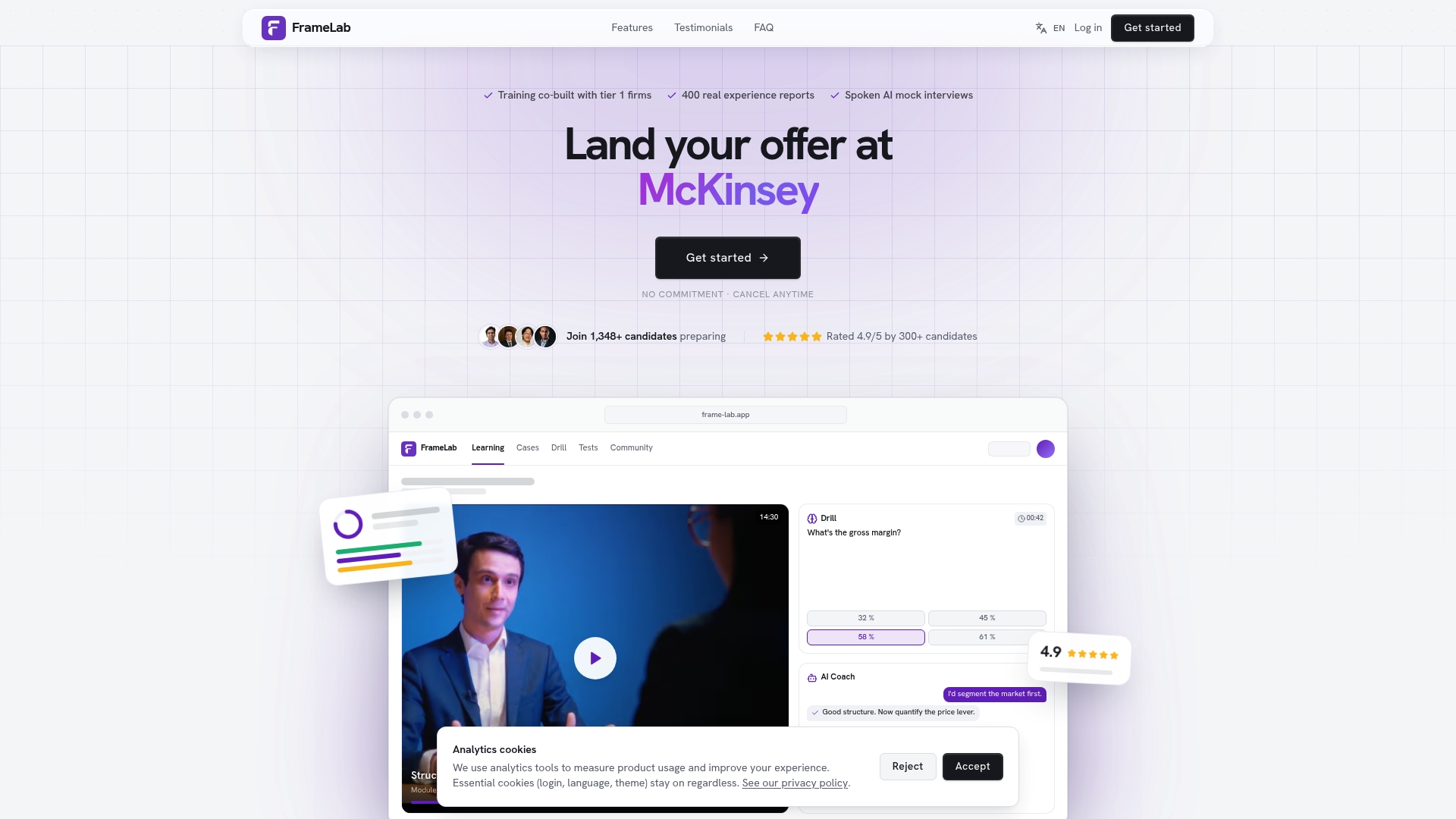
Frame-lab is built specifically for candidates preparing for consulting interviews at firms like McKinsey and BCG. The platform's fit interview training covers behavioral and narrative frameworks directly, with AI-driven mock interviews that give you real-time feedback on story structure and emotional clarity. Over 400 curated experience reports show you how successful candidates framed their own stories, giving you concrete models rather than abstract advice. Frame-lab's personalized training paths identify where your narrative preparation is weakest and target those gaps with structured drills. If you are serious about landing an offer in strategy consulting, the platform gives you the tools to get there.
FAQ
What is narrative architecture in consulting interviews?
Narrative architecture is a system that links your individual stories under a single, coherent identity thesis. It ensures that every story you tell reinforces the same core message about who you are as a candidate.
How long does it take to develop strong consulting interview stories?
Structured coaching engagements for narrative development typically run 6 - 12 months for deep results. Candidates with a clear framework can build a functional story bank in four to eight weeks of focused practice.
Why do polished stories hurt candidates in consulting interviews?
Overly polished stories remove conflict and vulnerability, which are the signals interviewers use to assess leadership potential. Authentic struggle and honest reflection build more trust than a flawless narrative.
What is the one-word test for storytelling?
The one-word test asks you to distill your story's intended transformation into a single concept, such as "ownership" or "resilience." If you cannot name it in one word, the story lacks focus and needs to be tightened.
How does storytelling apply to the case interview, not just fit questions?
Narrative structure improves case framing, hypothesis presentation, and final recommendations. Candidates who present their analysis as a coherent story, with a clear beginning, middle, and end, are consistently more persuasive than those who list findings without a through-line.