
Discover how real interview experience reports explained can boost your confidence for top-tier consulting interviews. Learn to excel today!
On this page▾
- What do real interview experience reports explained actually include?
- How do reports reveal the nuances of evaluating soft and technical skills?
- Where can you find and use real interview experience report platforms?
- What are the limitations of relying on interview experience reports?
- Key Takeaways
- Why I think most candidates use these reports the wrong way
- Frame-lab gives you more than reports to read
- FAQ
- What are real interview experience reports?
- How many rounds do consulting interviews typically include?
- Can I trust the signals described in experience reports?
- What is the biggest mistake candidates make when using these reports?
- How does Frame-lab use real interview experience reports?
- Recommended
Real interview experience reports are firsthand narratives written by candidates who have completed consulting and technical interviews, capturing the exact flow, question types, and evaluation criteria they encountered. These accounts are the closest thing you can get to a rehearsal before the real event. For graduates preparing for McKinsey, BCG, or similar top-tier firms, reading these reports cuts through the anxiety of the unknown. Understanding what real interview experience reports explained actually means, and how to use them well, is one of the most underrated preparation moves available to you.
What do real interview experience reports explained actually include?
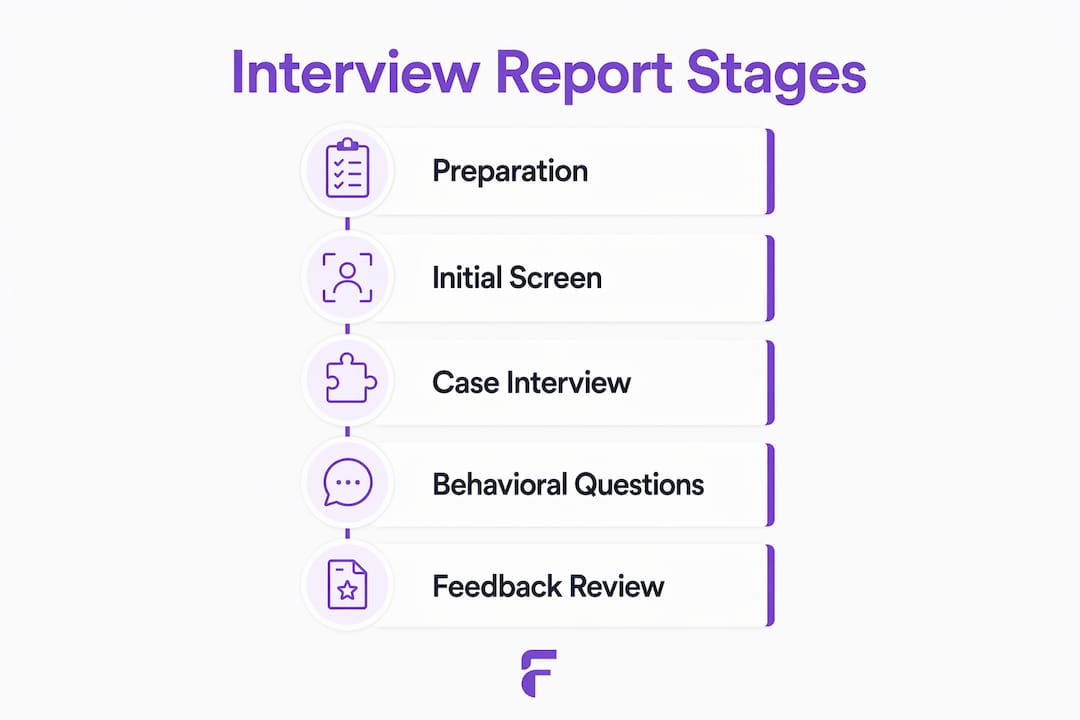
A real interview experience report is a structured account of every stage a candidate passed through, from the initial recruiter screen to the final hiring committee review. The best reports name the round, describe the format, and detail the types of questions asked. They also note the interviewer's behavior, pacing, and any follow-up questions that caught the candidate off guard.
Most consulting interview processes run across multiple stages. Top-tier interview processes typically include 4 to 8 distinct rounds spread over 1.5 to 10 weeks. That timeline matters because it tells you how long you need to sustain your preparation intensity, not just peak for one day.
A well-written report covers these core components:
- Resume screen: What the recruiter asked, how long it lasted, and whether any resume items triggered deeper questions.
- Online assessments: The format of cognitive or numerical tests, time limits, and question difficulty.
- Case interviews: The industry, the problem type (profitability, market entry, M&A), and how the interviewer guided or challenged the candidate's structure.
- Behavioral rounds: Which leadership or competency themes came up, and how specific the interviewer pushed for examples.
- Final rounds: Whether a partner interview differed in tone or depth from earlier rounds.
Pro Tip: When reading a report, pay close attention to the follow-up questions the interviewer asked. Those follow-ups reveal what the firm actually values, not just what the job description says.
The pacing of a report also tells you something. A candidate who describes a 45-minute case that felt rushed is signaling that the firm moves fast and expects you to structure quickly. A report describing long silences after answers suggests the interviewer was probing for depth, not speed.
How do reports reveal the nuances of evaluating soft and technical skills?
Interviewers evaluate reasoning and communication, not just final answers. Successful candidates consistently emphasize explaining trade-offs, assumptions, and decisions rather than jumping to conclusions. That finding applies directly to consulting case interviews, where the process of thinking out loud is the performance.

Real interview experience reports make this visible in ways that no prep book does. A candidate who writes "the interviewer stopped me mid-analysis and asked why I chose that framework" is showing you that the firm tests adaptability, not just preparation. Silence during problem-solving is read as being stuck. Continuous verbalization of your reasoning is critical.
Behavioral rounds carry more weight than most candidates expect. Behavioral interviews focusing on leadership hold equal weight alongside technical rounds in 2026 hiring processes. Interviewers assess organizational impact and decision-making depth, not just whether you are a "team player."
Here is what experience reports consistently reveal about how firms evaluate candidates:
- Reasoning transparency: Can you explain why you are making each move, not just what the move is?
- Adaptability under pressure: When the interviewer shifts the problem or adds a constraint, do you adjust your structure or freeze?
- Communication clarity: Do you lead with a clear hypothesis, or do you bury your point at the end?
- Leadership evidence: In behavioral rounds, do your examples show measurable impact, or just activity?
- Composure: Reports frequently note whether candidates recovered well from wrong turns, which interviewers observe closely.
"The interviewer introduced a new constraint halfway through my case. I had to restructure my entire analysis in real time. That moment, I realized, was the actual test."
One misunderstanding candidates carry into interviews is that a warm interviewer means a positive outcome. Hiring committees review interview packets and can override individual interviewer signals. A friendly conversation does not equal a pass. Reports that describe this dynamic help you stay focused on performance rather than reading the room for approval.
Where can you find and use real interview experience report platforms?
Candidates share interview accounts across several channels. Online communities on Reddit (particularly r/consulting and r/MBA), LinkedIn posts, and dedicated prep forums all host firsthand accounts. The quality varies widely. Some reports are detailed and structured; others are vague and emotionally driven.
Interview intelligence platforms analyze interview data to provide coaching, improve consistency, and raise overall interview quality. These platforms go beyond passive reading by connecting feedback to structured training modules. That integration is what separates active preparation from passive consumption.
Frame-lab takes this further for consulting candidates specifically. The platform combines over 400 curated experience reports with AI-driven mock interviews and structured feedback, giving you a preparation path built on real interview data rather than generic advice. You can explore FIT interview practice directly on the platform to see how behavioral rounds are modeled on actual candidate experiences.
The table below compares the main ways candidates access and use interview experience summaries:
| Source type | Strengths | Limitations |
|---|---|---|
| Online forums and communities | Free, large volume, diverse firms | Inconsistent quality, no structure |
| Dedicated prep platforms | Curated, structured, linked to practice | Requires subscription or sign-up |
| Interview intelligence tools | Data-driven, coaching-integrated | Often designed for interviewers, not candidates |
| Frame-lab experience reports | Consulting-specific, 400+ reports, AI feedback | Focused on top-tier consulting firms |
Pro Tip: Do not just read reports passively. After reading three reports from the same firm, write down the two or three patterns you noticed. Then build a mock case or behavioral answer that addresses those patterns directly.
Replicating real consulting conditions during practice is what converts reading into performance. Reports give you the map. Mock interviews give you the muscle memory.
What are the limitations of relying on interview experience reports?
Interview experience reports are useful, but they carry real risks if you treat them as ground truth. Every report reflects one candidate's experience with one interviewer on one day. The same firm can run a very different process depending on the office, the role level, and the hiring cycle.
Candidates seldom receive detailed feedback after interviews. Standard practice is a binary pass or fail notification. That absence of direct feedback makes reports feel more authoritative than they are, because they fill a vacuum.
The biggest risk is overfitting. If you memorize the specific cases or questions mentioned in reports, you prepare for the past, not the process. Firms rotate cases and update question banks regularly. The underlying skills, structuring, reasoning, and communication, stay constant. The specific questions do not.
Without direct feedback, candidates must rely on experience reports and indirect signals to adjust preparation. That reliance works best when you treat reports as evidence of patterns, not as a script to memorize.
Pro Tip: Cross-reference at least five reports from the same firm before drawing any conclusions. One report is an anecdote. Five reports start to show a pattern.
Balance reports with official firm resources, recruiter conversations, and structured coaching. Preparation that reduces interview anxiety comes from building genuine skills, not from collecting more reports. Reports are one input, not the whole preparation.
Key Takeaways
Real interview experience reports are most valuable when used as pattern-recognition tools, not as scripts, combined with active practice and structured coaching.
| Point | Details |
|---|---|
| Reports reveal real evaluation criteria | Firms assess reasoning transparency and communication, not just correct answers. |
| Behavioral rounds carry equal weight | Leadership and impact evidence matters as much as case performance in 2026 hiring. |
| Hiring committees override interviewer signals | A positive interview conversation does not guarantee a pass from the final review panel. |
| Overfitting to reports is a real risk | Focus on the underlying skills patterns reveal, not the specific questions mentioned. |
| Active practice converts reading into results | Combine reports with mock interviews and structured feedback for measurable improvement. |
Why I think most candidates use these reports the wrong way
Reading experience reports is not the same as learning from them. I have seen candidates spend hours collecting accounts from every firm they are targeting, building elaborate spreadsheets of questions and case types, and then walking into interviews completely unprepared for the moment an interviewer shifts the problem mid-case.
The reports that changed how I think about consulting interview preparation were not the ones that listed every question asked. They were the ones where the candidate described what they did when something went wrong. Those moments of recovery, of restructuring under pressure, of admitting an assumption and pivoting, are where the real evaluation happens.
The consulting interview in 2026 is not a knowledge test. It is a reasoning test conducted under social pressure. Reports that capture that dynamic are worth ten times more than reports that just list case topics. When you read a report, ask yourself: what did this candidate do when the interviewer pushed back? That answer tells you more about what the firm wants than any list of questions.
Use reports to build your mental model of the process. Then close the report and practice. The goal is not to recognize a case you have read before. The goal is to perform well on a case you have never seen.
Frame-lab gives you more than reports to read
Preparing for a McKinsey or BCG interview requires more than collecting accounts from online forums. Frame-lab is built specifically for consulting candidates who want to move from reading about interviews to performing well in them.
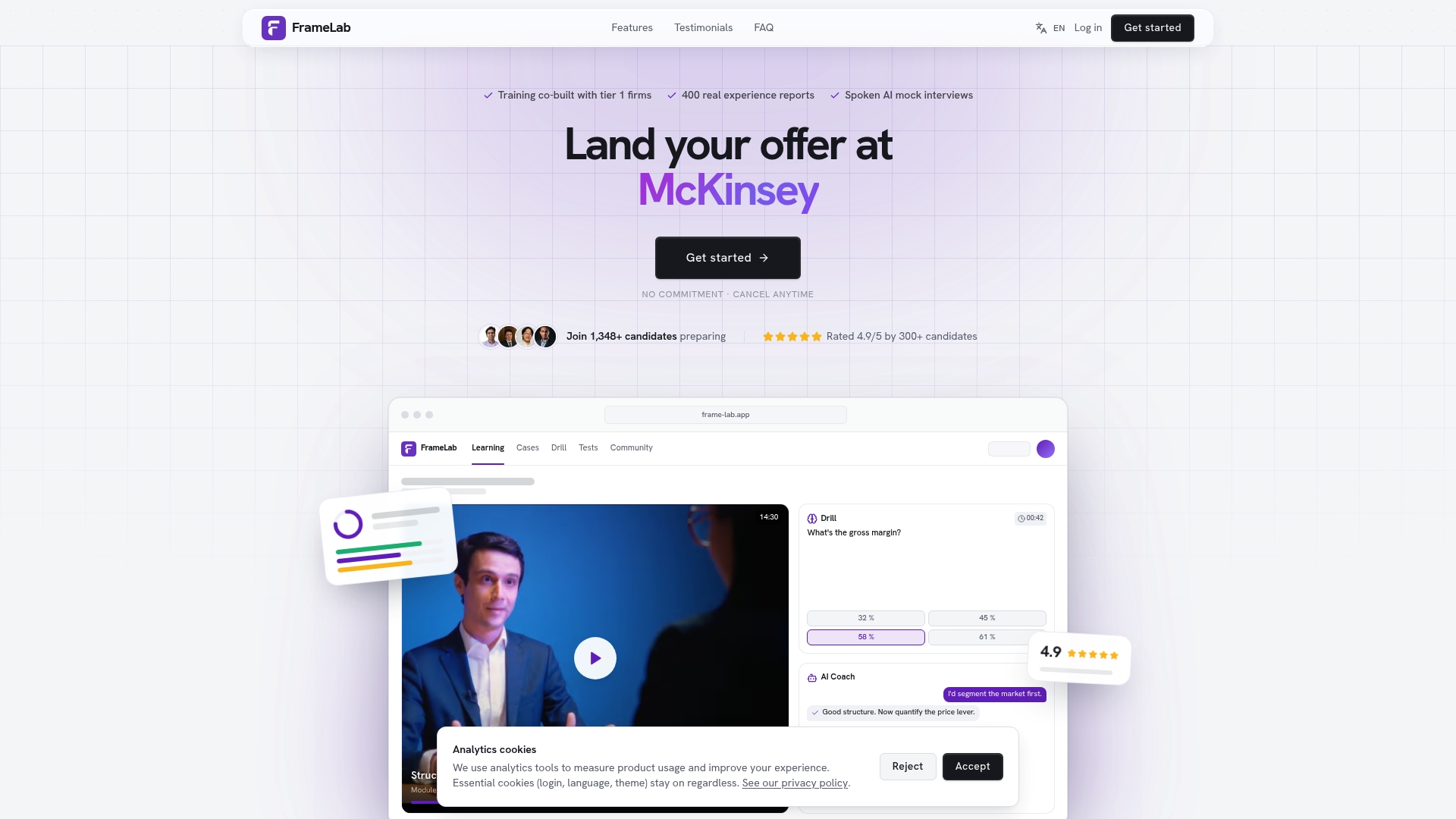
The platform combines over 400 curated experience reports with AI-driven mock interviews, structured case practice, and direct feedback tied to real consulting hiring criteria. Every training module on Frame-lab reflects patterns drawn from actual candidate experiences at top-tier firms. You can start with consulting interview preparation tailored to your current skill level, or go straight into personalized coaching built around your specific strengths and gaps. Frame-lab closes the gap between knowing what interviews look like and being ready to succeed in them.
FAQ
What are real interview experience reports?
Real interview experience reports are firsthand written accounts from candidates who have completed consulting or technical interviews. They describe the round structure, question types, interviewer behavior, and evaluation signals encountered during the process.
How many rounds do consulting interviews typically include?
Top-tier interview processes typically include 4 to 8 distinct rounds over 1.5 to 10 weeks, covering recruiter screens, case interviews, behavioral rounds, and partner meetings.
Can I trust the signals described in experience reports?
Not entirely. Hiring committees review all interview assessments and can override individual interviewer signals, so a positive conversation in one round does not guarantee an offer.
What is the biggest mistake candidates make when using these reports?
The biggest mistake is memorizing specific questions rather than identifying the underlying skills being tested. Firms rotate cases regularly, but the emphasis on reasoning clarity and communication stays consistent across reports.
How does Frame-lab use real interview experience reports?
Frame-lab curates over 400 experience reports and integrates them into AI-driven mock interviews and structured training modules, giving candidates practice scenarios modeled directly on real consulting hiring processes.