
Discover the role of audio feedback interviews in consulting prep. Improve your communication skills and interview readiness with spoken critiques.
On this page▾
- What is the role of audio feedback interviews in consulting prep?
- How audio feedback uncovers hidden communication skills
- Why is audio feedback better than written feedback for interview prep?
- How to use audio feedback interviews to improve your consulting skills
- What are the challenges of using audio feedback for interview prep?
- Key Takeaways
- Why audio feedback changed how I think about interview prep
- How Frame-lab supports your audio feedback interview training
- FAQ
- What does audio feedback measure in a consulting interview?
- How does audio feedback differ from written interview feedback?
- Can AI reliably score soft skills from audio recordings?
- How often should I use audio feedback in my interview prep?
- Should I use audio feedback alone or combine it with other methods?
- Recommended
Audio feedback interviews are defined as recorded or real-time voice-based practice sessions where candidates receive spoken critique on their verbal delivery, tone, pacing, and articulation. The role of audio feedback interviews in consulting prep is to surface communication flaws that written notes simply cannot capture. When you prepare for McKinsey or BCG, your answer structure matters. But so does how you sound when you deliver it. Tone, hesitation, and vocal confidence shape how interviewers perceive your thinking, and those elements only show up in audio. This guide explains what audio feedback measures, why it outperforms written critique, and how to use it to build real interview readiness.
What is the role of audio feedback interviews in consulting prep?
Audio feedback interviews capture the verbal layer of communication that text ignores. Voice-interactive simulation systems track behavioral performance using acoustic metrics like speech rate, loudness, and pause duration, and they flag answers that exceed a 2-minute limit. That 2-minute standard reflects real consulting interview conditions, where concise, confident delivery is expected. Exceeding it signals poor structure or nerves, both of which audio feedback exposes immediately.
The industry term for this practice is verbal performance assessment, and it sits alongside structured behavioral interviewing as a recognized evaluation method. Audio feedback interviews apply that same lens to your practice sessions. They give you a mirror for your voice, not just your words.

Audio feedback re-humanizes assessment by letting candidates perceive their own tone, inflection, and hesitation. That perception is the first step toward aligning your intended message with how it actually lands. Most candidates believe they sound confident. Most are wrong until they hear themselves.
How audio feedback uncovers hidden communication skills
Text-based feedback tells you what you said. Audio feedback tells you how you said it. That distinction matters enormously in consulting interviews, where vocal confidence signals analytical clarity.
Audio review detects specific behaviors that written notes miss entirely:
- Filler words: "Um," "like," and "you know" appear far more often than candidates realize. Audio makes them impossible to ignore.
- Pacing issues: Speaking too fast under pressure compresses your reasoning. Speaking too slowly signals uncertainty. Both show up clearly in playback.
- Pause duration: Strategic pauses signal thoughtfulness. Uncontrolled pauses signal confusion. Audio distinguishes between the two.
- Vocal stability: A steady voice projects confidence. A rising pitch at sentence ends turns statements into questions, undermining your authority.
- Hesitation patterns: Repeated restarts or mid-sentence corrections reveal where your thinking breaks down before your words do.
Multimodal AI systems can now score soft skills like confidence, articulation, and emotional composure directly from audio, with scoring variance reduced to under 5%. That level of consistency means you get reliable feedback every session, not just when a human coach happens to be paying close attention.
Emotional tone is another layer that audio captures. A candidate who sounds flat when describing a leadership achievement sends a different signal than one who sounds engaged. Interviewers at top firms read these cues, often without consciously realizing it. Audio feedback trains you to control them.
Pro Tip: Record yourself answering a behavioral question cold, then listen back before reviewing any written notes. Your first reaction to your own voice is the most honest signal you will get about how an interviewer hears you.
Why is audio feedback better than written feedback for interview prep?
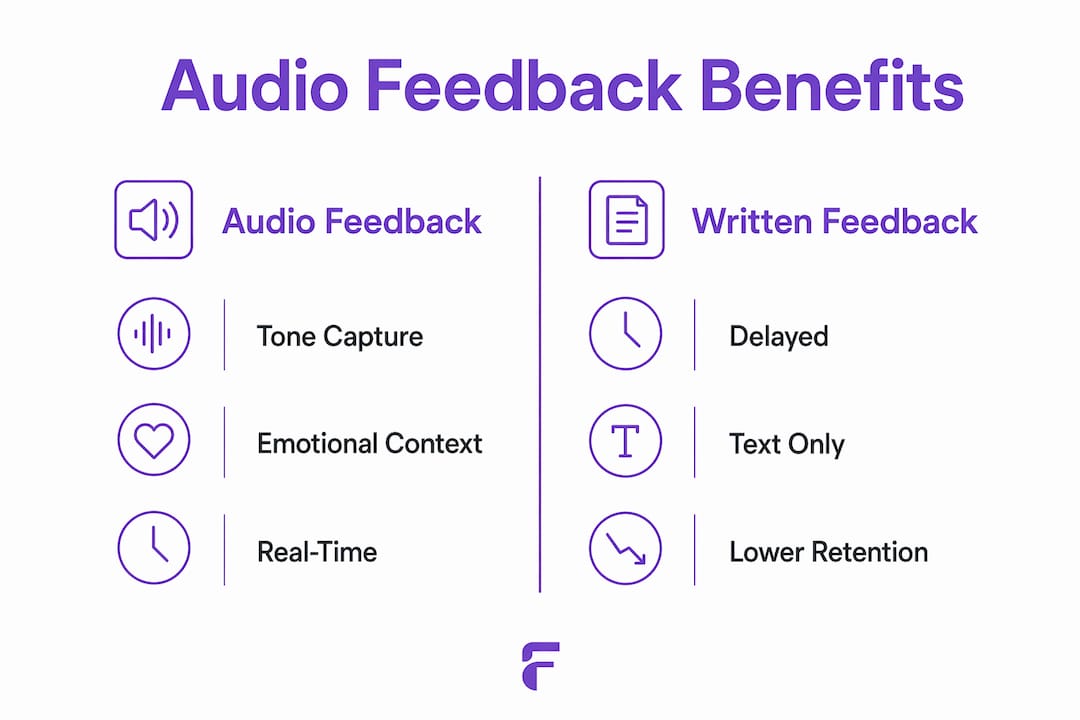
Written feedback describes what happened. Audio feedback lets you experience it. That difference changes how you process and retain critique.
| Feedback type | Delivery speed | Emotional context | Retention impact | Follow-up opportunity |
|---|---|---|---|---|
| Written notes | Slow, asynchronous | None, text is flat | Lower, easy to skim | Limited |
| Audio feedback | Fast, immediate | High, tone is preserved | Higher, voice carries meaning | Natural, conversational |
Audio feedback lowers performance anxiety and increases retention compared to written feedback by delivering critique through vocal intonation and encouragement. A written note that says "your pacing was off" reads as a judgment. The same point delivered with a calm, specific voice reads as coaching. That shift matters when you are already anxious about high-stakes interviews.
The transition from written to audio feedback in educational settings has produced higher follow-up engagement and clearer communication of both praise and critique. Candidates ask more questions, process feedback more deeply, and return to practice sooner. For consulting prep, where repetition drives improvement, that engagement gap is significant.
Audio feedback also supports active listening. When you hear a coach or AI system describe your delivery, you engage differently than when you read the same words. You pick up on emphasis, nuance, and priority. Written feedback flattens all of that into the same font size.
Pro Tip: After receiving audio feedback, write down the top two delivery issues in your own words before your next practice session. Translating spoken critique into written notes reinforces retention and gives you a personal checklist.
How to use audio feedback interviews to improve your consulting skills
A structured approach to audio feedback produces faster gains than casual review. Use this sequence to build a repeatable practice cycle.
- Record a timed mock answer. Set a 2-minute limit and answer a behavioral question without stopping. Treat it as a real interview. No editing, no restarts.
- Listen back without notes. Play the recording once and focus only on how you sound. Note your first impressions of confidence, pacing, and clarity.
- Pair audio with a transcript. Combining audio with transcripts lets you evaluate both delivery and content structure at the same time. Use the STAR framework (Situation, Task, Action, Result) to audit your response structure in the transcript while the audio reveals your delivery patterns.
- Flag specific issues. Identify the top two or three problems: filler words, pacing, flat tone, or weak closing. Do not try to fix everything at once.
- Re-record with one targeted fix. Repeat the same question with one specific improvement in mind. Compare the two recordings directly.
- Use AI scoring for consistency. AI-driven audio feedback delivers consistent, unbiased soft skill scores, making high-quality communication coaching available at scale. Use it to track progress across sessions rather than relying on memory.
Beyond the cycle itself, focus on these delivery priorities during practice:
- Articulation: Speak each word fully. Dropped endings and mumbled transitions are common under pressure.
- Filler word elimination: Replace "um" with a deliberate pause. Silence sounds more confident than filler.
- Sentence-ending pitch: Keep your pitch level or slightly downward at the end of statements. Rising pitch signals uncertainty.
- Energy management: Match your vocal energy to the content. Leadership stories need more energy than analytical walkthroughs.
Voice-first prep systems force candidates to articulate in real time under time pressure, matching real interview conditions better than typed exercises. Typing gives you time to think and edit. Speaking does not. That gap is exactly what audio feedback training closes. Candidates who practice with voice-interactive tools report measurable fluency gains and reduced communication errors under interview pressure, with documented results across consulting hiring rounds in the US, UK, and Germany.
Reviewing different feedback types alongside audio sessions helps you understand which signals matter most for consulting-specific evaluation criteria.
What are the challenges of using audio feedback for interview prep?
Audio feedback is powerful, but it has real limitations. Knowing them helps you use it more effectively rather than over-relying on it.
- Scoring variability from human reviewers: Human coaches differ in how they weight tone versus content. AI systems reduce this variance, but human audio feedback still benefits from a structured rubric to stay consistent.
- The discomfort of hearing your own voice: Most people dislike hearing themselves on recording. That reaction is normal and fades with repetition. Pushing through it is part of the training, not a reason to avoid it.
- Audio alone misses content gaps: Strong delivery cannot save a structurally weak answer. Audio feedback must be paired with content review to catch both problems. A confident voice delivering a vague answer still fails.
- Recording quality affects feedback accuracy: Background noise, poor microphone quality, and echo distort the signal. Use a quiet room and a decent headset to get clean recordings that reflect your actual delivery.
- Over-correction risk: Candidates who focus too heavily on delivery sometimes lose their natural conversational tone and sound rehearsed. The goal is controlled naturalness, not performance.
Balancing audio feedback with human coaching and community-based practice gives you multiple perspectives on the same performance. No single feedback channel captures everything.
Key Takeaways
Audio feedback interviews are the most direct method for identifying and correcting the verbal delivery issues that cost consulting candidates offers at McKinsey, BCG, and peer firms.
| Point | Details |
|---|---|
| Audio captures what text misses | Tone, pacing, and hesitation only appear in voice recordings, not written notes. |
| AI scoring reduces feedback variance | Multimodal AI systems score soft skills from audio with variance under 5%, giving consistent results. |
| Pair audio with transcripts | Reviewing both together lets you audit delivery and content structure in one session. |
| Practice under timed conditions | The 2-minute behavioral answer limit reflects real interview standards and should guide every mock session. |
| Manage discomfort deliberately | Discomfort with your own voice fades with repetition and is a necessary part of the training process. |
Why audio feedback changed how I think about interview prep
I used to believe that consulting interview prep was mostly a content problem. Learn the frameworks, memorize your stories, practice your cases. That belief lasted until I heard a candidate deliver a technically perfect STAR answer in a completely flat, uncertain voice. The content was there. The conviction was not. The interviewer would have passed.
Audio feedback exposed that gap in a way that no written debrief ever could. When you hear yourself hesitating before a key claim, or rising in pitch at the end of a statement that should land with authority, you cannot argue with it. The recording does not care about your intentions. It only captures what you actually produced.
The candidates I have seen improve fastest are the ones who treat audio review as a data source, not a judgment. They listen, they note two things to fix, and they record again. They do not spend time defending their choices or explaining what they meant to say. They just re-record.
The harder lesson is that preparation reduces interview fear most reliably when it includes voice practice, not just content review. Reading about pacing does nothing. Hearing yourself rush through an answer and then slowing down on the next take does everything. That cycle, repeated consistently, is what separates candidates who sound ready from candidates who are ready but do not sound it.
How Frame-lab supports your audio feedback interview training
Frame-lab is built specifically for consulting candidates preparing for firms like McKinsey and BCG. The platform's AI-powered mock interviews use voice-interactive sessions that score your delivery in real time, flagging pacing, filler words, and vocal confidence alongside content quality.
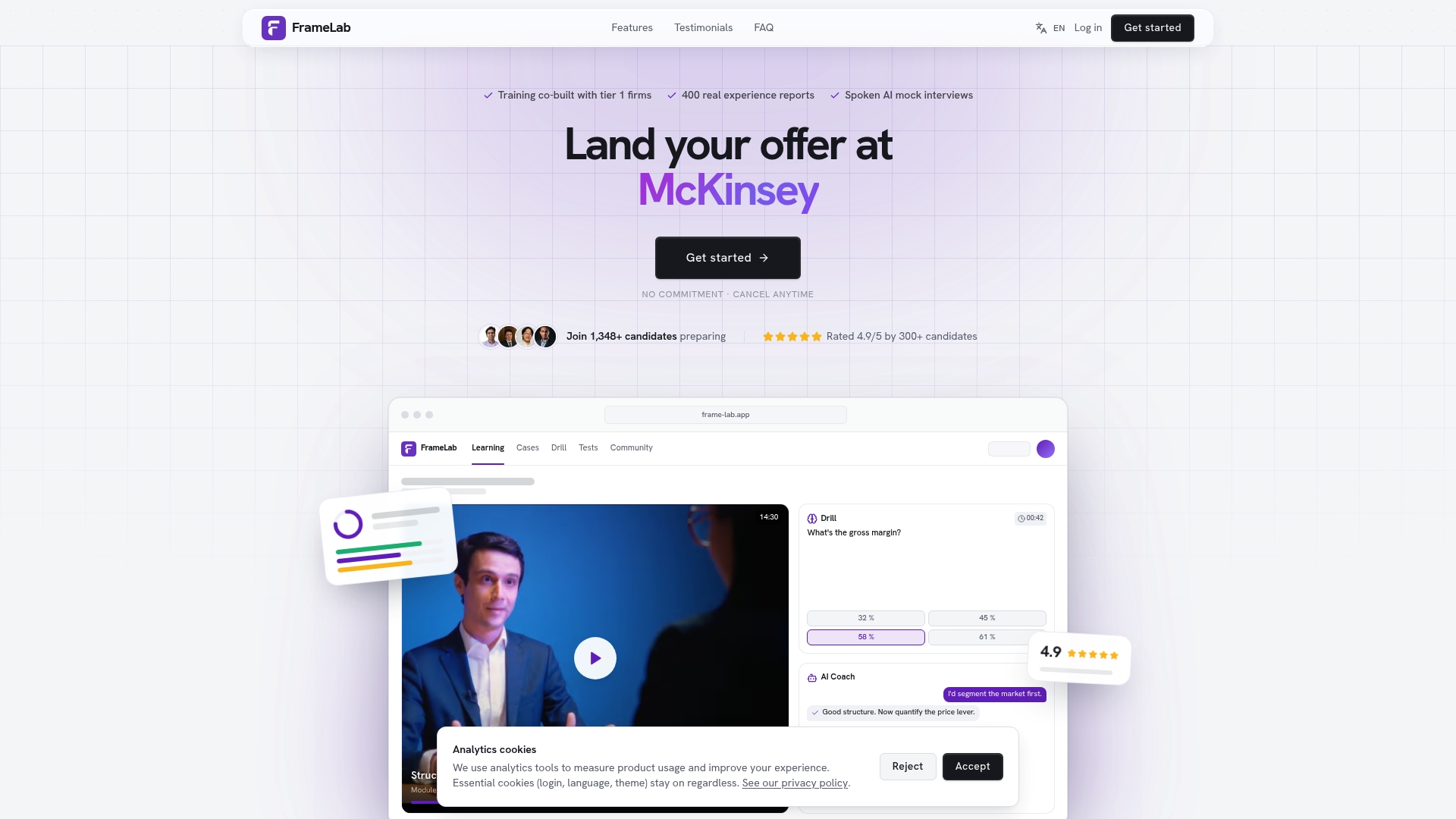
Every session on Frame-lab generates a structured scorecard tied to consulting-specific evaluation criteria, so you always know where your delivery stands relative to what top firms expect. The platform is available on demand, which means you can run a timed mock session and get scored audio feedback at any hour, without scheduling a coach. With over 400 curated experience reports and personalized study paths, Frame-lab gives you the full picture: what to say, and how to say it. Start your consulting interview training with the tools that reflect real interview conditions.
FAQ
What does audio feedback measure in a consulting interview?
Audio feedback measures speech rate, pause duration, filler word frequency, vocal pitch, and overall articulation. Voice-interactive systems also flag answers that exceed the standard 2-minute behavioral question limit.
How does audio feedback differ from written interview feedback?
Audio feedback preserves tone, intonation, and emotional context that written notes flatten into text. It produces higher retention and more follow-up engagement than written critique alone.
Can AI reliably score soft skills from audio recordings?
Multimodal AI systems analyze tone and speech patterns to score soft skills like confidence and articulation, with scoring variance under 5%. That consistency makes AI audio feedback a reliable supplement to human coaching.
How often should I use audio feedback in my interview prep?
Record and review at least one timed mock answer per practice session. Consistent repetition across multiple sessions produces measurable fluency gains and reduces communication errors under pressure.
Should I use audio feedback alone or combine it with other methods?
Audio feedback works best when paired with transcript review for content structure and human or peer coaching for qualitative perspective. No single feedback channel captures every dimension of interview performance.