
Discover what a case study interview is and how to excel in one. Prepare effectively for consulting roles with our 2026 guide.
On this page▾
- What is a case study interview testing in you?
- The core skills interviewers look for
- How are case study interviews typically structured?
- What types of case interview questions should candidates expect?
- How can candidates prepare and handle unexpected questions?
- Key Takeaways
- What I have learned from watching candidates succeed and fail
- How Frame-lab helps you build real case interview readiness
- FAQ
- What is a case study interview in consulting?
- What does a case interviewer expect from candidates?
- What are the main types of case interview questions?
- How should candidates handle unexpected case interview questions?
- How long does a typical case interview last?
- Recommended
A case study interview is defined as a structured exercise where an interviewer presents a real or realistic business problem and asks you to analyze it, structure your thinking, and propose a solution out loud. Consulting firms use simulated business scenarios to evaluate how candidates approach complex problems, not just what conclusions they reach. The format is the industry standard at firms like McKinsey, BCG, and Bain, and it mirrors the actual work consultants do every day. If you are preparing for a consulting career, understanding what a case interview tests and how it runs is the first step toward performing well in one.
What is a case study interview testing in you?
A case study interview, also called a case interview, tests your ability to think through an ambiguous business problem in real time. Interviewers evaluate structured thinking, communication skills, comfort with ambiguity, business intuition, and curiosity. The goal is not to see whether you know the answer. The goal is to see how you work toward one.
This distinction matters. Consulting firms are not hiring industry experts. They are hiring people who can take a messy, incomplete problem and make sense of it quickly. That is exactly what a case interview is designed to reveal.
The core skills interviewers look for
When a recruiter evaluates your performance, they watch for a specific set of attributes:
- Structured thinking. Can you break a large problem into smaller, logical parts without being told how?
- Comfort with ambiguity. Do you freeze when information is missing, or do you make reasonable assumptions and move forward?
- Clear verbal communication. Do you explain your reasoning in a way that is easy to follow, even under pressure?
- Business intuition. Do your recommendations make practical sense in a real business context?
- Curiosity and coachability. Do you ask good clarifying questions? Do you adjust when the interviewer pushes back?
These are not abstract qualities. Each one maps directly to what a junior consultant does on a client engagement. Interviewers do not expect you to be a domain expert. They expect a strong problem-solving methodology.
Pro Tip: Before your interview, practice explaining your reasoning out loud on everyday decisions. The habit of narrating your thinking is a skill, and it takes repetition to feel natural.

How are case study interviews typically structured?
Case interviews come in two main formats: interviewer-led and interviewee-led styles. Knowing which format you are walking into changes how you should prepare and perform.
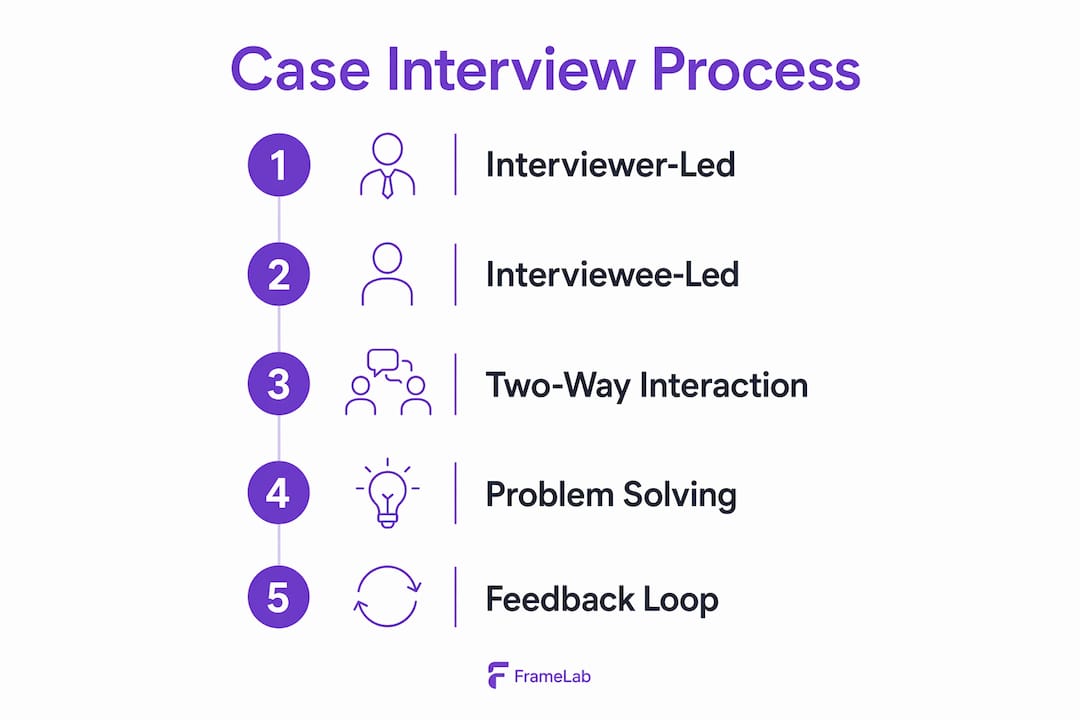
In an interviewer-led case, the recruiter controls the flow. They ask a series of targeted questions and guide you through the analysis step by step. This format is common at firms like McKinsey. Your job is to answer each question clearly and completely before moving on. You can read more about how to practice this format in Frame-lab's guide on interviewer-led case formats.
In an interviewee-led case, you drive the structure. The interviewer gives you a prompt and expects you to decide which areas to analyze, in what order, and how deep to go. This format is more common at BCG and Bain. It rewards candidates who can build and communicate a logical framework from scratch.
Regardless of format, most case interviews follow a recognizable flow:
- Prompt delivery. The interviewer describes the business situation and the core question you need to address.
- Clarification. You ask one or two targeted questions to confirm your understanding of the problem and the goal.
- Framework building. You take a moment to structure your approach, then share it with the interviewer before diving in.
- Analysis. You work through the problem, doing calculations, testing hypotheses, and interpreting data as needed.
- Synthesis. You deliver a clear, concise recommendation with supporting reasoning.
Two-way interaction is a defining feature of modern case interviews. The interviewer will challenge your assumptions, introduce new data, or redirect you. This is not a sign you are failing. It is part of the format.
Pro Tip: Treat the interviewer as a thinking partner, not an examiner. Consulting is collaborative work, and the best candidates make the conversation feel like a joint problem-solving session.
What types of case interview questions should candidates expect?
Case interview questions fall into several recurring categories. Each type tests a different dimension of analytical and strategic thinking. Knowing the categories helps you recognize what kind of problem you are facing and apply the right approach quickly.
| Question type | What it tests | Example prompt |
|---|---|---|
| Market sizing | Estimation, structured assumptions, numeracy | "How many coffee cups are sold in New York City each day?" |
| Profitability analysis | Financial reasoning, cost and revenue drivers | "Our client's profits have dropped 20% in two years. Why?" |
| Growth strategy | Strategic thinking, market opportunity assessment | "Should our client expand into Southeast Asia?" |
| Market entry | Risk evaluation, competitive analysis | "A European retailer wants to enter the US market. How?" |
| Mergers and acquisitions | Valuation logic, synergy analysis | "Should our client acquire this competitor?" |
| Digital transformation | Risk assessment, change management thinking | "A manufacturer wants to automate its supply chain. What are the risks?" |
Common case question types include market sizing, profitability analysis, growth strategies, and digital transformation risk assessments. Each one requires you to apply a clear framework, not memorize a fixed answer.
The profitability case is the most common starting point for beginners. It teaches you to separate revenue from cost, identify the key drivers of each, and form a hypothesis quickly. Market sizing cases, by contrast, test your ability to make structured estimates with limited data. Both are worth mastering early in your preparation.
How can candidates prepare and handle unexpected questions?
Effective preparation for a case interview is not about memorizing answers. It is about building the mental habits that let you think clearly under pressure. Practical exercises with peers or through training platforms improve both confidence and performance in actual interviews.
A strong preparation plan covers these areas:
- Learn the formats specific to your target firms. McKinsey's interviewer-led style requires different habits than BCG's interviewee-led format. Research each firm's approach before you practice.
- Build a core set of frameworks. Profitability trees, market entry frameworks, and Porter's Five Forces are starting points. Practice applying them to new problems, not reciting them from memory.
- Sharpen your mental math. Consulting interviews involve quick calculations. Practice dividing large numbers, estimating percentages, and working with ratios without a calculator.
- Simulate real conditions. Practice with a partner who will push back, introduce new data, and time you. Comfort under pressure only comes from repeated exposure to pressure.
- Develop a clarification routine. When a question surprises you, pause, restate what you heard, and ask one targeted question before you begin. This buys you thinking time and shows composure.
- Think aloud, always. Silence is the biggest mistake candidates make. Even if your reasoning is imperfect, narrating it gives the interviewer something to work with and shows your thought process.
There is no perfect answer in a case interview. The evaluation focuses on your thought process, creativity, and ability to deal with ambiguity. A candidate who reaches a flawed conclusion through clear, logical reasoning will often outscore one who guesses the right answer without showing their work.
When an unexpected question hits, the worst response is silence or a guess. The best response is to acknowledge the new information, connect it to your existing framework, and adjust your analysis out loud. Interviewers expect you to iterate. That is the point. You can find a structured approach to the full preparation process in Frame-lab's case interview preparation guide.
Key Takeaways
A case study interview tests your problem-solving process, not your industry knowledge, and success depends on structured thinking, clear communication, and composure under pressure.
| Point | Details |
|---|---|
| Core purpose | Case interviews simulate real consulting problems to assess reasoning, not domain expertise. |
| Two main formats | Interviewer-led cases are guided by the recruiter; interviewee-led cases require you to drive the structure. |
| Skills assessed | Structured thinking, comfort with ambiguity, verbal clarity, business intuition, and coachability. |
| Question categories | Expect market sizing, profitability, growth strategy, market entry, and digital transformation cases. |
| Preparation approach | Practice frameworks, mental math, and real-time simulation with a partner to build confidence. |
What I have learned from watching candidates succeed and fail
One pattern stands out above all others in case interviews. Candidates who treat the interview as a test they must pass tend to freeze when something unexpected happens. Candidates who treat it as a collaborative problem-solving session stay calm, ask good questions, and recover quickly from wrong turns.
The mindset shift sounds simple. It is not. Most candidates spend their preparation time memorizing frameworks and practicing calculations, which matters. But they underinvest in the skill of staying curious when the conversation goes sideways. The interviewer who challenges your assumption is not trying to trip you up. They are showing you how consulting actually works. Clients push back. Data changes. Good consultants adapt in real time.
The other thing I see consistently is candidates who fear silence so much that they rush to an answer before they have thought it through. A five-second pause to organize your thinking is not a weakness. It is a signal that you take the problem seriously. The stress that case interviews cause is real, but most of it comes from misunderstanding what the interviewer actually wants. They want to see you think. Give them that, and you are already ahead of most candidates in the room.
How Frame-lab helps you build real case interview readiness
Frame-lab is built specifically for candidates preparing for consulting interviews at firms like McKinsey and BCG. The platform combines AI-driven mock interviews, over 400 curated experience reports from real candidates, and a peer community for live practice.
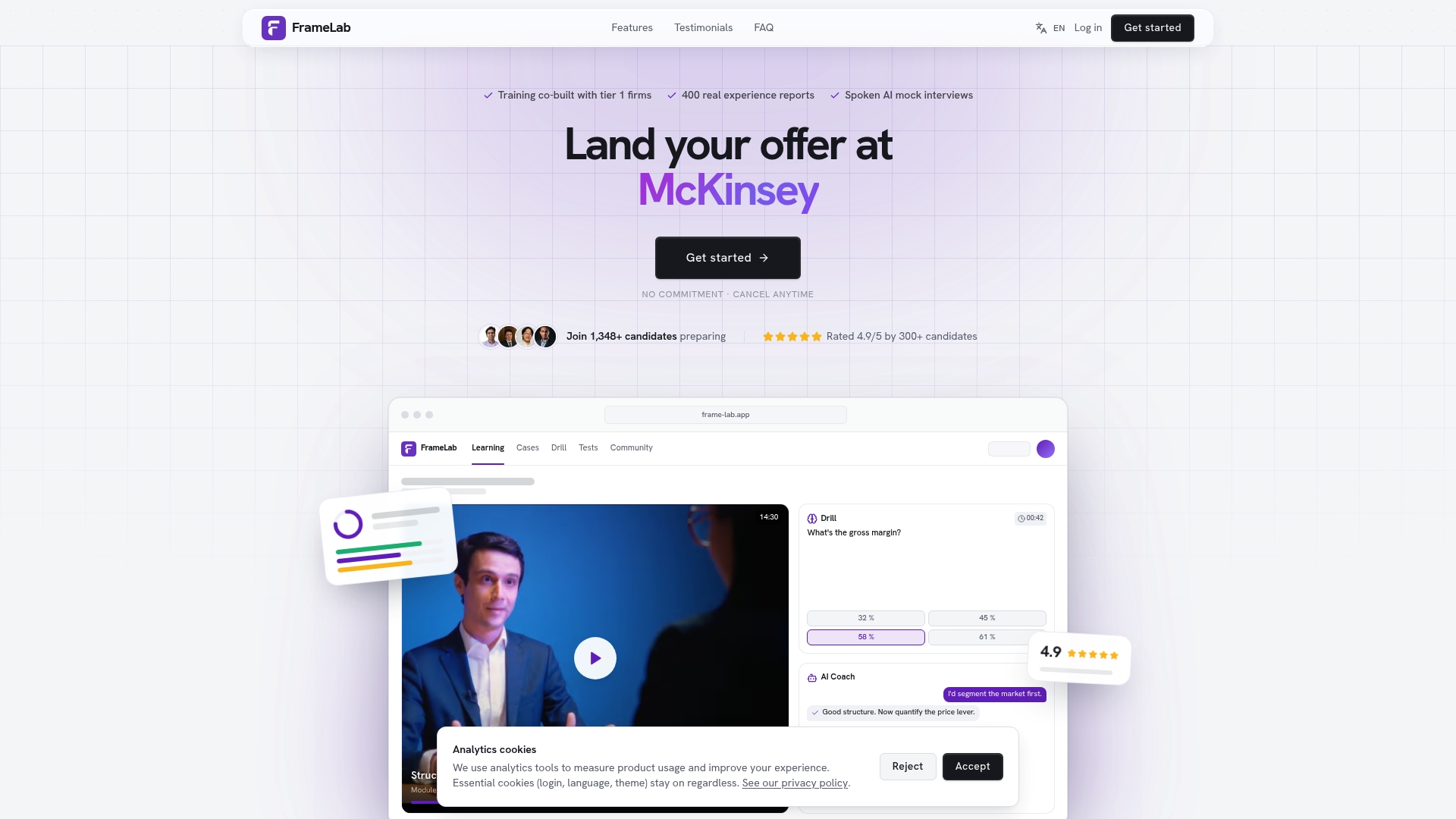
Frame-lab's training modules cover core frameworks, intermediate analysis techniques, and advanced case structures, each designed around real interview scenarios. You can work through cases like DataSecure Growth or Recyc'Tech Expansion to practice under realistic conditions. Personalized feedback shows you exactly where your reasoning breaks down, so you fix the right things before the real interview.
FAQ
What is a case study interview in consulting?
A case study interview is a structured exercise where you analyze a real or realistic business problem and propose a solution out loud. Consulting firms use this format to evaluate problem-solving skills, structured thinking, and communication under pressure.
What does a case interviewer expect from candidates?
Interviewers expect structured thinking, clear verbal reasoning, comfort with ambiguity, and curiosity. They do not expect industry expertise or a perfect answer, only a logical, well-communicated approach to the problem.
What are the main types of case interview questions?
The main types include market sizing, profitability analysis, growth strategy, market entry, mergers and acquisitions, and digital transformation cases. Each type tests a different dimension of analytical and strategic thinking.
How should candidates handle unexpected case interview questions?
Pause, restate what you heard, and ask one clarifying question before you begin. Then connect the new information to your existing framework and adjust your analysis out loud, showing the interviewer how you think in real time.
How long does a typical case interview last?
Most case interviews run between 30 and 45 minutes, including time for the prompt, your analysis, and a brief synthesis at the end. Some firms conduct multiple rounds in a single session.