
Discover why consulting values problem solving. Learn how this essential skill shapes client outcomes and drives successful consulting engagements.
On this page▾
- Seven essential traits of highly effective consulting problem solvers
- Why consulting emphasizes structured problem solving over creativity
- How consulting firms evaluate problem solving skills in interviews
- What real consulting experience reveals about problem solving
- How problem solving compares to other key consulting skills
- How strong problem solving shapes client outcomes
- Key Takeaways
- Recommended
Problem solving sits at the core of every consulting engagement. Firms like McKinsey and BCG are built around one fundamental premise: clients hire consultants because they face problems too complex, too unfamiliar, or too politically charged to resolve on their own. The ability to solve problems methodically is what McKinsey identifies as the number-one professional skill for success, and it shapes every stage of consulting work, from the first client meeting to the final recommendation.

What makes problem solving so central is not raw intelligence. It is the combination of structured thinking, clear communication, and disciplined prioritization that turns ambiguous situations into decisions clients can act on. Consulting firms value this skill because it is repeatable, teachable, and directly tied to client outcomes.
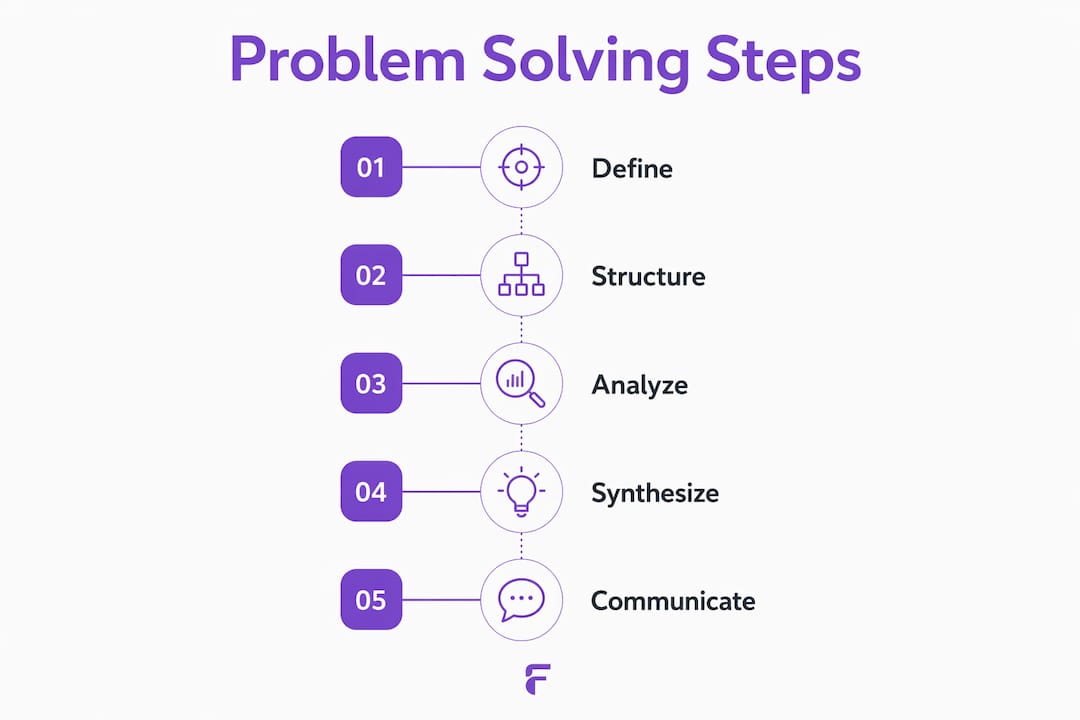
Here is what that looks like in practice:
- Defining the problem precisely before any analysis begins, aligning all stakeholders on what success actually means
- Structuring complexity into logical, manageable parts using tools like issue trees and MECE frameworks
- Prioritizing ruthlessly, focusing effort on the levers that move the needle rather than every possible variable
- Testing hypotheses iteratively, adjusting direction as data comes in rather than defending an initial assumption
- Synthesizing findings into a clear narrative that answers "what should we do?" not just "what did we find?"
Each of these steps reflects why consulting effectiveness and problem solving are inseparable. Without this process, even brilliant analysis produces recommendations that miss the mark.
Seven essential traits of highly effective consulting problem solvers
What separates a consultant who delivers from one who struggles? It comes down to a specific set of traits that top performers develop over time, often through deliberate practice and real client exposure.
-
Curiosity and open-mindedness. Strong consultants ask questions before they form opinions. They resist the pull toward a comfortable answer and stay genuinely open to where the data leads. This curiosity drives deeper exploration and surfaces insights that a more closed mindset would miss.
-
Analytical thinking. The ability to break a problem into its logical components, rank them by importance, and pursue the most critical ones first is the backbone of consulting work. Analytical thinking is not about running complex models; it is about knowing which questions to ask and in what order.
-
Creativity within structure. Lateral thinking matters, but in consulting it operates inside a defined framework rather than as a free-form brainstorm. The best consultants generate creative hypotheses while keeping their logic MECE, mutually exclusive and collectively exhaustive, so no angle is missed and no effort is wasted.
-
Resilience and adaptability. Hypotheses fail. Data contradicts assumptions. Projects pivot. Consultants who stay effective under these conditions treat a failed hypothesis as useful information, not a setback. This psychological flexibility is one of the clearest markers of consulting maturity.
-
Communication clarity. Analysis that cannot be explained simply does not drive decisions. Strong consultants translate complex findings into plain language, structuring their reasoning so a client can follow the logic and trust the conclusion. Articulating why a recommendation was chosen over alternatives is as important as the recommendation itself.
-
Attention to detail balanced with big-picture thinking. Consultants must hold two levels of focus simultaneously: the granular data that validates a hypothesis and the broader strategic question that gives that data meaning. Losing either perspective leads to recommendations that are either technically correct but strategically irrelevant, or directionally sound but unsupported.
-
Collaboration and buy-in building. Consulting rarely happens in isolation. Teams integrate diverse perspectives, and the best solutions often emerge from structured debate. Equally, clients who feel included in the problem-solving process are far more likely to implement recommendations, which is ultimately where the value is realized.
Why consulting emphasizes structured problem solving over creativity
Creativity gets a lot of credit in business conversations, but consulting firms consistently prioritize structure over open-ended ideation. The reason is practical: unstructured thinking wastes time, and consulting engagements run on tight timelines with high client expectations.
The MECE principle, developed by Barbara Minto at McKinsey, is the foundation of structured consulting work. By ensuring that every breakdown of a problem is mutually exclusive and collectively exhaustive, MECE prevents teams from double-counting effort or missing critical areas. Issue trees apply this principle visually, breaking a complex question into progressively smaller sub-questions until each branch is testable with data.
- Hypothesis-driven problem solving starts with a provisional answer on day one and designs analysis specifically to prove or disprove it. This approach prevents "boiling the ocean," the trap of analyzing everything equally rather than focusing on what matters most.
- Structured frameworks reduce wasted effort. Jumping to solutions before adequately structuring the problem is the most common mistake in consulting work, and it consistently leads to less impactful outcomes.
- The Pyramid Principle, also developed by Barbara Minto, governs how consultants communicate findings. Lead with the conclusion, support it with key arguments, and back each argument with evidence. Executives do not want to follow the analytical journey; they want the answer first.
- Creativity plays a role inside the structure, not before it. Once a problem is framed and broken down, creative hypotheses about root causes or solutions are genuinely valuable. But creativity without structure produces ideas that cannot be prioritized or tested.
- Pragmatism over elegance. Consulting solutions must be actionable and relevant to the client's specific constraints, including budget, timeline, and organizational appetite for change. A theoretically elegant solution that ignores these constraints is not a good consulting solution.
Pro Tip: When preparing for a case interview, practice building an issue tree before you brainstorm solutions. The structure you create in the first two minutes signals more about your consulting readiness than the ideas you generate afterward.
How consulting firms evaluate problem solving skills in interviews
Consulting interviews are designed to surface exactly the traits and skills described above, under pressure and in real time. Understanding what interviewers are actually looking for changes how you prepare.
- Problem framing comes first. When an interviewer says "walk me through how you would approach this," they are watching how you define the problem before you attempt to solve it. Strong candidates ask clarifying questions, establish boundaries, and confirm what success looks like. Framing the problem correctly is a signal of consulting maturity that interviewers specifically look for.
- Logical rigor and prioritization. Interviewers assess whether you can identify the most important branches of a problem and focus your analysis there, rather than treating every variable as equally significant.
- Clear communication of your thought process. Candidates who think silently and then deliver a conclusion miss the point of the case interview. The process is the evaluation. Interviewers want to follow your reasoning in real time.
- Adaptability under pressure. Interviewers often introduce new information mid-case to see whether you can incorporate it without losing your structure. Candidates who struggle often do so because they are reactive rather than proactive, and because they have not internalized what independent thinking actually looks like in a consulting context.
- Hypothesis testing, not just frameworks. Applying a memorized framework without adapting it to the specific problem is a red flag. Strong candidates form a hypothesis early, then use their structure to test it, revising as needed.
- Interpersonal presence. Consulting is a client-facing profession. Interviewers notice whether you communicate with confidence, listen actively, and engage collaboratively, even in a one-on-one case setting. These signals predict how you will perform with actual clients.
You can practice the full arc of this evaluation, from problem framing through synthesis, with real interview conditions that mirror what top firms actually use.
What real consulting experience reveals about problem solving
Frameworks and theory only go so far. The deeper lessons about consulting problem solving tend to come from practice, feedback, and exposure to how experienced consultants actually behave under pressure.
Communication is not a soft skill in consulting. It is a core deliverable. Transparent reasoning builds client confidence in ways that analysis alone cannot. When a consultant explains not just what the recommendation is but why it was chosen over alternatives, clients are far more likely to act on it.
Pulling up from a failed hypothesis is a mark of maturity, not failure. The most effective consultants detach emotionally from their initial ideas and pivot quickly when data points in a different direction. This iterative cycle of drilling down and pulling up is what keeps a project moving toward the right answer rather than defending the first one.
Problem framing is where most projects succeed or fail. Spending time with stakeholders to refine the problem statement before any analysis begins is not a delay; it is the highest-leverage activity in a consulting engagement. Teams that skip this step often spend weeks solving the wrong problem.
Theoretical frameworks rarely survive contact with a real project unchanged. The seven-step process, issue trees, and MECE are starting points, not scripts. Experienced consultants adapt these tools to the specific context, the client's constraints, and the available data.
Frame-lab is built around this gap between theory and practice. Its AI-driven mock interviews and library of real interview experience reports give candidates exposure to how problem solving actually unfolds in a case setting, not just how it is described in training materials.
Pro Tip: After each practice case, write a one-paragraph synthesis of your recommendation as if you had 30 seconds with a senior partner. If you cannot do it clearly, your structure needs work, not your analysis.
How problem solving compares to other key consulting skills
Problem solving does not operate in isolation. Consulting requires a cluster of skills, and understanding how they relate to each other helps you prioritize your preparation.
Structured thinking is the foundation that makes all other consulting skills functional. Without it, strong communication has nothing coherent to express, and analytical depth produces findings that cannot be organized into a recommendation.
Communication amplifies problem solving but cannot replace it. A consultant who communicates clearly but structures problems poorly will deliver polished presentations of the wrong answer. The two skills work together: structure gives communication its logic, and communication gives structure its impact.
Analytical rigor is a component of problem solving rather than a separate skill. The ability to gather, interpret, and validate data serves the broader problem-solving process. Consultants who treat analysis as the end goal, rather than a means to a recommendation, often produce what the industry calls "analysis without a so-what."
Client management and relationship skills matter enormously, but they operate downstream of problem solving. Clients trust consultants who demonstrate clear thinking first. Relationship skills then sustain and deepen that trust over the course of an engagement.
Creativity and design thinking are genuinely valuable, particularly for ambiguous problems where the problem definition itself is unclear. But in most consulting contexts, creativity is most useful after a problem has been structured, not before. The consulting problem-solving process treats creative ideation as one input into a disciplined framework, not as the primary method.
How strong problem solving shapes client outcomes
The reason consulting firms invest so heavily in problem-solving capability is straightforward: it directly determines whether clients get results or get a report.
When a consultant frames a problem correctly from the start, the entire engagement runs more efficiently. Effort concentrates on the levers that actually move outcomes, and the final recommendation lands in a context the client already understands and has helped shape. The seven-step process that McKinsey formalizes, from defining and structuring through prioritizing, analyzing, synthesizing, and recommending, is designed to prevent the most common failure mode: delivering a technically correct answer to the wrong question.
Poor problem solving produces the opposite outcome. Teams spend time on low-impact branches of the analysis, present findings without a clear recommendation, or solve a symptom while the root cause persists. These failures are expensive for clients and damaging to a firm's reputation.
The synthesis step is where problem solving most visibly affects client outcomes. Translating analysis into a compelling narrative that answers "what should we do?" is the moment consulting value becomes tangible. Without it, even excellent analysis sits unused. With it, clients leave the engagement with clarity, confidence, and a path forward they can actually execute.
Key Takeaways
Consulting values problem solving because it is the skill that converts complex, ambiguous client challenges into clear, prioritized, and executable recommendations.
| Point | Details |
|---|---|
| Structure before solutions | Jumping to answers without framing the problem first is the most common and costly consulting mistake. |
| MECE as the foundation | Mutually exclusive, collectively exhaustive thinking prevents gaps and overlap in every analysis. |
| Communication is part of the skill | Explaining why a recommendation was chosen over alternatives builds client trust and drives action. |
| Pulling up signals maturity | Revising a failed hypothesis quickly is a mark of elite consulting performance, not a weakness. |
| Framing determines project success | Spending time defining the problem precisely with stakeholders is the highest-leverage activity in any engagement. |