Discover why mock interviews mirror real ones for consulting. Learn how simulated pressure boosts your performance by 20% in high-stakes situations.
On this page▾
- Why mock interviews mirror real consulting interviews
- What specific elements make mock interviews realistic simulations?
- How does practicing mock interviews improve real interview performance?
- What common misconceptions separate mock from real interviews?
- How can candidates maximize the effectiveness of their mock interviews?
- Key Takeaways
- What I have learned from watching candidates prepare
- Frame-lab's FIT Interview module for realistic consulting practice
- FAQ
- What is a mock interview in consulting preparation?
- How many mock interviews do I need before a consulting interview?
- Why is solo practice not enough for consulting interview preparation?
- Do mock interviews reduce anxiety before real consulting interviews?
- What should I focus on when reviewing my mock interview recordings?
- Recommended
Mock interviews are defined as structured simulations that replicate the exact conditions, cognitive demands, and pressure of real consulting interviews. Understanding why mock interviews mirror real ones is the first step toward building a preparation strategy that actually works. Candidates who practice under simulated pressure perform 20% better in real high-stakes interviews. That gap is not about knowledge. It is about the ability to think clearly, speak precisely, and hold your structure when the stakes feel real. Frame-lab is built on this principle: realistic practice produces measurable results.
Why mock interviews mirror real consulting interviews
Mock interviews replicate real consulting interviews because they recreate the same three conditions that make those interviews difficult: time pressure, unpredictability, and live evaluation. Reading a case framework in a textbook does not trigger the same cognitive load as explaining it to a skeptical interviewer in under two minutes. Industry guidance describes mock interviews as flight simulators for the brain, compressing learning by providing realistic but consequence-free pressure. That compression is exactly what separates candidates who perform well from those who freeze.
The standard industry term for this process is simulated interview practice, though most candidates and coaches use "mock interview" interchangeably. Both refer to the same method: a structured session with a live or AI evaluator, timed responses, and feedback delivered after each answer. The key is that all three elements must be present. Remove any one of them and the simulation loses its power.
Real consulting interviews at firms like McKinsey and BCG test your ability to structure ambiguous problems quickly, communicate your reasoning out loud, and adapt when the interviewer pushes back. Mock interviews replicate each of those demands. That is why the benefits of mock interviews go far beyond familiarity with case types. They build the specific mental habits that real interviews require.
What specific elements make mock interviews realistic simulations?
The realism of a mock interview comes from its structural features, not just its content. Each feature maps directly to a condition you will face in the real interview room.
| Element | Real interview | Mock interview |
|---|---|---|
| Time pressure | Strict, unannounced limits | Timed responses with a clock |
| Unpredictability | Follow-up questions you cannot anticipate | Unrehearsed probing by the interviewer |
| Live evaluation | Interviewer scores your answer in real time | Observer provides immediate feedback |
| Environment | Professional dress, formal setting | Replicated dress code and setup |
| Remote tech | Camera, lighting, eye contact | Practiced with the same tools |
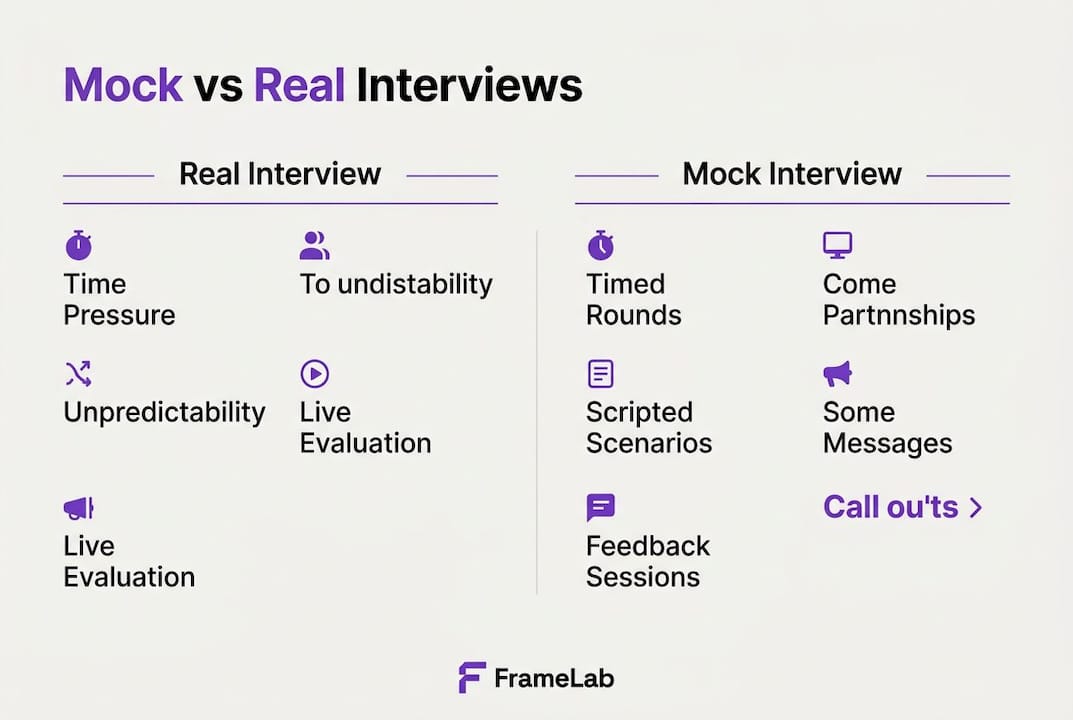
Each row in that table represents a skill you must develop before the real interview. Skipping any one of them creates a gap in your preparation.
The most underestimated element is unpredictability. Real consulting interviewers do not follow a script. They probe weak points, ask you to defend assumptions, and redirect mid-answer. Unpredictability and external evaluation are crucial features that solo rehearsals cannot replicate. A mock session with a qualified interviewer forces you to hold your structure even when the conversation shifts.
Remote interview conditions add another layer. Mastering the technical aspects of remote interviews, including lighting, camera angle, and eye contact, affects the impression you make just as much as in-person body language does. Candidates who practice these details in mock sessions arrive at virtual consulting interviews with one less variable to manage.
How does practicing mock interviews improve real interview performance?
Stress inoculation is the core mechanism. When you expose yourself repeatedly to a stressful situation in a controlled setting, your nervous system learns to treat it as familiar. Familiarity reduces arousal. Reduced arousal means clearer thinking. Even a single well-conducted mock interview reduces anxiety by making the environment feel known rather than threatening.
Beyond anxiety, mock interviews build muscle memory for structured thinking. Consulting interviews reward candidates who apply frameworks like STAR (Situation, Task, Action, Result) automatically, without burning mental energy on the structure itself. Structured thinking and muscle memory built through repeated mock sessions allow candidates to apply frameworks smoothly under pressure. That automaticity only comes from repetition under realistic conditions.
The top five benefits of mock interviews for consulting preparation are:
- Anxiety reduction: Repeated exposure to interview conditions lowers stress responses before the real event.
- Framework fluency: Applying STAR and case structures becomes automatic rather than effortful.
- Pacing and time management: You learn how much to say and when to stop within strict time limits.
- Blind spot identification: Live feedback reveals gaps in logic or clarity that self-study never surfaces.
- Communication precision: Speaking answers out loud repeatedly sharpens word choice and delivery.
Pro Tip: Record every mock session and watch it back with the sound off first. You will notice body language and pacing issues that you completely missed while speaking.
Feedback is the multiplier. Mock interviews expose blind spots like loss of logical cohesion or unstated assumptions that self-study cannot reveal. A peer or coach watching your answer in real time catches the moment your structure collapses, which you cannot detect from the inside. That external perspective is irreplaceable. Frame-lab's feedback mechanisms are built specifically to surface these blind spots for consulting candidates.
What common misconceptions separate mock from real interviews?
The most damaging misconception is that knowing the answer is enough. Speaking answers out loud under time pressure is a distinct skill that mock interviews develop better than passive study. You can read every case framework ever written and still stumble when asked to explain your reasoning to a live evaluator in 90 seconds. The gap between knowing and performing is exactly what mock interviews close.
A second misconception is that solo rehearsal is equivalent to a live session. Practicing in front of a mirror or mentally rehearsing answers does not replicate the cognitive load of being observed and evaluated. True mock interview effectiveness requires unpredictability and external evaluation to simulate the cognitive demands of a real interview. Without those two elements, you are rehearsing a monologue, not preparing for a conversation.
A third misconception is that one or two sessions are sufficient. At least three structured mock interviews with feedback are needed to see significant improvement in case and behavioral interviews. The first session reveals your baseline. The second lets you apply initial feedback. The third shows whether the changes have stuck. Spacing sessions over days or weeks gives your brain time to consolidate what it has learned.
Pro Tip: Treat each mock session as a data point, not a performance. After every session, write down one thing you did well and one thing you will change. That habit compounds quickly across multiple sessions.
Remote interview tech is another overlooked area. Candidates who have never tested their camera angle, background, or lighting before a virtual consulting interview are adding unnecessary risk. Practicing these details during mock sessions removes them from the equation entirely.
How can candidates maximize the effectiveness of their mock interviews?
Getting the most from real interview practice requires deliberate setup and consistent follow-through. These five steps produce the best results:
-
Replicate real conditions exactly. Dress as you would for the actual interview. Use the same room, the same camera, and the same time limits. Comfort in the setup reduces variables on the real day. Read more about replicating real conditions in a dedicated guide.
-
Use a qualified interviewer. A peer who has been through consulting interviews, a career coach, or an AI platform trained on real interview data will push back in ways that matter. Generic practice partners who do not know consulting interview standards cannot simulate the right kind of pressure.
-
Record every session. Video review reveals delivery issues, filler words, and pacing problems that are invisible in the moment. Watch the recording within 24 hours while the session is still fresh.
-
Solicit specific feedback. Ask your interviewer to rate your structure, your clarity, and your pacing separately. Vague feedback like "that was good" does not help you improve. Detailed feedback on mock interview feedback types gives you a clear target for the next session.
-
Space and repeat sessions over time. Schedule mock interviews across several weeks rather than cramming them into one weekend. Spaced repetition allows your brain to consolidate skills between sessions, which produces more durable improvement.
Key Takeaways
Mock interviews mirror real consulting interviews because they replicate time pressure, unpredictability, and live evaluation, which are the three conditions that self-study cannot reproduce.
| Point | Details |
|---|---|
| Simulation replicates real pressure | Mock interviews recreate time limits, observer evaluation, and unpredictable follow-ups. |
| Performance improves measurably | Candidates who practice under simulated pressure perform 20% better in real interviews. |
| Multiple sessions are required | At least three structured mock sessions with feedback produce significant improvement. |
| Feedback reveals blind spots | Live evaluation surfaces logic gaps and pacing issues that solo study never catches. |
| Remote tech matters | Practicing camera, lighting, and eye contact in mock sessions removes risk on the real day. |
What I have learned from watching candidates prepare
The candidates who improve the most are not the ones who know the most frameworks. They are the ones who get comfortable being uncomfortable on camera, in front of a stranger, with a clock running. That discomfort is the point.
I have watched candidates with strong academic records stumble badly in their first mock session, not because they lacked knowledge, but because they had never spoken a structured answer out loud under pressure. The first session is almost always humbling. The third session is almost always a different story. The change between session one and session three is not new information. It is repetition, feedback, and the willingness to sit with the discomfort of being evaluated.
The detail most candidates overlook is pacing. Real consulting interviewers notice when you rush through your structure because you are nervous. They also notice when you pad an answer because you lost the thread. Mock sessions are the only place where you can feel that dynamic and correct it before it costs you an offer.
Tech setup is the other blind spot I see consistently. A candidate who has never tested their lighting before a virtual interview is giving away points before they say a word. Practicing under pressure on camera is not optional for virtual consulting interviews. It is part of the preparation.
The iterative process works. Commit to it.
Frame-lab's FIT Interview module for realistic consulting practice
Candidates preparing for consulting interviews at firms like McKinsey and BCG need more than case frameworks. They need a realistic environment where the pressure, timing, and feedback mirror what they will face in the real interview.
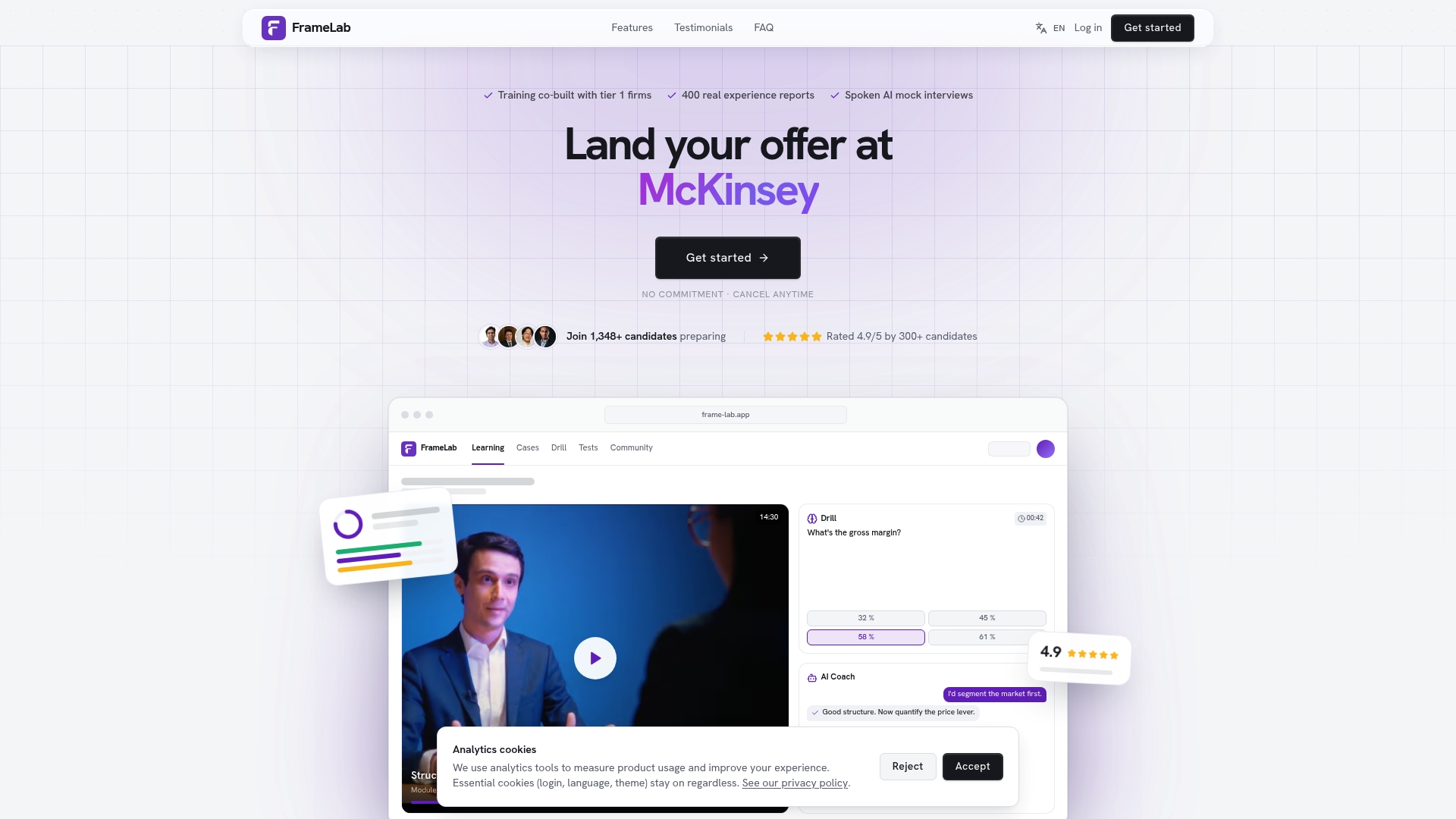
Frame-lab's FIT Interview module is built specifically for this. It combines timed sessions, real-time feedback, and over 400 curated experience reports drawn from actual consulting interviews. Candidates work through behavioral and fit questions under conditions that replicate the real interview format, then receive detailed feedback on structure, clarity, and delivery. The result is preparation that builds both competence and confidence before the real day arrives. Start with the full consulting training platform to find the right path for your level.
FAQ
What is a mock interview in consulting preparation?
A mock interview is a structured simulation of a real consulting interview, including timed responses, live evaluation, and unpredictable follow-up questions. It replicates the cognitive and emotional demands of the real interview to build performance before the stakes are real.
How many mock interviews do I need before a consulting interview?
Industry experts recommend at least three structured mock interviews with feedback to see significant improvement in case and behavioral performance. Spacing those sessions over several weeks produces more durable results than cramming them into a single day.
Why is solo practice not enough for consulting interview preparation?
Solo practice does not replicate unpredictability or external evaluation, which are the two conditions that create real cognitive load in a consulting interview. Speaking answers out loud to a live evaluator develops skills that reading or mental rehearsal cannot build.
Do mock interviews reduce anxiety before real consulting interviews?
Yes. Even a single well-conducted mock interview reduces anxiety by making the interview environment feel familiar rather than threatening. Repeated sessions lower the stress response further, which improves clarity of thought during the real interview.
What should I focus on when reviewing my mock interview recordings?
Focus on pacing, structure, and filler words first, then watch for body language and eye contact. Reviewing recordings within 24 hours of each session gives you the clearest picture of what to change before your next practice round.