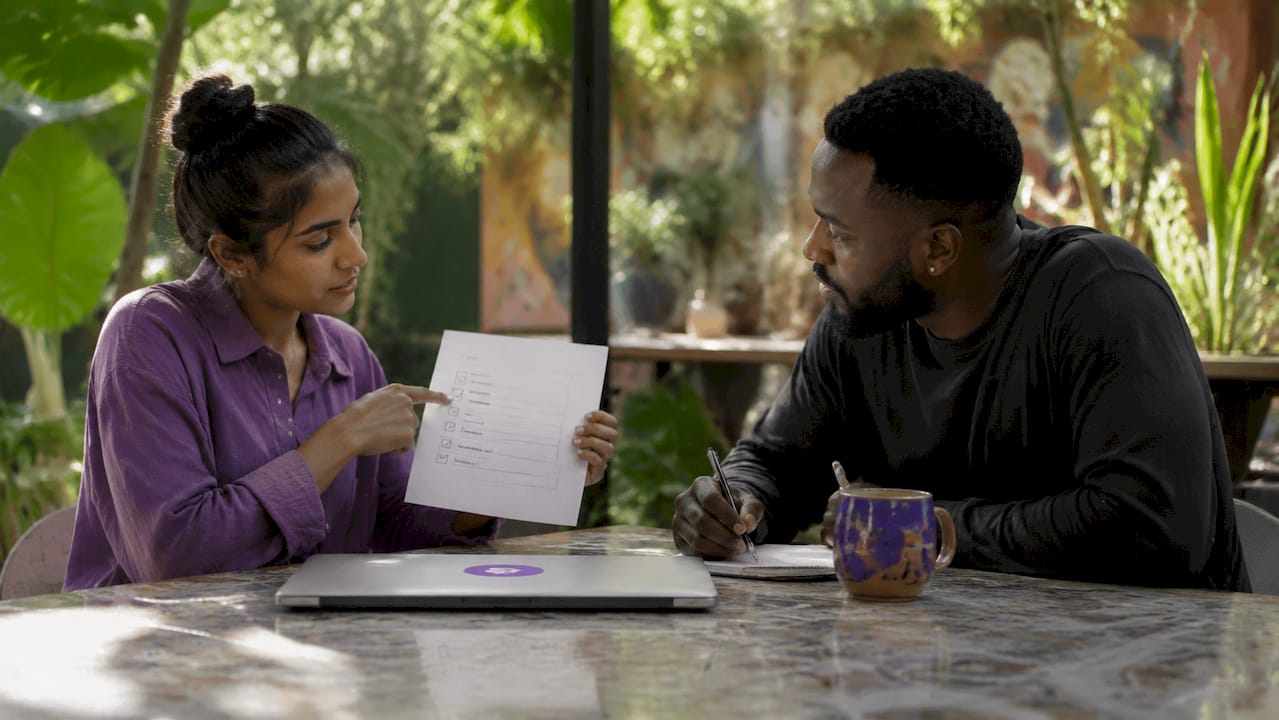
Boost your consulting interview prep with our interview practice partner checklist. Maximize your success rates and ensure quality preparation.
On this page▾
- 1. What belongs on your interview practice partner checklist
- 2. How the partner should conduct the mock interview
- 3. How to run the feedback and evaluation phase
- 4. What to confirm on the day of your mock interview
- Key takeaways
- Why role reversal changed how I think about interview prep
- Frame-lab makes structured partner practice easier
- FAQ
- What is an interview practice partner checklist?
- How long should a mock interview session last?
- What should the feedback rubric include?
- Why should candidates record their mock interviews?
- How much time should consulting candidates spend preparing?
- Recommended
An interview practice partner checklist is a structured tool that guides candidates and their partners through realistic, measurable mock sessions to build true consulting interview readiness. A structured checklist increases candidate success rates by 45%. That number reflects what separates candidates who walk in prepared from those who wing it. For consulting roles at firms like McKinsey and BCG, the margin between an offer and a rejection is rarely talent. It is almost always preparation quality. This guide covers every item your checklist needs, from environment setup and question delivery to scoring rubrics and day-of logistics, so you and your partner run sessions that actually move the needle.
1. What belongs on your interview practice partner checklist
The most effective mock interview checklist divides responsibilities between candidate and partner before the session even starts. Both sides need to prepare independently. The candidate researches the target firm, reviews the job description, and prepares STAR format stories. The partner reviews the question bank and understands the scoring criteria. When both arrive ready, the session mirrors a real consulting interview instead of a casual chat.
Pre-session preparation covers six core areas:
- Company and role research. The candidate maps the firm's recent engagements, service lines, and publicly stated priorities. Generic answers about "wanting to solve complex problems" fail at McKinsey and BCG. Specific references to practice areas or published case studies do not.
- Environment setup. Use a neutral background, consistent lighting from the front, and a quiet room. Treat the space as you would an actual video interview.
- Technology check. Test your camera, microphone, and internet connection at least 30 minutes before the session starts. A dropped connection mid-case destroys momentum and wastes both partners' time.
- Materials ready. Have your resume, the job description, a question bank, and blank paper for case math within reach. Digital copies work, but physical copies reduce screen-switching distractions.
- Session timing agreed. Mock sessions should run 30 - 60 minutes to mirror real interview lengths. Agree on this before you start, not after.
- Roles and feedback process defined. Decide who interviews first, how long each segment runs, and when the debrief happens. Ambiguity here wastes the first 10 minutes of every session.
Pro Tip: Read about reducing interview anxiety before your first partner session. Candidates who understand the source of their nerves prepare more deliberately.
2. How the partner should conduct the mock interview
The partner's job is to simulate a real consulting interviewer, not to be a supportive friend. That distinction matters more than most candidates realize. Friendliness during practice creates a false sense of security that collapses under real interview pressure.
- Select questions randomly. Pull from the prepared question bank without revealing the list to the candidate in advance. Predictability kills the value of practice.
- Use consulting-specific formats. Alternate between behavioral questions using the STAR method and case questions that reflect the firm's known interview style. Candidates should prepare 6 - 8 STAR stories covering themes like leadership, conflict, and failure before the session.
- Ask follow-up and clarifying questions. Real interviewers probe. If the candidate gives a clean answer, push deeper. "Why did you choose that framework?" or "What would you do differently?" are standard consulting interview moves.
- Enforce time limits. Give the candidate 2 minutes for behavioral answers and a defined window for case structuring. Use a timer. Candidates who practice without time pressure consistently over-explain in real interviews.
- Score independently before debriefing. Complete your rubric before you say a word. Post-session conversation influences memory, and you want your scores to reflect what actually happened, not what the candidate says happened.
- Trade roles. Practicing as the interviewer builds perspective. You start to see which answers land and which ones create doubt. That awareness transfers directly to your own performance as a candidate.
Pro Tip: Review interviewer-led case formats before your first session as the partner. Understanding the format makes your questions more realistic and your feedback more useful.
3. How to run the feedback and evaluation phase

Feedback is where most peer practice sessions fail. Vague comments like "that was pretty good" or "your structure could be cleaner" give the candidate nothing to act on. Quantified feedback using a 1 - 5 rating scale produces measurable improvement plans. That is not an opinion. Experts confirm that rating scales across specific dimensions outperform general impressions every time.
Use a rubric that covers five dimensions:
| Dimension | What to evaluate |
|---|---|
| Communication clarity | Did the candidate speak in clear, complete sentences without filler words? |
| Structure | Did the answer follow a logical framework (MECE, STAR, issue tree)? |
| Content quality | Was the analysis accurate, relevant, and specific to the case or question? |
| Presence | Did the candidate maintain eye contact, steady pacing, and confident posture? |
| Adaptability | Did the candidate adjust when challenged or redirected by the interviewer? |
Score each dimension from 1 to 5 immediately after the session. Then debrief with specific comments tied to each score. "You scored a 2 on structure because you listed three issues without grouping them" is useful. "Your structure needs work" is not.
"Recording your mock interview sessions is non-negotiable for serious preparation. Video reveals filler words, pacing problems, and eye contact weaknesses that neither you nor your partner will catch in the moment. Review the recording within 24 hours while the session is still fresh."
Video recording catches what live observation misses. Watch for filler words like "um" and "so," long silences before case answers, and whether you actually look at the camera or drift to your notes. Self-assessment alongside partner assessment gives you a complete picture. Track your scores across sessions in a simple spreadsheet. Improvement becomes visible, and visible progress builds the confidence you need for the real thing.
4. What to confirm on the day of your mock interview
Day-of logistics are the most overlooked part of any mock interview checklist. Candidates spend hours on case prep and then lose 10 minutes to a bad link or a noisy background. Confirming logistical details on the day of practice reduces cognitive load and keeps your focus where it belongs: on your answers.
Run through this list before every session:
- Confirm the meeting link and time zone. If you and your partner are in different cities, verify the time zone explicitly. A missed session wastes both schedules.
- Dress professionally. Wear what you would wear to the actual interview. Clothing affects mindset. Candidates who dress for practice perform differently than those who show up in a hoodie.
- Set up your environment. Check lighting, background, and noise level 15 minutes before the session. Fix problems before the clock starts.
- Have all materials within reach. Resume, job description, blank paper, and a pen. Do not spend the first two minutes of your session searching for a notepad.
- Prepare your opening and closing. Practice a 60-second professional introduction and a concise closing statement. These two moments frame every consulting interview, and candidates who stumble on them lose points before the case begins.
- Prepare questions to ask your partner. Treat the partner as the interviewer throughout. Prepare 5 - 7 thoughtful questions to ask at the close of the session. This habit builds the muscle you need for real interviews.
- Run a pre-session routine. Take 10 minutes before the call to review your STAR stories, breathe, and set your intention for the session. Candidates who arrive mentally ready perform better from the first question.
For high-stakes consulting roles, allocate 3 - 4 hours of total preparation for first-round interviews and 6 - 8 hours for final rounds. Day-of logistics should be completed at least 12 - 24 hours before the actual interview, not the morning of.
Key takeaways
A structured interview practice partner checklist, combined with quantified rubric-based feedback and recorded session review, produces the most measurable improvement for consulting candidates.
| Point | Details |
|---|---|
| Use a structured checklist | Structured preparation increases success rates by 45% compared to unstructured practice. |
| Run 30 - 60 minute sessions | Match real interview length to build accurate pacing and stamina. |
| Score with a 1 - 5 rubric | Rate communication, structure, content, presence, and adaptability after every session. |
| Record every session | Video reveals filler words and eye contact issues that live observation misses. |
| Confirm logistics 12 - 24 hours early | Resolve tech, time zone, and environment issues before the day of practice. |
Why role reversal changed how I think about interview prep
Most candidates treat partner practice as a one-way transaction. You answer questions, your partner gives feedback, and you repeat. That model leaves half the value on the table.
The single biggest shift I have seen in candidate performance comes from switching roles. When you sit in the interviewer's chair, you stop thinking about what sounds good and start thinking about what actually lands. You notice when an answer is too long before the candidate does. You feel the moment a structure collapses. That awareness is not something you can get from reading a prep guide. You have to experience it.
The second thing most candidates miss is the gap between what they think they said and what the recording shows. I have watched candidates insist their answer was clear and structured, then go silent when they see the footage. Filler words, wandering eye contact, and rushed pacing are invisible in the moment. The recording makes them undeniable.
Quantified feedback matters for the same reason. A score of 2 out of 5 on communication clarity is harder to dismiss than "you were a bit unclear." Numbers create accountability. They also make progress visible across sessions, which is the most motivating thing a candidate can experience during a long prep cycle.
The candidates who reach McKinsey and BCG final rounds are not always the most naturally talented. They are the ones who treated every practice session as a real performance, measured what happened, and fixed what the data showed.
Frame-lab makes structured partner practice easier
Candidates who want to run the checklist above without building every tool from scratch will find Frame-lab built for exactly this purpose.
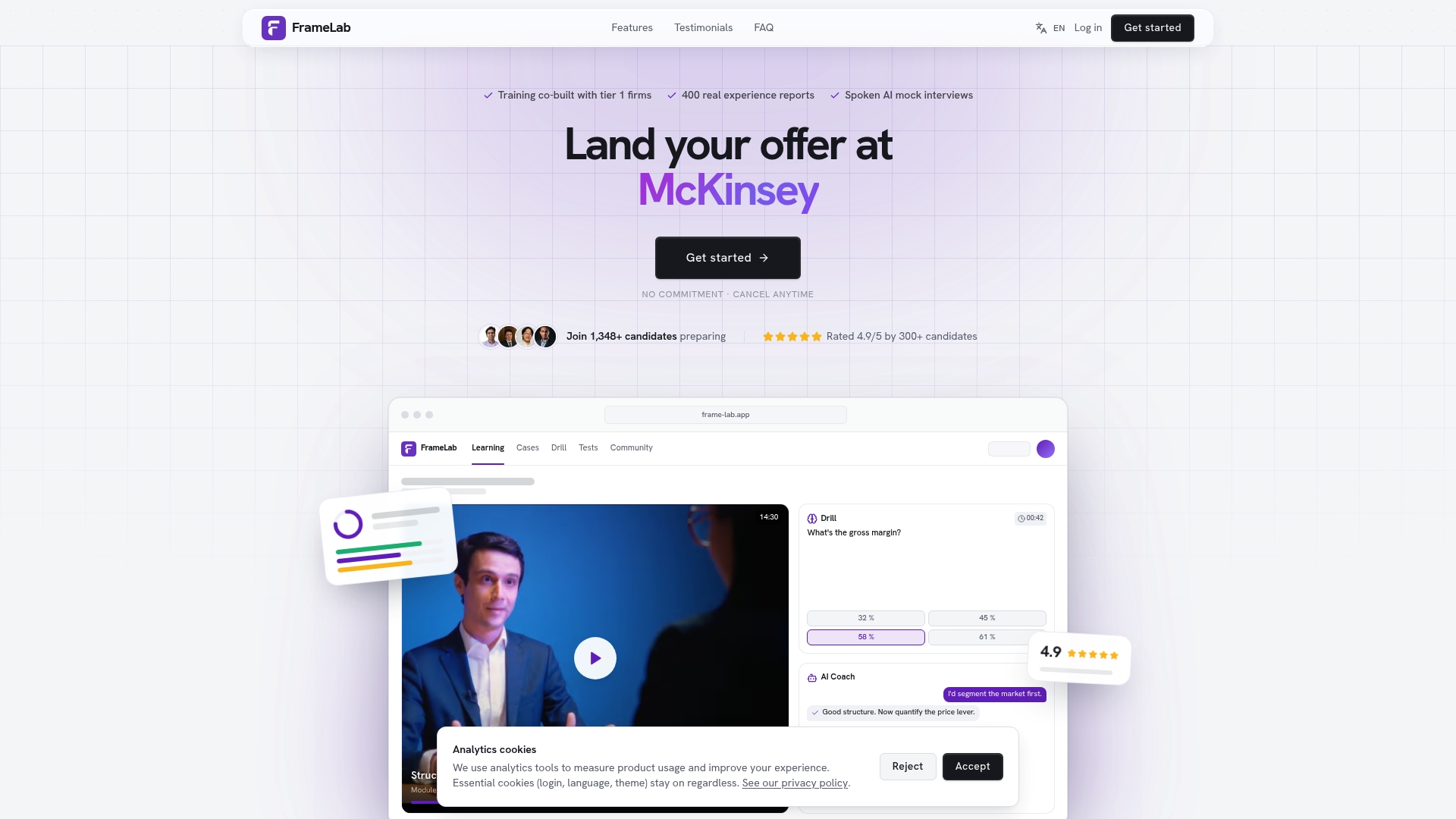
Frame-lab combines AI-driven mock interviews, over 400 curated experience reports from real consulting interviews, and a peer community for partner-based practice. The platform includes structured scoring rubrics, session tracking, and feedback tools that match the 1 - 5 scale approach described here. You can access consulting interview preparation resources and run partner sessions with built-in structure from day one. For candidates targeting McKinsey, BCG, or other top-tier firms, Frame-lab's personalized training paths adapt to your specific strengths and gaps, so every session moves you forward.
FAQ
What is an interview practice partner checklist?
An interview practice partner checklist is a structured list of preparation, execution, and feedback steps that two candidates follow together to simulate a real consulting interview. It covers environment setup, question delivery, scoring, and debrief protocols.
How long should a mock interview session last?
Standard mock sessions run 30 - 60 minutes to match real consulting interview lengths. Completing all logistics at least 12 - 24 hours before the session keeps the practice focused.
What should the feedback rubric include?
A strong rubric rates five dimensions on a 1 - 5 scale: communication clarity, structure, content quality, presence, and adaptability. Scores should be recorded independently before the debrief conversation begins.
Why should candidates record their mock interviews?
Recording reveals filler words, pacing problems, and eye contact weaknesses that neither the candidate nor the partner notices in real time. Reviewing the footage within 24 hours of the session produces the most useful self-assessment.
How much time should consulting candidates spend preparing?
For first-round consulting interviews, allocate 3 - 4 hours of total preparation. Final and panel rounds require 6 - 8 hours. Partner practice sessions count toward that total only when they follow a structured mock interview checklist.