
Master mental preparation for consulting interview day in 2026. Use proven strategies to overcome anxiety and perform at your best.
On this page▾
- What mental strategies are essential for interview day readiness?
- How to execute a step-by-step mental preparation routine on consulting interview day
- What common mental pitfalls occur on interview day and how to fix them?
- How do visualization and mental rehearsal boost interview performance?
- Key takeaways
- What I've learned about mental readiness that most guides get wrong
- How Frame-lab supports your consulting interview preparation
- FAQ
- What is mental preparation for a consulting interview?
- How early should I start my mental preparation routine on interview day?
- Does visualization actually improve interview performance?
- What should I do if I feel anxious right before the interview starts?
- Should I review case frameworks the morning of my consulting interview?
- Recommended
Mental preparation for consulting interview day is the deliberate practice of managing your cognitive and emotional state so you perform at your peak when it matters most. This goes beyond reviewing frameworks or practicing cases the night before. Psychological preparation for consulting interviews, sometimes called pre-interview mental conditioning in coaching circles, addresses the anxiety, mental blocks, and performance dips that knowledge alone cannot fix. The techniques covered here draw from neuroscience research and 2026 coaching frameworks to give you a concrete, timed routine you can follow from the moment you wake up to the moment you walk into the room.
What mental strategies are essential for interview day readiness?
The most effective interview day mental strategies combine physical regulation, cognitive priming, and environmental control. None of these require special equipment or hours of extra time. They require consistency and deliberate execution.
The table below maps the core techniques to their purpose and the tools you need.
| Technique | Purpose | What you need |
|---|---|---|
| Box breathing (4-4-4-4) | Lowers cortisol, activates calm | Timer or phone |
| Visualization | Primes neural pathways for key moments | Quiet space, 5 minutes |
| Affirmations | Reinforces process-oriented mindset | Written or memorized phrases |
| Grounding (5-4-3-2-1) | Resets nervous system to present moment | Your five senses |
| Power posing | Builds physical confidence before entry | Private space, 2 minutes |
Three prerequisites underpin all of these techniques. First, sleep. Sleep deprivation impairs verbal fluency and recall speed, both of which consulting interviewers test directly. Second, nutrition. Eat a balanced meal before the interview. Low blood sugar produces the same cognitive fog as anxiety. Third, logistics. Confirm your route, outfit, and materials the night before so your brain is not solving problems on interview morning.
On breathing: a 3-minute box breathing session using a 4-4-4-4 count reduces cortisol by approximately 15% and activates the parasympathetic nervous system. That is a measurable physiological shift you can produce in three minutes, with no tools.

Pro Tip: Time your caffeine intake carefully. Caffeine peaks in your bloodstream 45 - 60 minutes after consumption. If your interview is at 10:00 AM, drink your coffee at 8:45 AM, not 9:30 AM. A late caffeine spike raises cortisol and amplifies anxiety right when you need calm.
How to execute a step-by-step mental preparation routine on consulting interview day
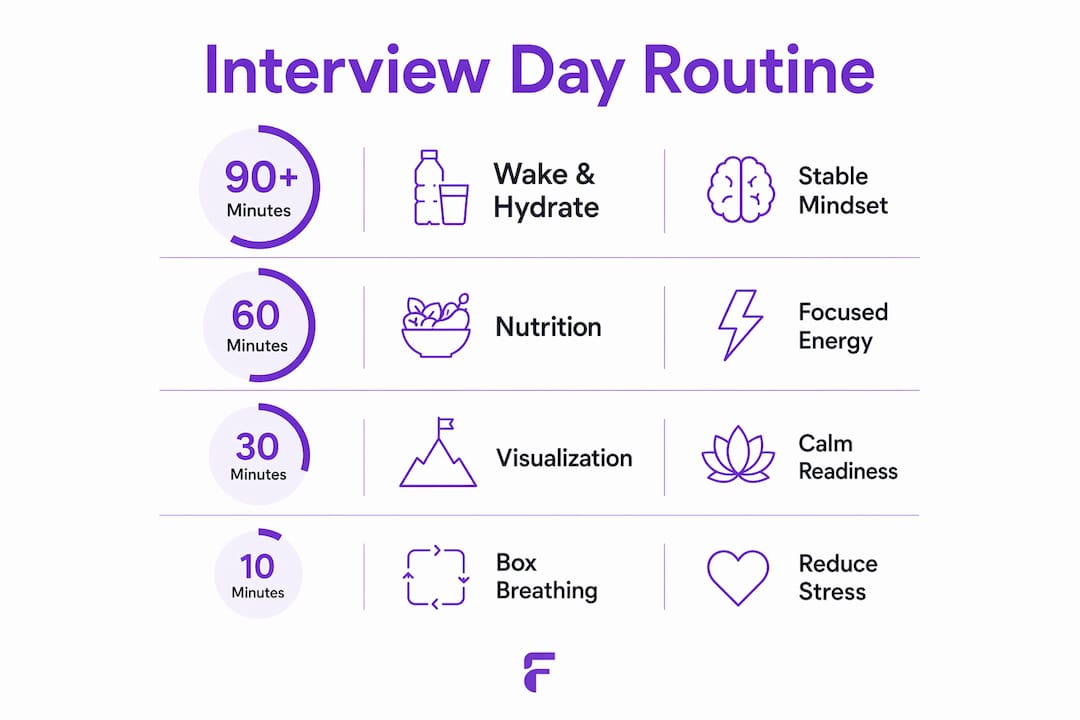
A timed morning routine removes decision fatigue and puts your brain in the right mode before you arrive. Follow this sequence on interview day.
- Wake up with margin. Set your alarm at least 90 minutes before you need to leave. Rushing produces cortisol. Margin produces composure.
- Hydrate immediately. Drink a full glass of water before coffee or food. Mild dehydration reduces concentration.
- Eat a real breakfast. Protein and complex carbohydrates sustain energy. Avoid heavy, greasy food that causes sluggishness.
- Review your affirmations. Read three to five written phrases focused on preparation and authenticity. Affirmations grounded in process ("I have prepared thoroughly and I respond well under pressure") outperform generic confidence statements. They reinforce a process-oriented mindset and reduce anxiety.
- Run your 5-minute visualization. Sit quietly and mentally rehearse the interview in segments: entering the room, the handshake, your opening answer, a tough case question, and your closing. The 5-minute mental rehearsal protocol segmented into key interview events optimally primes the brain before the real thing.
- Do 3 minutes of box breathing. Inhale for 4 counts, hold for 4, exhale for 4, hold for 4. Repeat for three minutes, starting 8 - 5 minutes before your interview begins.
- Rehearse your Entry Moment. Expert candidates practice the Entry Moment extensively because the first 30 seconds of an interview can determine up to 70% of the interviewer's final opinion. Stand, walk, greet, and sit as if you are already in the room.
- Arrive early and ground yourself. Use the 5-4-3-2-1 technique in the waiting area: name 5 things you see, 4 you can touch, 3 you hear, 2 you smell, 1 you taste. This resets your nervous system to the present moment.
Pro Tip: Stop all new studying by 6:00 PM the evening before your interview. Late-night cramming causes a 25% drop in working memory and decision-making ability. Your brain needs consolidation time, not more input.
The table below shows how the morning timeline maps to mental state goals.
| Time before interview | Activity | Mental state goal |
|---|---|---|
| 90+ minutes | Wake, hydrate, eat | Stable energy baseline |
| 60 minutes | Affirmations, light review | Confidence, calm focus |
| 30 minutes | Visualization, breathing | Primed, composed |
| 10 minutes | Entry Moment rehearsal | Ready, present |
| 5 minutes | Grounding technique | Fully present, settled |
What common mental pitfalls occur on interview day and how to fix them?
Most candidates who underperform on interview day do not fail because of missing knowledge. They fail because of avoidable mental mistakes. Recognizing these pitfalls before they happen is half the solution.
Common pitfalls and their fixes:
- Last-minute cramming. Reading new frameworks in the waiting room overloads working memory. Fix: close your notes 30 minutes before the interview starts and shift to breathing or grounding.
- Skipping the morning ritual. Candidates who skip their routine because they feel "ready enough" often freeze on the first question. Fix: treat the ritual as non-negotiable, not optional.
- Caffeine abuse. Two or three cups of coffee before a high-stakes interview spikes cortisol and produces jittery thinking. Fix: one cup, timed correctly (see the pro tip above).
- Negative self-talk. Thoughts like "I always blank on market sizing" activate the exact neural patterns you fear. Fix: replace them with process statements ("I structure my thinking out loud and that works").
- Comparing yourself to other candidates. Seeing confident-looking peers in the waiting room triggers social comparison anxiety. Fix: redirect attention inward with the 5-4-3-2-1 grounding method.
When an unexpected anxiety spike hits during the interview itself, you have one reliable tool: reframe nervousness as excitement. The physiological symptoms of anxiety and excitement are nearly identical. Telling yourself "I'm excited about this challenge" rather than "I'm nervous" produces measurably better cognitive performance in high-stakes situations. This is not a trick. It is a documented mindset shift that changes how your brain processes the same physical signal.
Pro Tip: If you blank on a question, say "Let me take a moment to structure my thinking." Silence feels longer to you than to the interviewer. A structured pause signals composure, not weakness.
The ability to fix mental blocks fast is a trainable skill, not a personality trait. Candidates who practice recovery techniques in mock interviews perform better when real pressure arrives.
How do visualization and mental rehearsal boost interview performance?
Visualization is not a motivational exercise. It is a neuroscience-backed technique that activates the same neural pathways as physical practice. When you mentally rehearse walking into an interview room and answering a case question, your brain fires the same motor and cognitive patterns it would during the real event.
Mental rehearsal protocols activate neural pathways for automatic responses to interview cues. This reduces the freeze response and builds poise under pressure. The result is that practiced candidates respond to tough questions with less hesitation, not because they memorized more, but because their brain has already run the scenario.
The comparison below shows how mental rehearsal differs from physical practice in a consulting prep context.
| Dimension | Physical rehearsal (mock interview) | Mental rehearsal (visualization) |
|---|---|---|
| Time required | 45 - 60 minutes per session | 5 minutes per session |
| Stress simulation | High (real-time pressure) | Moderate (controlled imagery) |
| Neural activation | Full cognitive and verbal load | Pathway priming only |
| Best use | Building retrieval muscles | Pre-interview state priming |
| Frequency | 3 - 5 times per week | Daily, including interview morning |
Both methods are necessary. Realistic mock interviews with distractions build retrieval muscles so you perform better under real pressure. Visualization primes your state for the specific day. Use mock interviews throughout your preparation period and visualization daily in the final week.
The shift from "Looking Up Answers Mode" to "Connecting Ideas Mode" is what visualization trains. When you mentally rehearse connecting a market sizing question to a structure you know, you practice fluid thinking rather than memory retrieval. That distinction is what separates candidates who sound natural from those who sound rehearsed.
Pro Tip: Run your visualization in first-person perspective, not as a spectator. See the room from your own eyes, feel the chair, hear the question. First-person visualization produces stronger neural priming than watching yourself from the outside.
Key takeaways
Effective mental preparation for consulting interview day combines timed rituals, breathing techniques, and visualization to shift your brain from anxiety to composure before you enter the room.
| Point | Details |
|---|---|
| Box breathing works fast | A 3-minute 4-4-4-4 session reduces cortisol by ~15% and activates calm within minutes. |
| The Entry Moment is decisive | The first 30 seconds shape up to 70% of the interviewer's impression, so rehearse it explicitly. |
| Stop studying the night before | Cutting new review by 6:00 PM protects working memory and prevents a 25% performance drop. |
| Reframe anxiety as excitement | Naming nervousness as excitement redirects the same physical signal toward better cognitive output. |
| Visualization primes neural pathways | A daily 5-minute mental rehearsal builds automatic responses that reduce freeze under real pressure. |
What I've learned about mental readiness that most guides get wrong
Most advice on psychological preparation for consulting treats confidence as the goal. It is not. Composure is the goal. Confidence is a feeling; composure is a state you can produce deliberately through ritual.
I've watched candidates who knew every framework walk into McKinsey and BCG interviews and blank on the first question. I've also watched candidates with thinner technical preparation perform exceptionally because they had trained their nervous system, not just their case knowledge. The difference was always the same: disciplined pre-interview rituals versus winging it and hoping motivation would carry them through.
The insight that changed how I think about this is the distinction between "Connecting Ideas Mode" and "Looking Up Answers Mode." Candidates who cram the night before arrive in retrieval mode. Their brain is scanning for stored answers. Candidates who stop studying early and run a proper morning ritual arrive in synthesis mode. Their brain connects what they know to what they hear. That is the mode consulting interviewers reward.
Mental readiness is not a personality trait. It is a preparation skill you build through consistent practice. If you treat the morning ritual as seriously as you treat case practice, you will enter the room as a different candidate.
How Frame-lab supports your consulting interview preparation
Frame-lab is built specifically for candidates preparing for top-tier consulting interviews at firms like McKinsey and BCG. The platform combines AI-driven mock interviews, over 400 curated experience reports, and structured training paths that address both case skills and mental readiness.
If you want to put the techniques in this article into practice with real feedback, Frame-lab's interview preparation plans include structured mock interview sessions designed to build the retrieval muscles and composure that interview day demands. The training platform also offers interactive drills with direct feedback so you can measure your progress and identify the specific gaps to close before your interview date.
FAQ
What is mental preparation for a consulting interview?
Mental preparation for a consulting interview is the deliberate practice of regulating your cognitive and emotional state before and during the interview. It includes techniques like box breathing, visualization, grounding, and affirmations to reduce anxiety and sharpen focus.
How early should I start my mental preparation routine on interview day?
Start your routine at least 90 minutes before you need to leave. This gives you time for breakfast, affirmations, visualization, and breathing without rushing, which itself raises cortisol.
Does visualization actually improve interview performance?
Yes. Visualization provides a measurable boost in performance by priming the brain to respond instinctively under pressure. A 5-minute daily protocol covering key interview moments is enough to produce this effect.
What should I do if I feel anxious right before the interview starts?
Use the 5-4-3-2-1 grounding technique: name 5 things you see, 4 you can touch, 3 you hear, 2 you smell, and 1 you taste. Situational grounding resets the nervous system to the present moment and reduces the freeze response.
Should I review case frameworks the morning of my consulting interview?
No. Stop new review by 6:00 PM the night before. On interview morning, focus on your mental routine. Overloading your brain with last-minute review impairs working memory and increases anxiety rather than improving recall.