
Discover essential mock interview feedback types for consulting candidates. Learn how structured critiques can boost your performance and confidence.
On this page▾
- 1. What are the key mock interview feedback types you should expect?
- 2. How structured frameworks like BARS and 10-metric scoring improve feedback quality
- 3. Common pitfalls of mock interview feedback and how to avoid them
- 4. How to interpret feedback and build a focused practice plan
- 5. How to choose the right feedback type for your preparation stage
- Key takeaways
- What I have learned about feedback that most candidates ignore
- Frame-lab's structured approach to consulting mock interview prep
- FAQ
- What are the main types of mock interview feedback?
- How many feedback points should I focus on per session?
- What is BARS in mock interview evaluation?
- Is delivery feedback more important than content feedback?
- How many mock sessions do I need before feedback becomes reliable?
- Recommended
Mock interview feedback types are defined as the distinct categories of structured critique that evaluators use to assess a candidate's performance across content, delivery, structure, and behavior. For consulting candidates targeting firms like McKinsey and BCG, the quality of feedback you receive directly determines how fast you improve. Vague impressions waste your preparation time. Structured, evidence-based feedback tied to specific behaviors gives you drillable next actions. Frameworks like BARS (Behaviorally Anchored Rating Scales), the STAR method, and 10-metric scoring systems are the standard tools that separate useful feedback from noise. Understanding which feedback categories to seek and how to act on them is the fastest path to reducing interview anxiety and building real confidence.
1. What are the key mock interview feedback types you should expect?
The six core feedback categories in consulting mock interview assessment are content, delivery, structure, behavioral, role alignment, and evidence quality. Each one targets a different dimension of your performance. Knowing which category a piece of feedback belongs to helps you prioritize your practice.
Content feedback addresses whether your answer actually answers the question. A confident vague answer is still vague; content clarity is more valuable than delivery polish because it reflects the substance of your thinking and directly influences hiring decisions.

Delivery feedback covers vocal pacing, eye contact, filler words, and body language. These signals matter, but they should never outweigh content. A candidate with strong problem-solving and weak communication advances at a 96% rate in data from 100,000 interview sessions. That rate drops sharply when the situation is reversed.
Structure feedback evaluates how you organize your answer. The STAR method (Situation, Task, Action, Result) is the standard framework for behavioral questions. Evaluators flag candidates who spend too long on setup, which signals rambling and weak answer architecture.
Behavioral feedback translates impressions into observable actions. Saying "you seemed nervous" is not useful on its own. Saying "you used filler words 11 times in 90 seconds" gives you something to practice.
Role alignment feedback checks whether your examples and language match the consulting context. Generic business stories score lower than examples that show judgment, client focus, or structured thinking.
Evidence quality feedback assesses whether your answers include specific, verifiable details. Vague claims without data or named outcomes weaken your credibility with evaluators.
Pro Tip: Before your next mock session, ask your evaluator to label each comment by category. This one habit turns a general debrief into a structured improvement map.
2. How structured frameworks like BARS and 10-metric scoring improve feedback quality
Structured feedback frameworks produce more reliable and consistent evaluations than open-ended impressions. BARS rubrics define observable behaviors at each score level, eliminating subjective guesswork. A score of 4 means sustained eye contact and complete sentences. A score of 2 means frequent gaze aversion and one-word responses. Every evaluator uses the same behavioral anchors, so your scores are comparable across sessions.
A 10-metric structured framework goes further by scoring distinct dimensions separately: clarity, evidence quality, role alignment, vocal pacing, structure, and more. This granularity shows you exactly where you are strong and where you are losing points. A single overall score tells you nothing about which skill to practice next.
Simplified 3-category rubrics work well for quick peer evaluations. You can score content, structure, and delivery on a 1 - 5 scale with one behavioral anchor per level. This format is faster to complete and still produces signal-rich feedback.
Immediate feedback (delivered right after the session) captures specific moments while they are fresh. Delayed feedback (written and reviewed 24 hours later) allows for more considered analysis. The best preparation programs use both. Immediate feedback addresses delivery and structure; delayed feedback addresses content depth and role alignment.
Pro Tip: Ask your evaluator to score you on a BARS rubric before giving verbal comments. Seeing the numbers first removes defensiveness and helps you absorb the verbal feedback more clearly.
| Feedback method | Best for | Limitation |
|---|---|---|
| BARS rubric | Consistent, comparable scores across sessions | Requires evaluator training to apply correctly |
| 10-metric scoring | Granular skill diagnosis | Takes longer to complete per session |
| 3-category rubric | Fast peer feedback | Less diagnostic depth |
| Open-ended debrief | Nuanced qualitative insight | High variability between evaluators |
3. Common pitfalls of mock interview feedback and how to avoid them
The most common feedback mistake is prioritizing delivery over content. Delivery is visible and easy to comment on. Content requires deeper analysis. Candidates who receive mostly delivery feedback leave sessions without knowing whether their actual answers are strong enough to get an offer.
Watch for these specific pitfalls:
- Affect-only feedback. Comments like "you seemed nervous" or "you came across as unsure" are not drillable. Behavior-based feedback transforms those impressions into countable actions, such as tracking filler word frequency or measuring pause length.
- Feedback overload. Capping improvement points to 2 - 3 areas per session protects your working memory and improves retention. More than three points per session reduces the chance that you act on any of them.
- Ignoring role-critical skills. If every evaluator flags weak evidence quality but you keep focusing on vocal pacing, you are optimizing the wrong variable. Consistent themes across sessions point to real skill gaps.
- Accepting outlier feedback too quickly. A single session has high variance. One evaluator's strong reaction to a minor habit does not mean you need to rebuild your approach. Tracking consistent issues across three mock sessions separates true gaps from one-off errors.
- Skipping self-reflection. The debrief gap is the absence of self-analysis before receiving evaluator feedback. Candidates who skip five to ten minutes of self-reflection before the debrief are more defensive and retain less of what they hear.
Understanding why preparation reduces interview fear starts with recognizing that structured, targeted feedback is itself a form of preparation. Each session with clear feedback categories builds your mental model of what good looks like.
4. How to interpret feedback and build a focused practice plan
Effective feedback interpretation starts with evidence. Highly effective feedback specifies exact transcript moments, avoids generic advice, and links each critique to a targeted next action. When your evaluator says "your Result in question three was vague," you have a specific moment to revisit and a clear drill to run.
Use this process after each session:
- Self-reflect first. Spend five to ten minutes writing down what you thought went well and what felt weak before reading or hearing evaluator comments.
- Categorize each piece of feedback. Sort comments into content, delivery, structure, behavioral, role alignment, and evidence quality.
- Weight by frequency. Flag any issue that appears in two or more sessions. That pattern is your highest-priority drill target.
- Apply STAR weighting. Candidates often give equal weight to all STAR parts. Evaluators recommend spending the majority of your answer on Action and Result, with Situation and Task kept brief. If feedback flags long setups, your drill is to cut Situation to two sentences.
- Set a vocal rate target. A vocal rate of 140 - 160 words per minute and a two-second pause before answering reduce nervousness signals and improve perceived authority. Use a stopwatch during practice to calibrate.
- Build a drill log. Record each feedback point, the session it came from, and the specific drill you ran in response. Review the log before your next session.
Pro Tip: Record your mock sessions and review the transcript yourself before the debrief. You will catch at least two issues your evaluator missed, and you will arrive at the debrief with specific questions instead of passive listening.
Consulting interview preparation benefits from managing nerves through structured practice. When you know exactly what to practice, anxiety drops because uncertainty drops.
5. How to choose the right feedback type for your preparation stage
The right feedback type depends on where you are in your preparation. Early-stage candidates need broad diagnostic feedback across all six categories. Advanced candidates need deep, evidence-specific feedback on their two or three weakest dimensions.
Use these criteria to guide your choice:
- Peer feedback works well for structure and delivery checks. Peers can flag rambling, filler words, and unclear transitions. They are less reliable for role alignment and evidence quality, which require consulting-specific knowledge.
- Expert or coach feedback is best for content depth, role alignment, and judgment signals. A former consultant can tell you whether your answer reflects the thinking style firms actually hire for.
- AI-driven feedback tools provide consistent, immediate scoring across multiple metrics. They are particularly useful for tracking vocal pacing, filler word frequency, and STAR structure adherence across many sessions.
- Rubric-aligned platforms give you objective scores that are comparable across sessions. Frame-lab's consulting interview training uses structured evaluation frameworks built around real consulting interview criteria, so your scores reflect actual hiring standards.
| Preparation stage | Recommended feedback type | Primary focus |
|---|---|---|
| Early (first 1 - 3 sessions) | Broad diagnostic, peer or AI | All six categories |
| Mid (4 - 8 sessions) | Expert feedback, rubric-aligned | Content, role alignment, evidence |
| Advanced (9+ sessions) | Targeted expert, transcript-based | Weakest 2 - 3 dimensions only |
Pro Tip: Before any external feedback session, score yourself on a simple 1 - 5 rubric across content, structure, and delivery. Comparing your self-score to your evaluator's score reveals blind spots faster than any other method.
Choosing between immediate and delayed feedback also matters. Immediate feedback is best for delivery and structure. Delayed, written feedback is best for content and role alignment, where the evaluator needs time to assess the depth and accuracy of your reasoning.
Key takeaways
Structured, evidence-based mock interview feedback tied to specific behavioral categories is the most reliable method for improving consulting interview performance and reducing preparation anxiety.
| Point | Details |
|---|---|
| Six feedback categories matter | Content, delivery, structure, behavioral, role alignment, and evidence quality each target a different skill. |
| BARS and 10-metric scoring outperform vague ratings | Behaviorally anchored rubrics produce consistent, comparable scores across sessions and evaluators. |
| Cap feedback to 2 - 3 points per session | Exceeding this limit overloads working memory and reduces the chance you act on any single point. |
| Self-reflect before the debrief | Five to ten minutes of self-analysis before evaluator feedback reduces defensiveness and improves retention. |
| Track patterns across three sessions | Consistent issues across multiple sessions identify true skill gaps; single-session errors have high variance. |
What I have learned about feedback that most candidates ignore
By Nahïm
Most candidates treat mock interview feedback as a report card. They read it, feel good or bad about the score, and move on. That is the wrong frame entirely.
The candidates I have seen improve fastest treat each feedback session as a data collection exercise. They are not looking for validation. They are looking for the two or three specific behaviors that are costing them points with every evaluator, every time.
The biggest mistake I observe is over-indexing on delivery feedback because it is the most visible and the easiest to act on. Slowing down your speech and making eye contact are real improvements. But a confident, well-paced answer that lacks evidence or role alignment still fails. Content clarity is the variable that actually drives hiring decisions, and it is the one most candidates under-practice.
The second mistake is accepting feedback without categorizing it. When you sort every comment into content, structure, delivery, or evidence quality, patterns emerge quickly. You stop feeling like you have ten things to fix and start seeing that you really have one or two recurring gaps.
AI and human feedback models are converging in useful ways. AI tools give you consistent, immediate scoring on delivery and structure. Human experts give you the judgment call on whether your thinking reflects consulting-level analysis. The combination is more powerful than either alone. Frame-lab's approach of pairing structured rubrics with real interview experience reports reflects exactly this direction.
My honest recommendation: run at least three mock sessions before drawing any conclusions about your weak areas. One session is noise. Three sessions are signal.
Frame-lab's structured approach to consulting mock interview prep
Preparing for McKinsey or BCG requires more than generic practice. You need feedback tied to real consulting interview standards, not broad career advice.
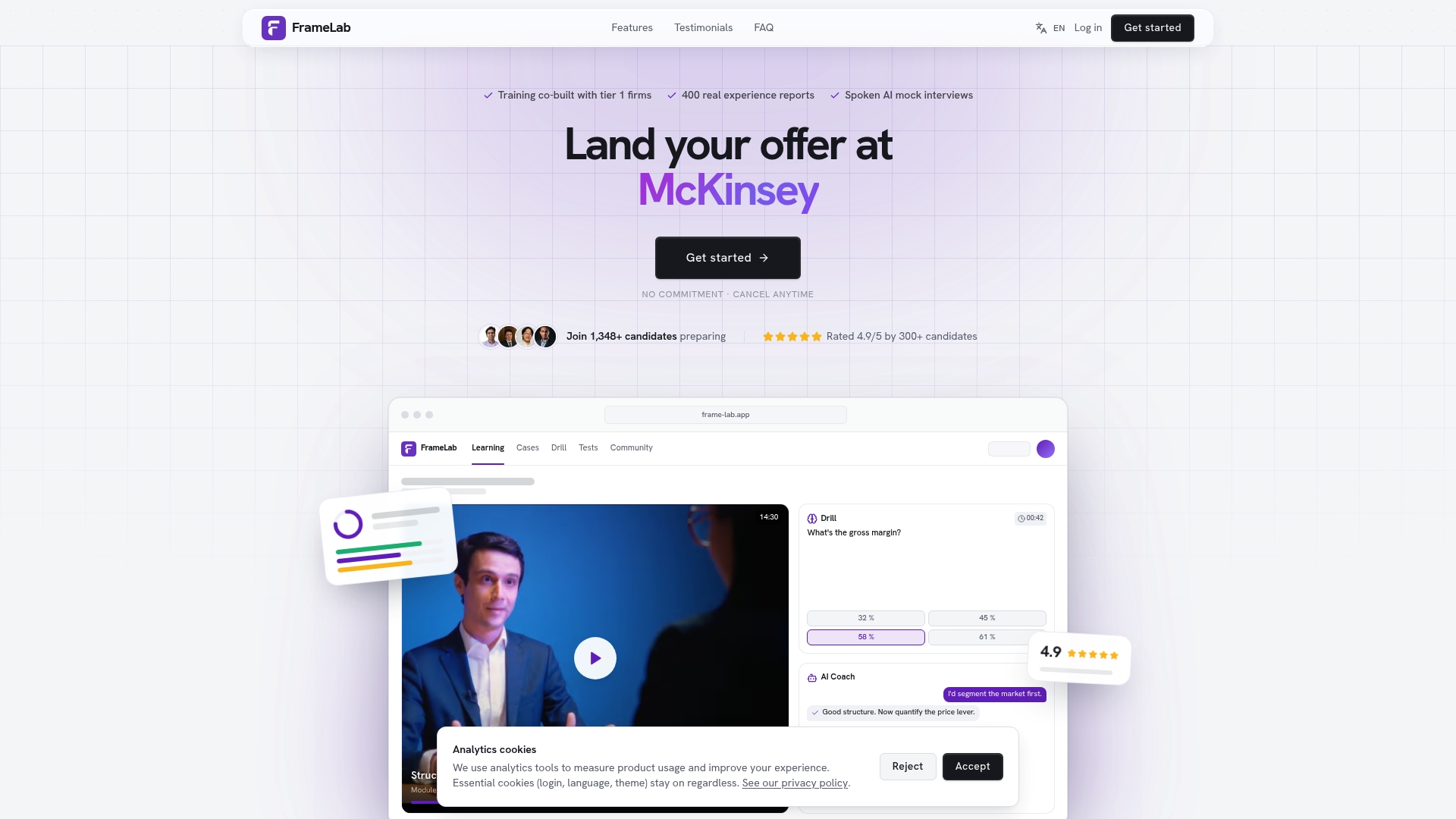
Frame-lab is built specifically for consulting candidates. The platform combines AI-driven mock interviews, rubric-based scoring, and over 400 curated experience reports from real consulting interviews. Every feedback mechanism on Frame-lab is aligned to the same criteria that top firms use to evaluate candidates. You can track your scores across sessions, identify recurring gaps, and work through targeted drills on core consulting frameworks and FIT interview preparation. If you are serious about landing an offer at a top-tier firm, structured feedback is not optional. Frame-lab gives you the system to make every mock session count.
Start your consulting prep on Frame-lab
FAQ
What are the main types of mock interview feedback?
The six main types are content, delivery, structure, behavioral, role alignment, and evidence quality. Each targets a distinct dimension of interview performance and requires different drills to improve.
How many feedback points should I focus on per session?
Cap your focus to 2 - 3 improvement points per session. Exceeding that number overloads working memory and reduces how much you actually retain and act on.
What is BARS in mock interview evaluation?
BARS stands for Behaviorally Anchored Rating Scales. It defines specific observable behaviors at each score level, so evaluators apply consistent criteria rather than subjective impressions.
Is delivery feedback more important than content feedback?
Content feedback is more important. Data from 100,000 interview sessions shows that strong problem-solving with weak communication advances candidates at a 96% rate, while the reverse produces much lower success rates.
How many mock sessions do I need before feedback becomes reliable?
Track patterns across at least three sessions before drawing conclusions. Single-session feedback has high variance and should not trigger major changes to your preparation approach.