
Discover why case interviews cause stress and learn strategies to tackle cognitive overload. Prepare effectively and boost your performance.
On this page▾
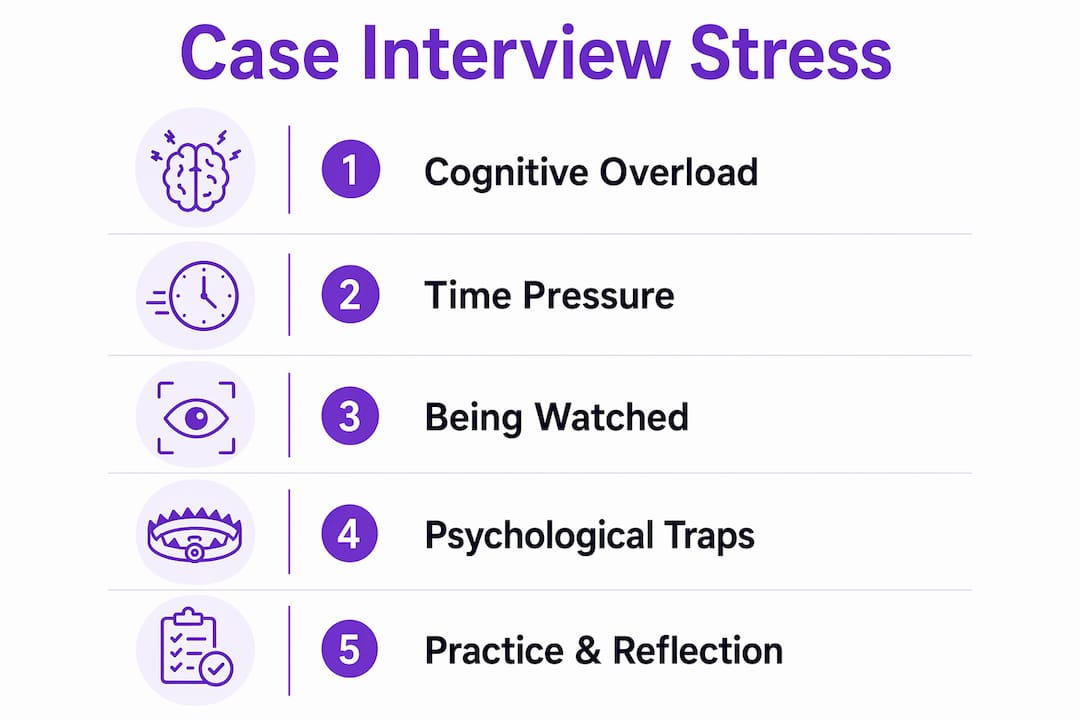
- Why case interviews cause stress: the cognitive overload problem
- How does time pressure make case interview anxiety worse?
- Why does being watched make case interview pressure worse?
- What psychological traps make case interview stress spiral?
- Key Takeaways
- My honest read on what actually drives case interview stress
- Frame-lab builds the skills that reduce case interview pressure
- FAQ
- Why are case interviews more stressful than regular interviews?
- Does stress actually hurt your case interview performance?
- Why do candidates keep ruminating after a case interview?
- What is the most common psychological trap in case interviews?
- How do you reduce stress in case interviews through preparation?
- Recommended
Case interview stress is defined as the cognitive and emotional overload that occurs when candidates must solve complex business problems, communicate clearly, and perform under strict time limits while being evaluated in real time. This combination is not just uncomfortable. It is neurologically taxing in ways that generic interview prep rarely addresses. Understanding why case interviews cause stress gives you a real advantage. You stop fighting a vague feeling and start targeting the specific mechanisms that hurt your performance. This guide breaks down those mechanisms using research from cognitive psychology and social anxiety science, so you can prepare with precision.
Why case interviews cause stress: the cognitive overload problem
Case interviews function as dual-task situations that tax your limited cognitive resources because they demand simultaneous reasoning and verbal communication. This is not a metaphor. Cognitive science calls this the bottleneck effect: your brain can only route a finite amount of mental bandwidth through its processing channels at one time. When two demanding tasks compete for the same channel, accuracy drops and reaction time slows.
In a case interview, you are doing at least three things at once. You are building a structured argument in your head, translating that argument into spoken words, and monitoring the interviewer's reactions for feedback. Each of those tasks draws from the same pool of working memory. The result is that none of them gets your full attention.

Research on dual-task interference shows that multitasking strategies vary between candidates. Faster, non-overlapping strategies tend to be less accurate than overlapping ones. Candidates with higher cognitive flexibility tend to use parallel processing, which is more efficient but harder to develop without deliberate practice. This is why candidates who have rehearsed extensively under realistic conditions consistently outperform those who have only studied frameworks on paper.
The stress you feel is not a character flaw. It is a predictable output of asking your brain to do too much at once without enough practice routing those tasks efficiently.
- Working memory overload: Holding a hypothesis in mind while speaking out loud depletes the same cognitive resource.
- Communication bottleneck: Translating structured thinking into clear speech in real time is a separate skill from the thinking itself.
- Monitoring cost: Watching the interviewer for cues while reasoning adds a third competing demand.
- Practice gap: Without timed repetition, the brain never learns to coordinate these tasks smoothly.
Pro Tip: Practice speaking your reasoning out loud while solving problems, not just thinking through them silently. This trains the specific coordination your brain needs to handle the dual-task load of a real case interview.
How does time pressure make case interview anxiety worse?
Time pressure does not just add urgency. It chemically changes how your brain processes information. Research shows that stress alone does not reduce decision quality, but when stress combines with time pressure, decision quality falls sharply. In one study, performance dropped from 83% to 57% under the combined condition. That is a drop of about 5 percentage points on average, and it represents the difference between a strong recommendation and a wrong answer.
The mechanism is attention allocation. Under time pressure, your brain shifts to a faster, shallower scanning mode. You spend less time examining information before moving on. You test fewer hypotheses. You are more likely to accept the first plausible answer rather than the best one.
The stress-plus-time combination also increases pessimism. Candidates under this condition show a marked increase in negative responses, meaning they are more likely to dismiss a line of reasoning prematurely or conclude that a case is unsolvable. This is not a rational judgment. It is a stress artifact. Recognizing it as such is the first step to countering it.
Key stat: Decision quality fell from 83% to 57% when stress and time pressure were combined. Stress alone did not produce this drop. Time pressure is the amplifier.
Time pressure also punishes candidates who search too broadly for the perfect framework. Prioritizing likely drivers early and using the interviewer's cues as signals is the most effective counter. It narrows the cognitive search space before time anxiety sets in.
Pro Tip: Set a personal time limit of 60 - 90 seconds for structuring your initial response. Committing to a framework early, even an imperfect one, protects your decision quality better than searching for the ideal approach under pressure.
That reflex comes with repetition, on cases played as in a real interview.
Why does being watched make case interview pressure worse?
Being evaluated by another person activates social anxiety mechanisms that are distinct from the cognitive load of the case itself. Research shows that being observed disrupts task execution not by distracting your attention but by imposing an outer monitoring loop that interferes with smooth, fluent performance. You become self-conscious about your own process, which breaks the automaticity you need to perform well.
This effect is stronger for candidates who experience fear of positive evaluation, not just fear of negative judgment. Fear of positive evaluation means anxiety about being seen as competent, because competence raises expectations for future performance. Both forms of evaluation fear feed the same stress response.
The social anxiety component does not end when the interview ends. Research on post-event processing shows that candidates with higher fear of evaluation engage in prolonged negative rumination about their performance, sometimes for weeks after a single interview. This rumination maintains anxiety and shapes how they approach the next interview, often making preparation feel heavier than it needs to be.
"Social anxiety is maintained not just by the event but by how people think about it afterward, prolonging stress well beyond the interview room."
Three specific patterns define this post-interview stress cycle:
- Replaying mistakes: Mentally reviewing every moment where you hesitated or misspoke, amplifying their significance.
- Catastrophizing outcomes: Treating one poor answer as evidence of global incompetence rather than a single data point.
- Avoidance behavior: Reducing practice frequency to avoid the discomfort of being evaluated, which weakens preparation over time.
Understanding this cycle lets you interrupt it. Structured post-interview reflection that focuses on specific improvements rather than general self-criticism is a direct counter to rumination.
What psychological traps make case interview stress spiral?
The most common stress spiral in case interviews starts with ambiguity. When the case prompt does not map cleanly onto a memorized framework, many candidates freeze or guess. Research confirms that top students often fail case interviews because of a surface-level approach: they search for the framework that fits rather than generating and testing hypotheses quickly.
This is a critical distinction. Framework matching is a passive strategy. Hypothesis testing is an active one. Under time pressure and stress, passive strategies collapse because they depend on a match that may not exist. Active strategies hold up because they generate forward momentum regardless of whether the case fits a familiar pattern.
The following traps are the most common reasons stress spirals rather than stabilizes during a case:
- Broad framework searching: Spending the first two minutes mentally cycling through every framework you know instead of committing to the most likely driver. This wastes time and triggers the time-pressure stress response.
- Premature guessing: Jumping to a conclusion early to relieve the discomfort of uncertainty. This feels like progress but usually produces a wrong answer that the interviewer will challenge, adding more stress.
- Ignoring interviewer cues: Treating the interviewer as a passive observer rather than a source of directional signals. Interviewers often redirect candidates toward the right area. Missing those cues extends the search and deepens anxiety.
- Perfectionism under pressure: Waiting to speak until you have a complete answer. Consulting interviewers expect structured thinking in progress, not a finished product. Silence reads as confusion, not depth.
- Catastrophizing a single misstep: Treating one wrong calculation or missed branch as a signal that the entire case is lost. This pulls cognitive resources away from recovery and toward self-monitoring.
The antidote to each of these traps is the same: practice under conditions that replicate the actual stress environment. Reading about frameworks does not build the mental reflexes needed to avoid these traps. Timed, evaluated practice does. Reviewing case interview strategies that address these specific failure modes gives you a concrete starting point.
Key Takeaways
Case interview stress is not random anxiety. It is the predictable result of cognitive overload, time pressure, and social evaluation combining to exceed your brain's processing capacity.
| Point | Details |
|---|---|
| Cognitive overload is the root cause | Simultaneous reasoning, speaking, and monitoring deplete working memory and reduce accuracy. |
| Time pressure is the amplifier | Stress alone does not hurt decision quality, but stress combined with time pressure drops performance significantly. |
| Social evaluation extends stress | Being watched disrupts fluent performance, and post-event rumination prolongs anxiety after the interview ends. |
| Psychological traps worsen spirals | Framework searching, premature guessing, and perfectionism under pressure are the most common performance killers. |
| Practiced repetition is the fix | Timed, evaluated mock interviews build the cognitive coordination that reduces stress responses over time. |
My honest read on what actually drives case interview stress
I have watched hundreds of candidates prepare for McKinsey and BCG interviews, and the pattern is consistent. The ones who struggle most are not the ones who know the least. They are the ones who have prepared in the wrong environment. They have studied frameworks in silence, alone, without a clock running and without anyone watching. Then they walk into a live case and encounter a completely different cognitive experience.
The research on dual-task interference and time pressure confirms what I have seen directly. Your brain needs to practice coordinating reasoning and speaking at the same time, under time constraints, with someone evaluating you. That specific combination is what builds the neural pathways that make stress manageable. No amount of silent reading builds those pathways.
The post-event rumination finding also resonates with me. Candidates who spiral after a bad mock interview often reduce their practice frequency to avoid the discomfort. That is the worst possible response. The discomfort is the training signal. A bad mock interview that you analyze carefully is worth more than ten smooth ones where nothing challenged you.
My practical advice: treat every mock interview as a stress inoculation session, not a performance test. Your goal is not to get it right. Your goal is to get comfortable operating under the exact conditions that currently feel overwhelming. That shift in framing changes everything about how you prepare.
Frame-lab builds the skills that reduce case interview pressure
Case interview anxiety does not disappear through more reading. It decreases through structured, evaluated practice that replicates the real pressure environment.
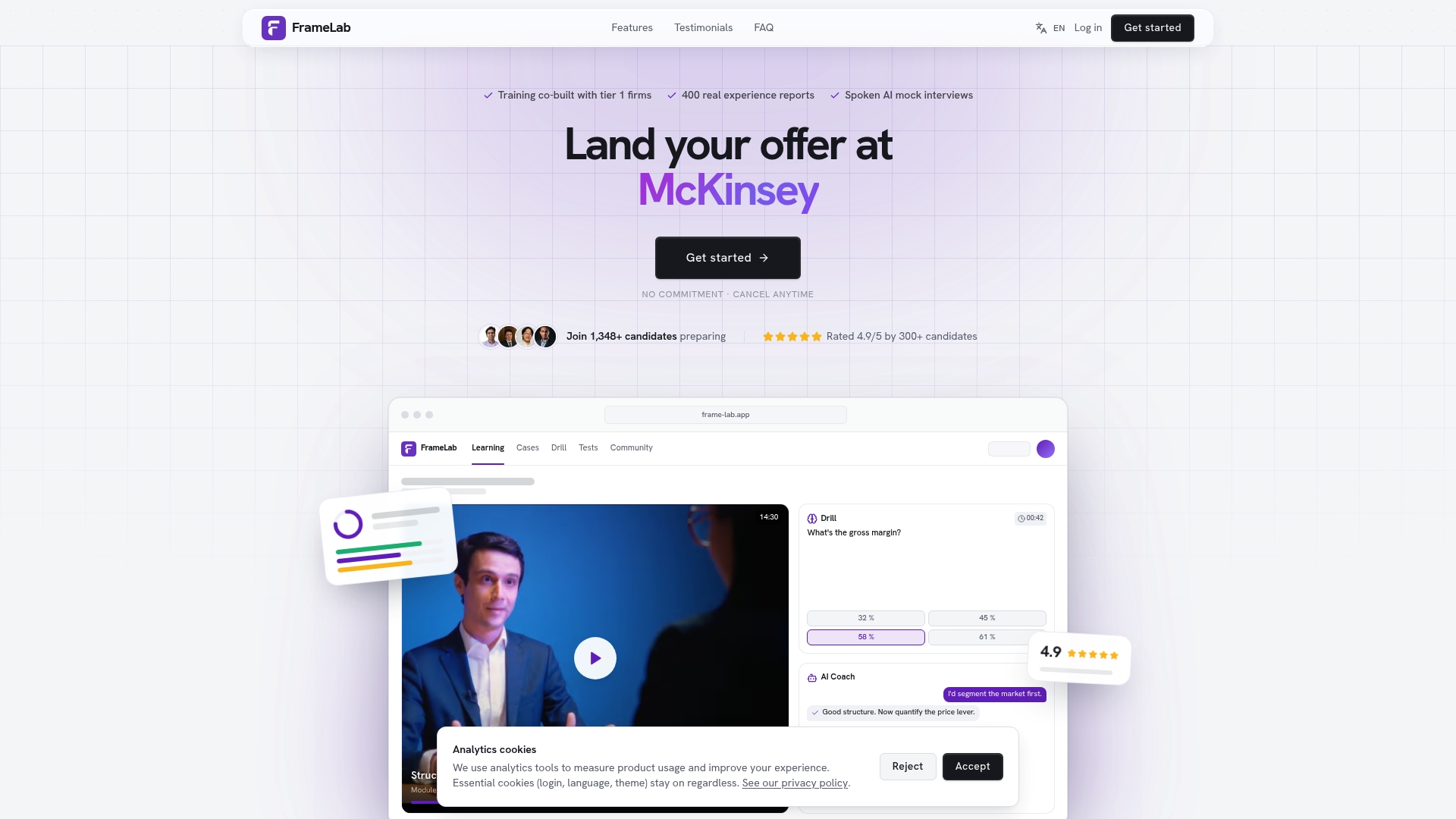
Frame-lab is built specifically for candidates preparing for McKinsey, BCG, and other top-tier consulting firms. The platform combines AI-driven mock interviews, over 400 curated experience reports from real candidates, and a peer community for live practice. Every session is designed to build the cognitive coordination and decision quality that stress and time pressure erode. You get personalized feedback on your specific weaknesses, not generic tips. Start your preparation with a platform that trains the exact skills this article describes, or compare your current prep approach against Frame-lab's consulting training program to see where the gaps are.
FAQ
Why are case interviews more stressful than regular interviews?
Case interviews require simultaneous problem-solving, verbal communication, and performance under evaluation, which creates a cognitive bottleneck that standard interviews do not. The combination of time pressure and social evaluation activates distinct stress mechanisms that compound each other.
Does stress actually hurt your case interview performance?
Stress alone does not significantly reduce decision quality, but stress combined with time pressure causes a measurable drop in performance. Research shows decision quality can fall from 83% to 57% under the combined condition.
Why do candidates keep ruminating after a case interview?
Post-event processing driven by fear of evaluation causes candidates to replay their performance negatively for extended periods. Research shows this rumination can persist for weeks and directly increases anxiety before future interviews.
What is the most common psychological trap in case interviews?
Searching too broadly for the right framework instead of generating and testing a small set of hypotheses quickly is the most common trap. It wastes time, triggers the time-pressure stress response, and often leads to premature guessing.
How do you reduce stress in case interviews through preparation?
Timed, evaluated practice that replicates the real interview environment is the most effective method. Practicing speaking your reasoning out loud under time constraints builds the cognitive coordination that reduces the stress response over repeated sessions.