
Learn how to replicate real consulting interview conditions with effective simulations. Master behavioral and case analysis for success.
On this page▾
- What does it take to replicate real consulting interview conditions?
- Required tools and setup at a glance
- How do you structure and run a full mock consulting interview session?
- What common mistakes undermine authentic interview practice?
- Authentic vs. inauthentic practice: a direct comparison
- How do you use feedback to keep improving your performance?
- Key Takeaways
- What I have learned from running hundreds of mock sessions
- How Frame-lab supports your consulting interview preparation
- FAQ
- What is the difference between a content drill and a performance drill?
- How long should a full mock consulting interview session be?
- Why does McKinsey's PEI matter as much as the case?
- Should I practice interviewer-led and candidate-led cases separately?
- How often should I record my mock sessions?
- Recommended
Replicating real consulting interview conditions means practicing both case analysis and behavioral questioning under timed, professional settings that mirror live interviews. Most candidates prepare by drilling frameworks and math in isolation. That approach leaves a critical gap: the actual interview combines cognitive pressure, interpersonal assessment, and time constraints all at once. Closing that gap requires what practitioners call "consulting interview simulation," a structured method that trains your nervous system, not just your knowledge. This guide shows you exactly how to build that simulation, run it end to end, and use feedback to improve before the real thing.
What does it take to replicate real consulting interview conditions?
Authentic consulting interview simulation requires three layers: the right environment, the right tools, and the right sequence. Most candidates get one of the three right. Getting all three right is what separates candidates who feel calm on interview day from those who freeze.
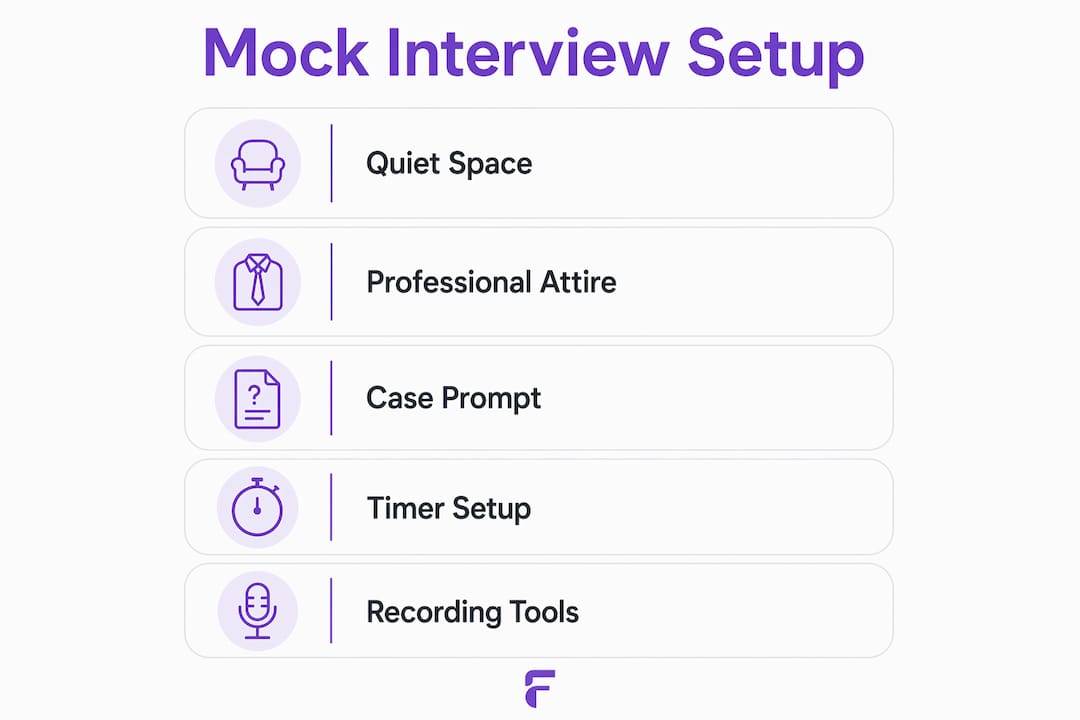
The environment means a quiet space, a camera, a microphone, and professional attire. This is not cosmetic. Rehearsing with a camera and professional dress creates physiological cues that help your nervous system treat practice as real. Your body learns to perform under those conditions, so the actual interview feels familiar rather than foreign.

The tools are a case prompt, any exhibits or data tables included in the prompt, and a timer set with no-restart rules. Using a strict timer with no pauses mimics the pacing of a live round and trains natural time management. Skipping the timer is the single most common shortcut that undermines otherwise solid preparation.
The sequence matters because real consulting interviews at firms like McKinsey, BCG, and Bain do not separate case and behavioral components. They run together. McKinsey pairs the case with the Personal Experience Interview (PEI), which probes leadership, motivation, and impact, in the same session. Your mock sessions must do the same.
Required tools and setup at a glance
| Component | Purpose | Minimum standard |
|---|---|---|
| Timer | Enforce real pacing | Set to case length, no restarts |
| Case prompt and exhibits | Simulate actual materials | Use real or realistic prompts |
| Camera and microphone | Mirror virtual or in-person format | Laptop camera is sufficient |
| Professional attire | Trigger performance mindset | Business casual or above |
| Recording software | Enable self-review | Any screen recorder works |
| Practice partner or AI tool | Simulate interviewer interaction | Peer, coach, or AI platform |
Pro Tip: Set your phone to "Do Not Disturb" and close all browser tabs before starting a mock session. Interruptions break the pressure simulation and teach your brain that it is acceptable to pause mid-case.
How do you structure and run a full mock consulting interview session?
A full mock session runs 45 - 60 minutes and mirrors the actual interview sequence. Shorter sessions are useful for drilling specific skills, but they do not train the energy management that a real interview demands. The goal is to feel the full arc: opening small talk, behavioral questions, case analysis, and close.
Run your sessions in this order:
- Opening (2 - 3 minutes). Greet your practice partner as you would an interviewer. Exchange brief pleasantries. This primes your social brain before the analytical work begins.
- Personal Experience Interview or behavioral segment (10 - 15 minutes). Your partner asks one to two PEI-style questions focused on leadership, impact, or personal drive. Answer using a structured story format. Do not skip this step.
- Case introduction (2 - 3 minutes). Your partner reads the case prompt aloud and hands over any exhibits. Start your timer at this point.
- Case analysis (25 - 30 minutes). Work through the case as you would in a live round. For McKinsey-style sessions, your partner leads. For BCG or Bain-style candidate-led formats, you drive the structure and ask for data as needed. Practicing both formats builds the flexibility to switch comfortably.
- Wrap and recommendation (3 - 5 minutes). Deliver a clear, structured recommendation under time pressure. Do not trail off or hedge.
- Debrief (10 minutes). Stop the recording and review together. Focus on structure, pacing, and composure rather than whether you got the "right" answer.
Pro Tip: Treat the transition from behavioral to case as a skill in itself. Real interviews require you to shift mental gears quickly. Practice that shift deliberately by giving yourself no buffer time between the PEI and case segments.
What common mistakes undermine authentic interview practice?
The most damaging mistake is treating preparation as memorization. Case preparation works best as dynamic problem-solving practice, not script recall. Interviewers at McKinsey and BCG are trained to spot candidates who are reciting frameworks rather than thinking. Memorized answers collapse under follow-up questions.
The second most common mistake is ignoring the behavioral interview entirely. Candidates who rehearse only case content often underestimate how much the PEI or fit interview influences the final hiring decision. Behavioral performance is not a formality. At McKinsey, it runs concurrently with the case and carries equal weight.
Other frequent errors include:
- Practicing without a timer or allowing yourself to pause and restart
- Skipping professional attire because the session is "just practice"
- Never recording sessions, which means never seeing your own filler words, pacing gaps, or body language
- Practicing only one case format (interviewer-led or candidate-led) and being caught off guard by the other
- Ending sessions without a structured debrief, which removes the feedback loop entirely
Authentic vs. inauthentic practice: a direct comparison
| Practice element | Authentic simulation | Inauthentic simulation |
|---|---|---|
| Timing | Strict timer, no restarts | Flexible, pauses allowed |
| Attire | Professional dress | Casual or no consideration |
| Interview sequence | PEI plus case in one session | Case only, no behavioral |
| Recording | Every session recorded | Never recorded |
| Feedback | Structured debrief on structure and pacing | Vague or no debrief |
| Case format | Both interviewer-led and candidate-led | Only one format practiced |
How do you use feedback to keep improving your performance?
Feedback is the mechanism that converts practice into progress. Without it, you repeat the same errors with more confidence. With it, you identify specific patterns and fix them before they show up in a real interview.
Feedback focused on pacing, clarity, and composure produces consistent improvement across sessions. The key is specificity. "You were unclear" is not useful. "You used the phrase 'um' eleven times in your recommendation" is. Watch your recordings with that level of attention.
Build your feedback process around these four areas:
- Structure: Did you open with a clear framework? Did you stay organized as new data arrived?
- Communication: Were your sentences short and direct? Did you summarize before moving to the next branch?
- Pacing: Did you rush through math? Did you pause too long before answering behavioral questions?
- Composure: Did your voice stay steady? Did you recover cleanly when you made an error?
Integrating both case and behavioral practice under timed conditions also trains your ability to manage energy across a full session. That energy management is itself a skill. Candidates who only drill cases in isolation often hit a wall in real interviews when the behavioral segment drains them before the case even starts.
Reviewing your recordings also helps you catch issues you cannot feel in the moment, such as speaking too fast, avoiding eye contact with the camera, or trailing off at the end of sentences. These are fixable. You just need to see them first.
Pro Tip: Schedule at least two full mock sessions per week in the final three weeks before your interview. Space them out to allow recovery and reflection. Mental rehearsal between sessions, where you visualize the full arc of the interview going well, reinforces the physical practice.
Key Takeaways
Replicating real consulting interview conditions requires combining a professional environment, strict timing, and the full case-plus-behavioral sequence in every practice session.
| Point | Details |
|---|---|
| Simulate the full sequence | Always pair a PEI behavioral segment with your case practice in one session. |
| Use strict timing and no restarts | A timer with no-pause rules trains real pacing and time pressure response. |
| Record every session | Recordings reveal filler words, pacing gaps, and composure issues you cannot feel live. |
| Practice both case formats | Drill both interviewer-led and candidate-led cases to handle McKinsey, BCG, and Bain styles. |
| Build a structured feedback loop | Review structure, communication, pacing, and composure after every session. |
What I have learned from running hundreds of mock sessions
By Nahïm
The candidates who improve fastest are not the ones who practice the most. They are the ones who practice the most uncomfortably. There is a real difference.
I have watched candidates run fifty case sessions in a relaxed setting and still freeze in their first real interview. The environment was wrong. No camera, no timer, no professional attire. Their brain never learned that this was high stakes. When the real stakes arrived, the body had no reference point.
The insight that changed how I think about preparation is this: your nervous system learns from context, not just content. You can know every framework perfectly and still perform poorly if your body has never practiced performing under pressure. The fix is not more content. It is more authentic context.
The other thing I push back on is the instinct to skip the behavioral segment. I have seen candidates with strong case skills get rejected because their PEI answers were vague and unstructured. McKinsey interviewers are explicitly trained to probe for leadership and impact. If you have not rehearsed those stories under timed conditions, you are walking into half the interview unprepared.
Embrace the discomfort of a full, recorded, timed session. It feels harder than a real interview at first. That is exactly the point. When the real interview arrives, it will feel easier by comparison.
How Frame-lab supports your consulting interview preparation
Preparing for a McKinsey or BCG interview means practicing in conditions that match the real thing. Frame-lab is built specifically for that purpose.
Frame-lab combines AI-driven mock interviews, timed case prompts, and over 400 curated experience reports from real consulting interviews. The platform covers both case and fit interview preparation, so you practice the full sequence rather than isolated components. Structured feedback mechanisms show you exactly where your structure, pacing, and composure need work. You can start your consulting prep with a personalized training path that adapts to your strengths and gaps. For candidates focused on the behavioral side, Frame-lab's fit interview modules provide dedicated practice for the PEI and similar formats used by top firms.
FAQ
What is the difference between a content drill and a performance drill?
A content drill builds knowledge, such as math, frameworks, and case structures. A performance drill replicates real conditions, including timing, recording, and professional attire, to train composure and pacing under pressure.
How long should a full mock consulting interview session be?
A full mock session should run 45 - 60 minutes to mirror the actual interview arc, including a behavioral segment, case analysis, and structured debrief.
Why does McKinsey's PEI matter as much as the case?
McKinsey's PEI runs concurrently with the case and assesses leadership, motivation, and impact. Interviewers weight it equally in the final hiring decision, so skipping it in practice leaves a major gap.
Should I practice interviewer-led and candidate-led cases separately?
Practicing both formats is necessary because McKinsey uses interviewer-led cases while BCG and Bain favor candidate-led formats. Comfort with both prevents surprises on interview day.
How often should I record my mock sessions?
Record every session without exception. Recordings surface filler words, pacing issues, and composure gaps that you cannot detect while you are actively performing.