
Learn how to manage consulting interview nerves effectively. Use proven techniques to boost your performance and conquer anxiety during interviews.
On this page▾
- How can you manage consulting interview nerves with breathing techniques?
- A 5-minute daily breathwork routine
- What cognitive strategies reframe anxiety as productive excitement?
- How does retrieval practice under pressure protect your performance?
- External anchors
- Structured uncertainty practice
- What interview-day routines keep anxiety from spiraling?
- Which common consulting interview fears cause the most anxiety?
- Key Takeaways
- What I have learned from watching candidates freeze and recover
- Frame-lab's training tools for interview-ready candidates
- FAQ
- What is consulting interview anxiety, exactly?
- How do I calm nerves right before a consulting interview?
- Does trying to calm down actually help performance?
- What is the fastest way to recover after blanking mid-case?
- How much practice is enough to reduce interview anxiety?
- Recommended
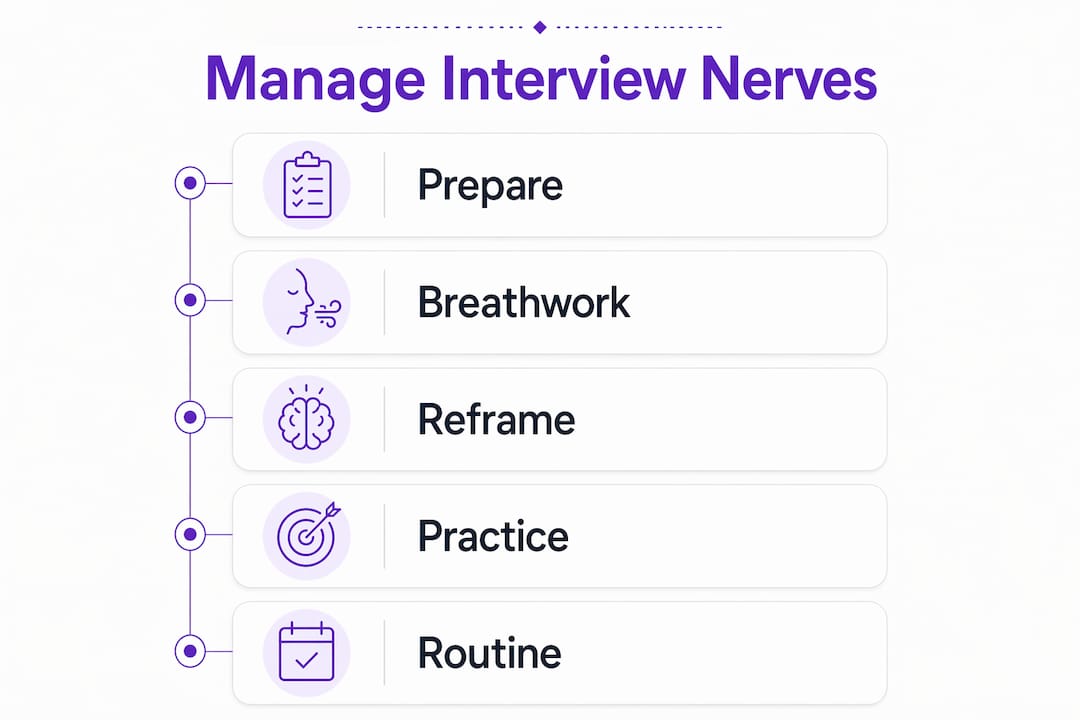
Consulting interview anxiety is defined as a combined physiological and cognitive stress response that disrupts working memory and recall precisely when you need them most. The good news: you do not need to eliminate that anxiety to perform well. Interview anxiety is best understood as a "state and retrieval" failure mode, meaning it breaks down into two fixable problems. You can manage consulting interview nerves effectively by combining four proven components: physiological regulation, cognitive reframing, retrieval practice, and external anchors. Each component targets a different part of the anxiety chain, and together they give you a complete system for performing under pressure.
How can you manage consulting interview nerves with breathing techniques?
High stress disrupts working memory, and disrupted working memory is the direct cause of the blank-mind spiral candidates fear most in case interviews. When your body reads the interview as a threat, cortisol rises, and your prefrontal cortex, the part responsible for structured thinking, goes offline. The fix starts at the physiological level, before you walk into the room.
Cyclic sighing is the most effective breath technique for this purpose. A Stanford randomized trial with 111 volunteers over 28 days found that daily 5-minute breath practice using cyclic sighing significantly improved mood and reduced physiological arousal, outperforming mindfulness meditation. That result matters because it means a short, consistent practice produces measurable calm faster than most candidates expect.
A 5-minute daily breathwork routine
Follow this sequence every morning during your prep period:
- Inhale slowly through your nose for 4 counts.
- Take a second short inhale at the top to fully expand your lungs.
- Exhale slowly through your mouth for 6 - 8 counts until your lungs are empty.
- Repeat for 5 minutes without interruption.
On interview day, run one 2-minute version in the waiting room or bathroom before you enter. Keep your eyes open and your posture upright. This signals alertness to your nervous system while still lowering your heart rate.
Pro Tip: Set a phone reminder to practice this every morning at the same time. Consistency builds the habit so the technique feels automatic when you need it under real pressure.

What cognitive strategies reframe anxiety as productive excitement?
Physiological calm is necessary, but it is not sufficient. You also need to change how you interpret the arousal you feel. Harvard Business School research found that candidates who said "I am excited" before a high-pressure task achieved 81% accuracy, compared to 53% for those who tried to calm down and 69% for those who labeled themselves as anxious. That gap is significant. Trying to suppress nerves actually reduces performance more than leaning into them.
The mechanism is called cognitive reappraisal. You are not pretending the nerves do not exist. You are re-labeling anxiety as excitement, which keeps your arousal level high but shifts its meaning from threat to opportunity. The result is more energy, not less, directed toward the task.
Here is how to apply this in a consulting context:
- Replace "I hope I don't blank out" with "I'm curious what problem they'll give me."
- Replace "They're judging me" with "I'm here to diagnose a business situation."
- Replace "I need to impress them" with "I need to understand their problem."
This shift is sometimes called the Consultant's Audit Approach. You move your mental focus from self-performance to problem diagnosis. Interviewers at McKinsey and BCG consistently report that candidates who ask sharp diagnostic questions feel more like consultants than candidates who rush to show answers.
Pro Tip: Before each mock interview, write down two diagnostic questions you would ask if you were a consultant hired to solve the case. This primes your brain to enter problem-solving mode rather than performance mode.
This priming works best when you apply it to real interview cases.
How does retrieval practice under pressure protect your performance?
Knowing your material and retrieving it under stress are two separate skills. Retrieval under stress is a trainable skill that most candidates never practice deliberately. They study frameworks, read case books, and do mock interviews in calm conditions. Then they freeze in the real interview and blame themselves for not knowing the material. The material was there. The retrieval pathway was not built for pressure.
The solution has two parts: external anchors and structured uncertainty practice.
External anchors
External anchors are any tools that offload memory demands during the interview itself. They include:
- Notes and scratch paper: Writing your framework structure on paper before speaking reduces the cognitive load of holding it in your head while talking.
- Whiteboards: Sketching a structure visually gives you a reference point to return to if you lose your train of thought.
- Real-time coaching cues: Platforms that provide hints or prompts during practice simulate the kind of external support that helps candidates recover mid-answer.
Using external retrieval anchors like notes and structured hints helps candidates deliver prepared material even when anxiety disrupts recall. This is not cheating. It is how experienced consultants work: they use structured tools to think clearly under pressure.
Structured uncertainty practice
| Practice method | What it trains |
|---|---|
| Timed mock interviews | Retrieval speed under time pressure |
| Interruptions mid-answer | Recovery and composure |
| Ambiguous case prompts | Tolerance for uncertainty |
| Distracted environment | Focus filtering |
Designing practice with structured uncertainty builds retrieval pathways that hold up when conditions are unpredictable. Practice in a coffee shop. Have a friend interrupt you mid-case. Set a timer and stop yourself before you feel ready. These conditions create the retrieval pathways that prevent freezing in the real interview.
Pro Tip: Record your mock interviews and watch them back. You will notice exactly where your retrieval breaks down, which tells you precisely what to rehearse next.
What interview-day routines keep anxiety from spiraling?
Unstructured time before an interview raises stress. When you have no plan for the two hours before you walk in, your brain fills that space with worst-case scenarios. Building a pre-interview routine reduces decision fatigue and keeps your focus where it belongs.
A reliable pre-interview routine looks like this:
- Wake at a consistent time and eat a real meal, not just coffee.
- Run your 5-minute cyclic sighing practice.
- Review one framework and one market sizing example, not your entire prep library.
- Arrive at the location 20 minutes early and sit quietly for 5 minutes.
- Say "I am excited" out loud or in your head before entering the room.
During the interview, mistakes will happen. The candidates who recover fastest are the ones who have a prepared reset sequence. Acknowledging nervousness when appropriate and using recovery loops, including grounding phrases and deliberate pauses, help candidates regain composure quickly without losing the interviewer's confidence.
A simple Recovery Loop works like this:
- Pause for one full breath.
- Say "Let me take a moment to structure that" or "Good question, let me think through this."
- Write one word on your scratch paper to anchor your next thought.
- Continue from that anchor, not from where you lost the thread.
This sequence takes under 10 seconds and signals composure rather than panic. Interviewers at top firms expect candidates to hit rough patches. How you recover is part of what they are evaluating.
Which common consulting interview fears cause the most anxiety?
Most consulting interview fears fall into four categories, and each one has a direct counter.
- Fear of blanking out: This is retrieval failure, not ignorance. Counter it with pressure practice and external anchors, not more studying.
- Fear of failure: This is a pass/fail mindset. Shift to a discovery mindset: every interview teaches you something about how you think under pressure.
- Imposter syndrome: This is the belief that you do not belong in the room. Counter it by focusing on the problem in front of you, not on your credentials.
- Fear of interviewer judgment: Interviewers at McKinsey, BCG, and Bain are trained to evaluate structured thinking, not confidence theater. They want to see how you reason, not how polished you look.
Most interview anxiety comes down to retrieval failure under stress rather than lack of preparation. That reframe matters because it points you toward the right solution: practice under stress, not more passive review. Candidates who understand this stop over-studying and start building the right kind of resilience.
The long-term mindset shift is from "I need to pass this interview" to "I need to show how I think." That shift reduces the stakes your brain assigns to each moment, which directly reduces the physiological arousal that disrupts working memory. It is a practical loop, not just a motivational idea.
Key Takeaways
Managing consulting interview nerves requires combining physiological regulation, cognitive reframing, retrieval practice, and external anchors to protect working memory and perform consistently under pressure.
| Point | Details |
|---|---|
| Breathwork reduces arousal | Daily cyclic sighing for 5 minutes lowers heart rate and improves mood faster than meditation. |
| Reframe nerves as excitement | Saying "I am excited" produces higher task accuracy than trying to calm down. |
| Retrieval practice is a separate skill | Practice under pressure, not just in calm conditions, to build recall pathways that hold under stress. |
| External anchors protect performance | Notes, scratch paper, and structured cues reduce cognitive load during the interview itself. |
| Recovery loops restore composure | A deliberate pause plus one anchor word resets your thinking after a mistake in under 10 seconds. |
What I have learned from watching candidates freeze and recover
I have watched a lot of candidates prepare for McKinsey and BCG interviews, and the pattern is almost always the same. The ones who struggle are not underprepared. They are over-reliant on passive review and under-trained in retrieval under pressure. They can explain a profitability framework perfectly in a quiet room. They cannot access it when an interviewer interrupts them mid-sentence.
The techniques in this article are not motivational advice. They are functional tools that address specific failure points. Cyclic sighing lowers cortisol before your brain needs to perform. Cognitive reappraisal keeps your arousal working for you instead of against you. Retrieval practice builds the neural pathways that actually fire under stress. External anchors give you a safety net when those pathways temporarily fail.
The candidates who improve fastest are the ones who treat interview prep like athletic training. They simulate real conditions, they practice recovery, and they use tools like Frame-lab to get feedback on their actual performance rather than their imagined performance. The case interview secrets that matter most are not about frameworks. They are about building a mind that stays clear when the pressure is highest.
If you take one thing from this article, let it be this: anxiety in a consulting interview is not a sign that you are not ready. It is a signal that your brain is engaged. Your job is to direct that energy toward the problem, not toward yourself.
Frame-lab's training tools for interview-ready candidates
Frame-lab is built specifically for candidates preparing for strategy consulting interviews at firms like McKinsey and BCG. The platform combines AI-driven mock interviews, over 400 curated experience reports, and real-time feedback that functions as an external anchor system during practice.
Frame-lab's consulting training modules incorporate stress simulation, cognitive reframing exercises, and structured uncertainty practice, the exact methods this article covers. Candidates who want immersive, pressure-tested preparation can also explore the Strategy Consulting Bootcamp, which runs across four in-person Saturdays and is designed to build the retrieval resilience that separates strong candidates from great ones. Start with the full training platform to find the right entry point for your preparation level.
FAQ
What is consulting interview anxiety, exactly?
Consulting interview anxiety is a physiological and cognitive stress response that disrupts working memory and recall during high-pressure interviews. It is best understood as a retrieval failure problem, not a knowledge gap.
How do I calm nerves right before a consulting interview?
Run a 2-minute cyclic sighing sequence: double inhale through the nose, long exhale through the mouth. Repeat for 2 minutes. This lowers heart rate and reduces physiological arousal quickly.
Does trying to calm down actually help performance?
Harvard Business School research shows that trying to calm down produces lower task accuracy (53%) than reframing nerves as excitement (81%). Suppressing arousal is less effective than redirecting it.
What is the fastest way to recover after blanking mid-case?
Pause for one breath, say "Let me structure that," and write one anchor word on your scratch paper. This Recovery Loop takes under 10 seconds and signals composure to the interviewer.
How much practice is enough to reduce interview anxiety?
There is no fixed number, but the quality of practice matters more than the quantity. Practicing under simulated pressure, with interruptions and time constraints, builds retrieval pathways that hold up in real interviews far better than calm repetition alone.