
Master peer practice consulting case interviews with our complete guide. Boost your skills in a collaborative, low-stakes environment for success!
On this page▾
- What are the prerequisites for peer practice consulting case interviews?
- Choosing your group members
- Setting up a group contract
- Tools you need before session one
- How to conduct effective peer practice case interviews step-by-step
- Common pitfalls in peer practice groups and how to fix them
- What platforms and resources support peer practice consulting case interviews?
- Case libraries and practice repositories
- Digital tools for scheduling and feedback
- Comparing entry-level and advanced peer practice tools
- Key takeaways
- Why I think most peer practice groups fail before they start
- How Frame-lab strengthens your consulting case interview prep
- FAQ
- What is peer practice in consulting case interviews?
- How many people should be in a peer practice group?
- How often should peer practice sessions happen?
- What frameworks should candidates use during peer practice?
- Can peer practice replace professional interview coaching?
- Recommended
Peer practice consulting case interviews are defined as a collaborative mock interview method where candidates simulate real consulting interview conditions with fellow candidates. This approach is the most effective form of self-directed consulting interview preparation available to graduate students and early-career professionals. Top-tier firms like McKinsey and BCG evaluate candidates on structured thinking, communication, and problem-solving under pressure. Peer practice builds all three by putting you in the hot seat repeatedly, in a low-stakes environment where mistakes become lessons rather than lost offers.
What are the prerequisites for peer practice consulting case interviews?
Effective peer practice starts with the right people and the right structure. Without both, sessions drift into casual conversation and produce little measurable improvement.
Choosing your group members
Peer groups work best with 4 to 8 committed members who share clear learning goals and consistent schedules. That size balances diversity of thought with practical manageability. Smaller groups risk echo chambers; larger groups make scheduling a nightmare and reduce individual practice time. Prioritize commitment over friendship. A peer who cancels frequently does more damage than good.

Look for members at a similar preparation stage but with different academic or professional backgrounds. A finance graduate and an engineering graduate will approach the same case differently. That difference is the point. Diverse perspectives challenge assumptions and sharpen your reasoning in ways that solo practice never can.
Setting up a group contract
A group contract is not optional. It is the document that separates productive peer groups from ones that dissolve after three sessions. The contract should cover confidentiality, attendance expectations, and rotating facilitation roles. Rotating leadership prevents dominance and keeps the group dynamic egalitarian, which is critical for honest feedback.
Agree on meeting frequency before the first session. Weekly sessions are the standard for candidates within 8 weeks of their interview date. Bi-weekly works for those in earlier stages of consulting interview preparation.
Tools you need before session one
| Prerequisite | Details |
|---|---|
| Case library | A curated set of cases covering profitability, market entry, M&A, and operations |
| Video conferencing | A platform that supports screen sharing and session recording |
| Timing device | A visible timer to enforce realistic time constraints |
| Note-taking system | Shared documents for structured feedback after each session |
| Group contract | A written agreement on roles, attendance, and confidentiality |
Pro Tip: Record your sessions with consent from all members. Watching yourself on video reveals communication habits, like filler words and hesitation patterns, that you cannot detect in the moment.
How to conduct effective peer practice case interviews step-by-step
Structure is what separates a productive session from an hour of vague conversation. Every session needs a defined opening, clear roles, and a structured debrief.
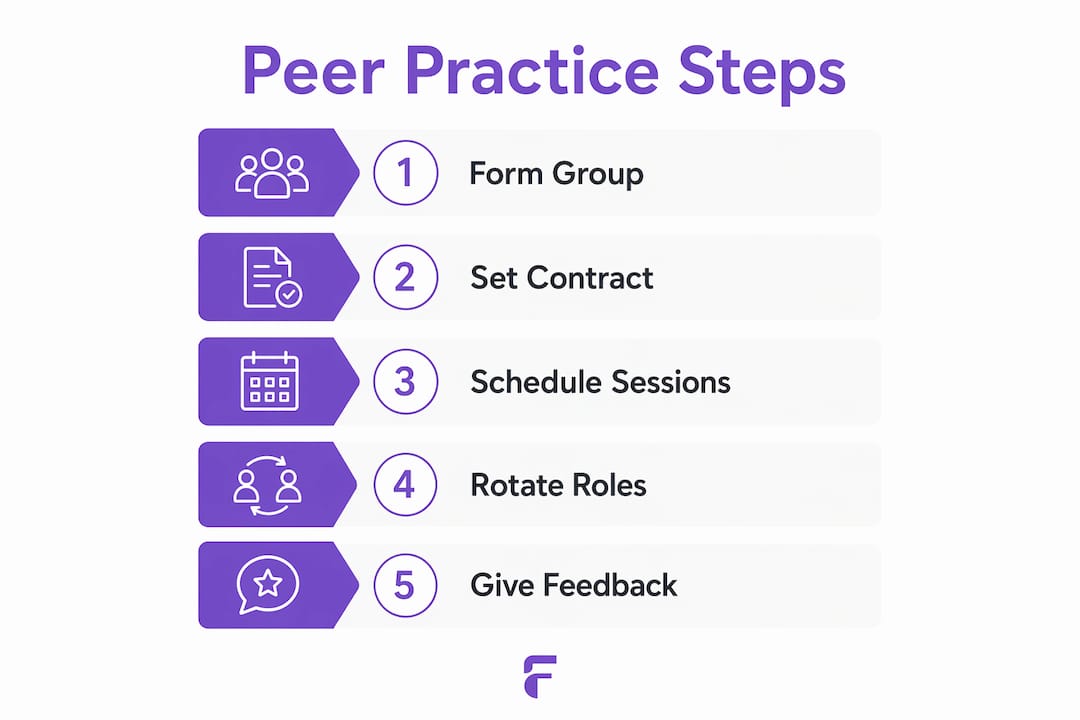
Here is the step-by-step method for running a full peer practice session:
-
Set the session objective. Before the case begins, the facilitator states the specific skill being practiced. For example: "Today we focus on structuring the opening hypothesis." This keeps feedback targeted.
-
Assign roles clearly. Every session has three roles: interviewer, interviewee, and observer. The interviewer delivers the case prompt and probes the candidate. The interviewee works through the case out loud. The observer tracks time, notes communication patterns, and prepares structured feedback.
-
Deliver the case prompt. The interviewer reads the prompt once, then waits. Silence is part of the test. Interviewees should take 60 - 90 seconds to structure their thinking before speaking.
-
Run the case with time pressure. Most consulting case interviews run 25 - 35 minutes. Set a timer and stick to it. Cutting a session short because the interviewee is struggling is the single fastest way to reduce the value of peer practice.
-
Apply a recognized framework. Candidates should use structured approaches like issue trees, the profitability framework, or the 4Ps during case exploration. Consulting frameworks give the interviewer a clear standard against which to evaluate the response.
-
Deliver real-time micro-feedback. The interviewer can pause the case once, briefly, to redirect if the candidate goes completely off track. This mirrors what real interviewers do at firms like BCG.
-
Run a structured debrief. The observer speaks first, then the interviewer, then the interviewee reflects. Each person uses the format: what worked, what did not, and one specific improvement for next time.
-
Rotate roles. Every participant should play all three roles in a single session where time allows.
Pro Tip: Rotate roles every session without exception. Playing the interviewer forces you to internalize what good structure looks like from the other side of the table. Candidates who skip this step consistently underperform in real interviews.
Common pitfalls in peer practice groups and how to fix them
Even well-intentioned groups fall into patterns that reduce their effectiveness. Recognizing these problems early saves weeks of wasted preparation time.
-
Unstructured sessions. Sessions without a defined objective become social time. Fix this by requiring the facilitator to send a one-line session goal 24 hours in advance.
-
One dominant voice. When one member consistently leads feedback, others disengage. Rotating facilitation roles prevents this and keeps participation balanced across the group.
-
Vague feedback. "That was good" or "you need to be clearer" tells the candidate nothing. Require all feedback to follow the format: specific observation, impact, and suggested alternative. For example: "You jumped to a solution before structuring the problem. That signals weak analytical thinking. Next time, state your framework before diving in."
-
Inconsistent attendance. One or two absences can collapse group momentum. The group contract should specify that two consecutive absences without notice result in removal from the group. This sounds harsh, but it protects the majority.
-
Feedback that feels personal. Psychological safety is the foundation of honest peer feedback. Establish a norm early: feedback targets the performance, never the person. Phrases like "the answer lacked structure" work better than "you were disorganized."
-
Plateau without new cases. Groups that recycle the same 10 cases stop improving after a few weeks. Rotate in fresh cases from structured case libraries regularly to maintain challenge and variety.
What platforms and resources support peer practice consulting case interviews?
The right tools reduce friction and increase session quality. You do not need expensive software, but you do need tools that serve each part of the practice process.
Case libraries and practice repositories
A strong case library is non-negotiable. Entry-level repositories offer basic profitability and market-sizing cases. Advanced platforms include cases modeled on real interview scenarios from top-tier firms, with annotated solutions and scoring rubrics. Frame-lab's training platform offers structured case libraries built with insights from actual consulting interviews, which gives peer groups a realistic benchmark for their practice.
Digital tools for scheduling and feedback
Video conferencing platforms with recording capability are the baseline requirement for remote peer groups. Shared note-taking tools let observers document feedback in real time without interrupting the session. Scheduling tools reduce the coordination burden that causes groups to lose momentum between sessions.
Comparing entry-level and advanced peer practice tools
| Feature category | Entry-level tools | Advanced platforms |
|---|---|---|
| Case variety | Basic profitability and market-sizing | Full case types with firm-specific formats |
| Feedback structure | Informal, unguided | Rubric-based with scoring criteria |
| AI feedback | Not available | AI-driven mock interviews with instant analysis |
| Experience reports | None | Curated reports from real interview candidates |
| Learning paths | Generic | Personalized by skill gap and target firm |
Frame-lab sits firmly in the advanced category. The platform combines AI-driven mock interviews, over 400 curated experience reports, and structured learning paths that candidates can use alongside their peer group sessions.
Pro Tip: Integrate your platform use with your group contract. Assign specific modules or cases from your chosen platform as homework before each session. This ensures everyone arrives prepared and sessions stay focused on practice, not catch-up.
Key takeaways
Peer practice consulting case interviews deliver the most value when groups are structured, roles rotate, and feedback is specific and consistent.
| Point | Details |
|---|---|
| Group size matters | Keep peer groups to 4 - 8 members for the best balance of diversity and accountability. |
| Contracts prevent drift | A written group contract covering roles, attendance, and confidentiality keeps sessions productive. |
| Role rotation builds range | Playing interviewer, interviewee, and observer in every session develops a fuller skill set. |
| Specific feedback drives improvement | Vague feedback stalls progress; use the observation-impact-alternative format every time. |
| Platforms extend practice quality | Structured case libraries and AI feedback tools raise the standard of peer group sessions. |
Why I think most peer practice groups fail before they start
Most candidates treat peer practice like a study group. They find two or three friends, agree to "do cases together," and show up without a plan. The sessions feel productive because they are social and low-pressure. But low pressure is exactly the problem.
Real consulting interviews at McKinsey or BCG are high-pressure by design. The interviewer is watching how you think when you are uncomfortable. If your peer sessions never replicate that discomfort, you are practicing the wrong thing. The preparation that actually reduces interview fear is the kind that feels slightly uncomfortable in the moment.
The groups I have seen succeed share one trait: they treat sessions like professional meetings. There is an agenda, a facilitator, a timer, and a debrief. Nobody checks their phone. Nobody lets a weak answer slide with a polite nod. The feedback is direct, specific, and kind. That combination is rare, but it is what produces candidates who walk into McKinsey interviews feeling ready rather than hoping for the best.
Early-career professionals benefit most from this method because they have not yet developed the professional habits that make high-pressure situations feel normal. Peer practice, done right, accelerates that development faster than any other preparation method available. The group becomes a mirror that shows you exactly where your thinking breaks down, before a real interviewer does.
How Frame-lab strengthens your consulting case interview prep
Peer practice works best when it is paired with structured, expert-level content. Frame-lab is built specifically for candidates targeting top-tier consulting firms, and its tools complement peer group sessions directly.
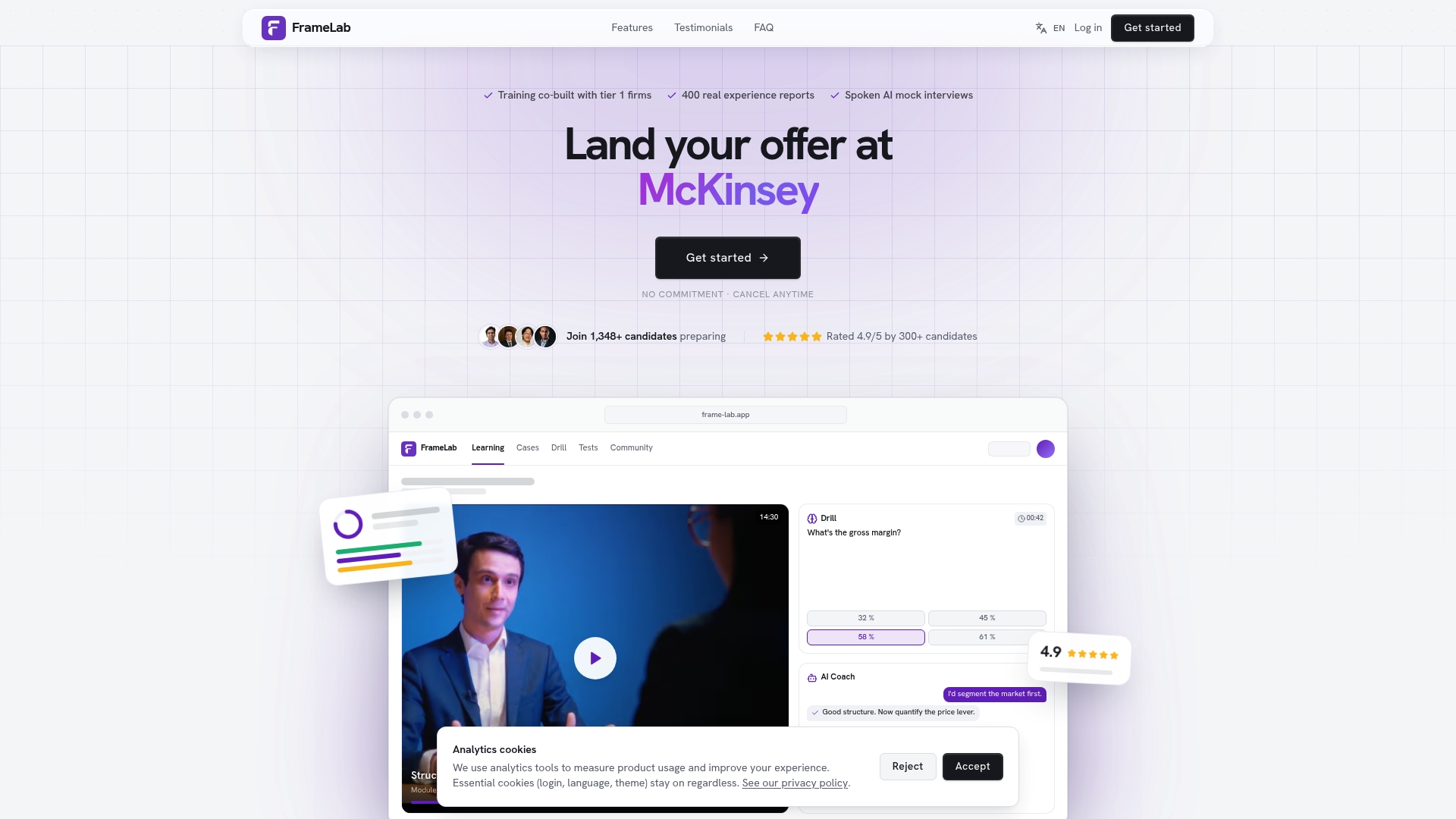
Frame-lab offers AI-driven mock interviews, role-play simulations, and rubric-based feedback that give your peer group a professional standard to work toward. The platform's FIT Interview learning path develops the personal narrative and communication skills that case practice alone does not cover. With over 400 curated experience reports from real interviews at firms like McKinsey and BCG, you get the insider context that generic prep tools cannot provide. Frame-lab's personalized training paths identify your specific gaps and guide you through them, session by session.
FAQ
What is peer practice in consulting case interviews?
Peer practice in consulting case interviews is a structured mock interview method where candidates take turns playing interviewer, interviewee, and observer to simulate real consulting interview conditions. It builds case reasoning, communication, and feedback skills simultaneously.
How many people should be in a peer practice group?
Groups of 4 to 8 members deliver the best results. That size provides enough diverse perspectives to challenge your thinking without making scheduling unmanageable.
How often should peer practice sessions happen?
Weekly sessions are the standard for candidates within 8 weeks of their interview date. Consistency matters more than frequency; a reliable bi-weekly schedule outperforms irregular weekly sessions.
What frameworks should candidates use during peer practice?
Candidates should practice with recognized consulting frameworks such as issue trees, the profitability framework, and the 4Ps. Structured frameworks give both the interviewer and observer a clear standard for evaluating the quality of the response.
Can peer practice replace professional interview coaching?
Peer practice is highly effective for building case fluency and feedback habits, but it works best alongside structured platforms like Frame-lab that provide expert-level content, AI feedback, and real interview experience reports.