
Discover what causes mental blocks in interviews and how to fix them fast. Learn to overcome stress and perform your best with expert insights.
On this page▾
- What causes mental blocks during interviews?
- The stress hormone effect
- The Yerkes-Dodson curve
- How preparation mistakes make mental blocks worse
- What does a mental block actually look like?
- How to overcome mental blocks: strategies that actually work
- Train retrieval under pressure
- Use state regulation, not suppression
- Compare preparation methods by retrieval impact
- Key takeaways
- The part most candidates skip entirely
- Frame-lab trains you to retrieve under real pressure
- FAQ
- What causes a mental block during an interview?
- Why do I blank even when I know the answer?
- What are the signs of a mental block in an interview?
- How do I recover from a mental block mid-interview?
- What is the most effective way to prevent mental blocks in interviews?
- Recommended
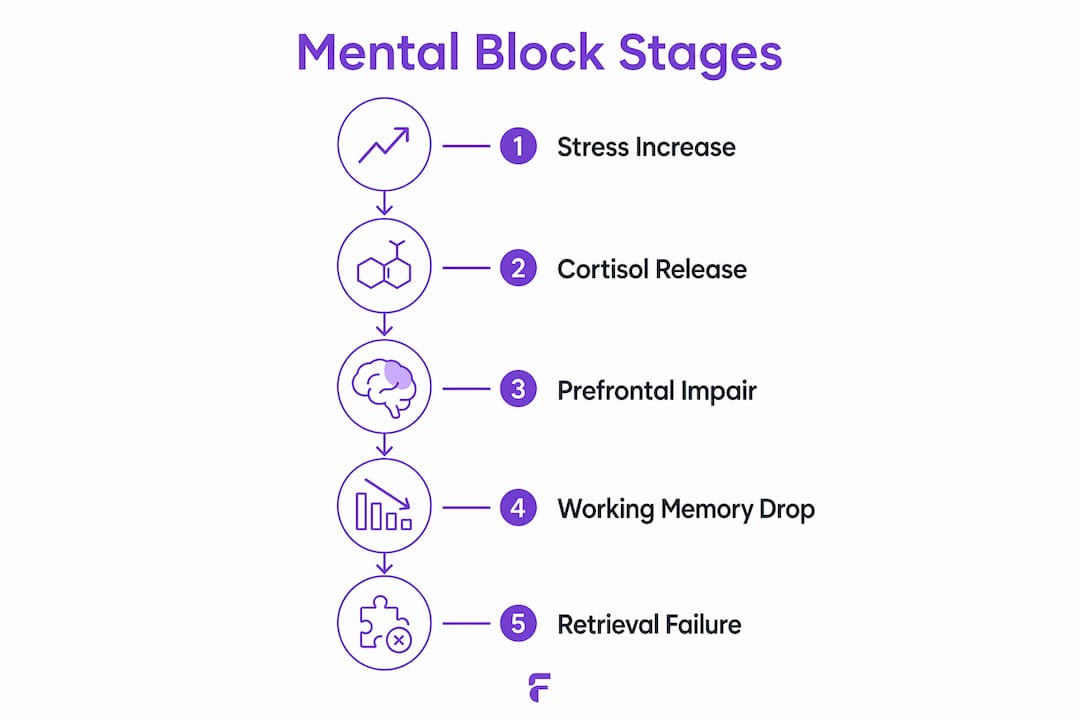
A mental block during an interview is a retrieval failure caused by acute stress, not a sign that you don't know the material. When cortisol and adrenaline spike, your prefrontal cortex loses access to the neural pathways you rehearsed. Working memory narrows, and practiced answers become temporarily unreachable. Understanding what causes mental blocks in interviews is the first step toward fixing them. Platforms like Frame-lab are built around this exact problem, combining stress-conditioned retrieval practice with real interview feedback so candidates can perform when it counts.
What causes mental blocks during interviews?
Mental blocks are retrieval failures, not knowledge gaps. You studied, you practiced, you know the content. But under the pressure of a live interview, your brain temporarily loses access to what it knows. The mechanism behind this is physiological, not personal.

The stress hormone effect
Stress hormones like cortisol impair the prefrontal cortex, the brain region responsible for memory retrieval and speech articulation. This effect is strongest in the first ten minutes of a high-stakes interaction. That is exactly when interviewers ask their opening questions.
Adrenaline compounds the problem. Your body shifts into threat mode, redirecting cognitive resources away from complex thinking and toward basic survival responses. The result is a narrowed working memory that cannot hold the structured answer you prepared.
The Yerkes-Dodson curve
The Yerkes-Dodson Law describes an inverted-U relationship between arousal and performance. Moderate arousal sharpens focus. Too much arousal overloads cognition and causes performance to drop sharply. Interview conditions push most candidates past the optimal point.
The following factors push arousal into the danger zone:
- Observation stress. Being watched and evaluated activates threat circuits even in well-prepared candidates.
- Time pressure. Knowing you must respond quickly consumes working memory before you even start answering.
- Catastrophizing thoughts. Thoughts like "I'm going to fail this" take up cognitive space needed for problem-solving.
- Mind-reading. Assuming the interviewer is judging you negatively creates a second mental task running alongside your answer.
- Cognitive interference. Anxiety-related thoughts hijack working memory, consuming the resources you need to structure a coherent response.
Each of these factors stacks on top of the others. By the time you open your mouth, your working memory is already partially occupied by threat-monitoring, leaving less capacity for the actual answer.
How preparation mistakes make mental blocks worse
Most candidates prepare by re-reading notes or rehearsing silently in a calm environment. Both methods feel productive. Neither one trains the retrieval pathway that gets used in a live interview.
Re-reading instead of self-quizzing creates familiarity with material but does not build the retrieval reflex needed under stress. Familiarity and retrieval are different cognitive processes. Familiarity fails under pressure. Retrieval, when trained correctly, holds.
Here is how preparation mistakes compound over time:
- Practicing silently. Silent rehearsal does not activate the verbal production pathways used in a real interview. Speaking out loud forces your brain to retrieve and articulate simultaneously, which is the actual skill being tested.
- Practicing only in calm conditions. Your nervous system adapts to the conditions you train in. Calm practice builds calm-condition retrieval. It does not prepare you for the cortisol spike that hits when an interviewer stares at you.
- Skipping observation stress. Practicing alone removes the social evaluation component entirely. Adding a peer, a camera, or a timer changes the physiological state and forces real adaptation.
- Not reviewing recorded answers. Recording yourself and watching it back reveals delivery symptoms you cannot notice in the moment, including filler words, pacing collapse, and hedging language.
- Treating knowledge mastery as interview readiness. Knowing a framework and retrieving it under pressure are separate skills. Candidates often know the content but fail retrieval in live conditions because they never practiced with time pressure and observation stress.
Pro Tip: Record one mock answer per day for a week. Watch each recording with the sound off first. You will spot physical signs of overload, like frozen posture and loss of eye contact, that you completely miss while speaking.
You can film yourself on a first interview case to start.
What does a mental block actually look like?
Recognizing a mental block in real time is harder than it sounds. Most candidates interpret the symptoms as a knowledge problem and try to think harder. That response makes the block worse.
Delivery symptoms like increased filler words, pacing collapse, hedging language, and degraded answer structure are the clearest markers of working memory overload. These symptoms come from the brain, not from a gap in preparation. Saying "um" repeatedly or losing the thread of a structured answer signals that your working memory is overwhelmed, not that you forgot the content.
The following symptoms indicate a mental block rather than a knowledge deficit:
- Filler word spikes. A sudden increase in "um," "like," or "you know" signals cognitive overload, not ignorance.
- Pacing collapse. Speaking too fast or freezing completely both indicate that the prefrontal cortex is under stress.
- Hedging language. Phrases like "I think maybe" or "it could possibly be" replace confident statements when working memory is strained.
- Intolerable silence. Feeling compelled to fill silence with anything, even irrelevant content, is a stress response, not a communication choice.
- Lost structure. Starting a STAR or MECE answer and losing the thread mid-way through is a direct sign of working memory hijacking.
Candidates with higher working memory capacity are paradoxically more vulnerable to choking under pressure. Anxiety consumes the same cognitive resources that make them high performers in calm conditions. Recognizing this pattern removes the self-blame and points toward the real fix.
How to overcome mental blocks: strategies that actually work
Willpower does not fix a mental block. Trying to suppress anxiety through sheer determination activates ironic monitoring processes that increase stress. The effective approach is physiological, not motivational.
Train retrieval under pressure
Simulated practice with realistic interviewer friction and time constraints reduces the cortisol response over time. Your nervous system adapts to the conditions you practice in. Frame-lab's case interview training builds this adaptation through structured, progressive mock sessions that replicate the observation stress of a real McKinsey or BCG interview.
Use state regulation, not suppression
Shifting physiological arousal to a manageable level is more effective than trying to calm down through willpower. Practical techniques include:
- Slow your speech rate deliberately. Speaking slower signals safety to your nervous system and frees working memory.
- Take one slow breath before answering. This is not a meditation exercise. It is a two-second physiological reset.
- Use a brief environmental reset. Short physical resets break the stuck loop and restore attention, enabling retrieval again.
Compare preparation methods by retrieval impact
| Preparation method | Retrieval under stress | Physiological adaptation |
|---|---|---|
| Re-reading notes | Low | None |
| Silent solo rehearsal | Low | None |
| Out-loud solo rehearsal | Moderate | Low |
| Timed solo rehearsal | Moderate | Moderate |
| Peer mock with feedback | High | High |
| Recorded mock with review | High | High |
| Simulated stress practice | Very high | Very high |
The table makes the gap clear. Methods that feel productive, like re-reading, produce almost no retrieval benefit under stress. Methods that feel uncomfortable, like timed peer mocks, produce the most adaptation.
Pro Tip: Before your next mock session, set a one-minute timer and answer a case prompt out loud with no notes. The discomfort you feel is your nervous system adapting. That adaptation is exactly what you need.
Frame-lab's FIT interview training combines timed retrieval drills with peer observation and direct feedback, targeting the specific conditions that trigger mental blocks in consulting interviews.
Key takeaways
Mental blocks in interviews are physiological retrieval failures caused by stress, not knowledge gaps, and fixing them requires training retrieval under realistic pressure.
| Point | Details |
|---|---|
| Stress causes retrieval failure | Cortisol impairs the prefrontal cortex, blocking access to rehearsed answers during interviews. |
| Calm practice is not enough | Practicing without stress does not prepare your nervous system for live interview conditions. |
| Symptoms signal overload | Filler words, pacing collapse, and lost structure indicate working memory strain, not ignorance. |
| Suppression backfires | Trying to force calm through willpower increases stress; physiological resets work better. |
| Simulated pressure builds resilience | Timed peer mocks and recorded reviews are the most effective preparation methods for retrieval under stress. |
The part most candidates skip entirely
Most of the candidates I work with arrive having done serious content preparation. They know their frameworks. They can explain a profitability case in their sleep. What they have not done is train their nervous system to retrieve that knowledge while being watched, timed, and evaluated.
The uncomfortable truth is that blanking is a state problem. It is not a character flaw, a sign of weakness, or proof that you are not ready. It is a biological response to perceived threat. Your brain is doing exactly what it evolved to do. The problem is that interview rooms are not actually dangerous, but your nervous system does not know that yet.
The preparation mistake I see most often is treating knowledge mastery and retrieval skill as the same thing. They are not. You can know every McKinsey framework perfectly and still blank on the first question because you have never practiced retrieving it under observation stress. These are two separate training targets, and most prep programs only address the first one.
The other thing candidates miss is pacing. Speaking slowly during a case interview feels unnatural, almost rude. But slow speech is one of the most reliable ways to keep your prefrontal cortex online. It signals to your nervous system that the situation is under control. It also gives your working memory the fraction of a second it needs to retrieve the next structured point.
If you blank during an interview, do not fight it. Treat it as a biological signal. Take one breath, slow your speech, and give yourself permission to pause. The answer is there. Your brain just needs a moment to find the pathway back.
Frame-lab trains you to retrieve under real pressure
Mental blocks in consulting interviews are not solved by knowing more. They are solved by practicing retrieval under the conditions that cause them.
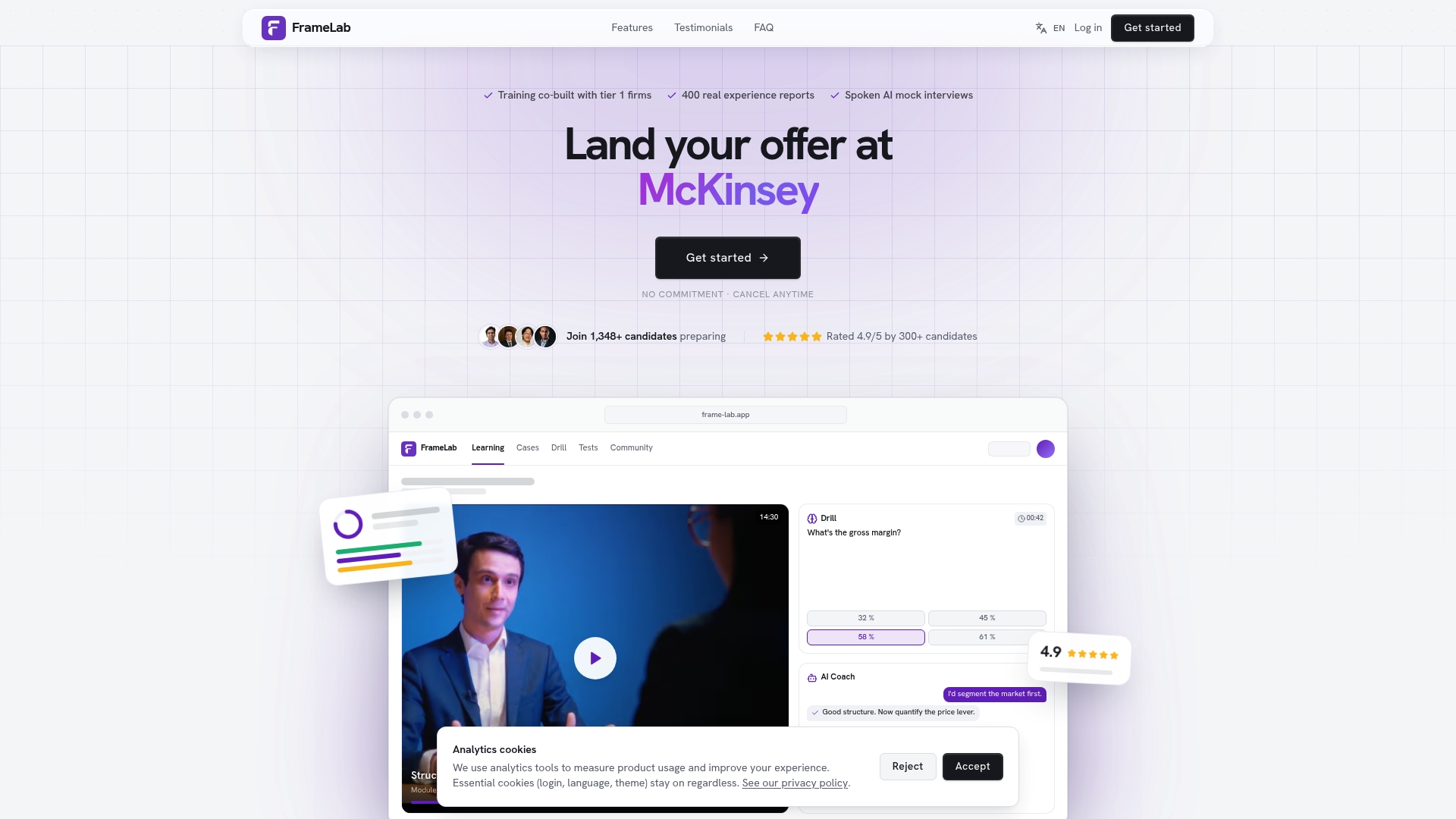
Frame-lab is built specifically for candidates targeting McKinsey, BCG, and other top-tier firms. The platform combines AI-driven mock interviews, over 400 curated experience reports, and peer practice sessions that replicate real observation stress. Every module is designed to close the gap between what you know and what you can access under pressure. You can start your preparation with structured modules that build retrieval resilience from the ground up, or explore targeted training focused on physiological regulation and real-time recovery skills.
FAQ
What causes a mental block during an interview?
A mental block during an interview is caused by acute stress that impairs the prefrontal cortex and narrows working memory. Cortisol and adrenaline temporarily block access to rehearsed neural pathways, making practiced answers feel unreachable.
Why do I blank even when I know the answer?
High working memory candidates are especially vulnerable to choking under pressure because anxiety consumes the same cognitive resources needed for retrieval. Knowing the content and retrieving it under observation stress are two separate skills that require separate training.
What are the signs of a mental block in an interview?
The clearest signs are increased filler words, pacing collapse, hedging language, and lost answer structure. These delivery symptoms indicate working memory overload, not a knowledge deficit.
How do I recover from a mental block mid-interview?
A short physical or environmental reset breaks the anxiety loop and restores attention. Slow your speech, take one breath, and give yourself permission to pause before continuing.
What is the most effective way to prevent mental blocks in interviews?
Simulated practice with realistic time pressure and observation stress is the most effective prevention method. This type of practice reduces the cortisol response over time and builds retrieval pathways that hold under live interview conditions.