
Master the case interview preparation stages with our 2026 guide. Build skills progressively to ace your McKinsey or BCG interview!
On this page▾
- 1. What are the case interview preparation stages?
- 2. Familiarization with case interview structure and format
- 3. How to develop case interview frameworks step by step
- 4. What are effective case interview drill types and how to use them in 2026?
- 5. When and how to incorporate mock interviews and expert feedback
- 6. How to build business knowledge and recover from setbacks
- Key takeaways
- What I have learned about case prep that most guides miss
- Frame-lab supports every stage of your preparation
- FAQ
- How many weeks does case interview preparation take?
- What are the main case interview drill types?
- When should I start mock interviews?
- What is the MECE principle in case frameworks?
- Do I need to prepare for behavioral questions alongside case practice?
- Recommended
Case interview preparation is a structured, multi-stage process that builds analytical, communication, and business skills progressively before you walk into a McKinsey or BCG interview room. Skipping stages or jumping straight to mock interviews without a foundation is the most common reason candidates stall. The Yale Office of Career Strategy recommends a 4 - 6 week prep timeline, with clear milestones at each phase. This guide breaks down every case interview preparation stage so you know exactly what to do, when to do it, and how to measure progress.
1. What are the case interview preparation stages?
Case interview preparation follows a recognized progression: familiarization, framework development, drill practice, mock interviews, and business knowledge building. Each stage builds on the last. Jumping ahead before mastering the basics produces candidates who can recite frameworks but cannot apply them under pressure. The standard industry term for this multi-phase approach is structured case prep, and it is the method top consulting coaches and university career offices use consistently.
The stages are not rigid weeks on a calendar. They are skill thresholds. You move forward when your performance at the current stage is consistent, not when a certain number of days have passed.

2. Familiarization with case interview structure and format
The first stage is understanding what a case interview actually is. A case interview is a problem-solving exercise where the interviewer presents a business scenario and evaluates how you structure your thinking, ask clarifying questions, and communicate conclusions. Before you practice a single case, you need to know the format cold.
Start by learning the four main case interview structure types: market sizing, profitability analysis, market entry, and M&A or merger cases. Each has a recognizable shape. Knowing that shape lets you orient yourself quickly when the interviewer speaks.
- Read the prompt carefully. Identify the client, the problem type, and the key objective.
- Take notes. Write down numbers, constraints, and any unusual details the interviewer mentions.
- Clarify before structuring. Ask one or two targeted questions to confirm your understanding of the goal.
- Restate the problem. Summarize what you heard before proposing any framework.
Pro Tip: Practice restating case prompts out loud with a timer. Most candidates underestimate how much time they lose by jumping straight to analysis without confirming the problem.
The Yale Office of Career Strategy recommends completing at least 3 cases in structured "case mode" before booking your first high-stakes mock interview. That threshold exists because the first few cases teach you the mechanics. You cannot get useful feedback on your thinking until the mechanics are automatic.
3. How to develop case interview frameworks step by step
Frameworks are the analytical structures you use to break a problem into manageable parts. The seven most common case interview frameworks serve as building blocks: profitability, market entry, M&A, pricing, competitive response, operations, and market sizing. You learn these first, then build custom frameworks from them.
The MECE principle (Mutually Exclusive, Collectively Exhaustive) governs good framework design. Every branch of your framework should cover a distinct part of the problem with no overlap and no gaps. Interviewers at McKinsey and BCG evaluate this explicitly.
Steps to build a custom framework:
- Identify the core business objective (grow revenue, cut costs, enter a market, evaluate a deal).
- Choose 2 - 4 top-level buckets that cover the problem without overlapping.
- Add one level of sub-points under each bucket to show depth.
- Check: does your framework address the client's stated goal directly?
- Trim anything that does not connect back to the objective.
Pro Tip: Write your framework on paper before speaking. Candidates who structure silently for 60 - 90 seconds and then present a clean, organized framework consistently outperform those who think out loud from the start.
Communicating your framework in 30 - 60 seconds and then checking with the interviewer for alignment is a recognized best practice. That check-in signals confidence and collaboration. It also gives you a chance to course-correct before you spend five minutes going down the wrong path.
The table below shows how standard frameworks map to common case types.
| Case type | Primary framework | Key focus area |
|---|---|---|
| Profitability | Revenue vs. cost tree | Identify which driver changed and why |
| Market entry | Market attractiveness + competitive position | Size, growth, and fit with client capabilities |
| M&A / merger | Synergies + risks | Revenue upside, cost savings, integration risk |
| Market sizing | Segmentation approach | Population, penetration rate, average spend |
4. What are effective case interview drill types and how to use them in 2026?
Drills are the core of skill development in the middle stages of prep. Practicing each case component separately improves overall case performance more than running full cases repeatedly. Full cases test everything at once. Drills isolate one skill and build it to automaticity.
The main case interview drill types are:
- Math drills: Mental arithmetic, percentage calculations, and estimation under time pressure. Frame-lab's math drill module targets this specifically.
- Structuring drills: Given a one-sentence problem, build a MECE framework in 90 seconds.
- Brainstorming drills: Generate 8 - 10 ideas in a given category within two minutes.
- Chart reading drills: Interpret a graph or table and state the key insight in one sentence.
- Hypothesis drills: State a hypothesis, identify the data that would confirm or refute it.
Various drill tools offer different focuses. AI-enabled platforms simulate time pressure and give instant feedback on structure. Peer-based practice adds the communication dimension that solo tools cannot replicate. The best prep programs combine both.
A practical weekly drill schedule for weeks 2 - 4 of prep looks like this: two math drill sessions, one structuring session, one brainstorming session, and one chart reading session. Each session runs 20 - 30 minutes. That volume builds speed without burning out your preparation time.
Pro Tip: Track your drill scores in a simple spreadsheet. Seeing your math accuracy improve from 70% to 90% over two weeks is motivating and tells you when you are ready to move on.
5. When and how to incorporate mock interviews and expert feedback
Mock interviews belong in the later stages of prep, not the beginning. Booking mock interviews too early reduces their effectiveness because you spend the session learning mechanics instead of refining judgment. The threshold is clear: complete at least 3 full cases in structured practice before your first mock.
Once you are ready, follow this sequence:
- Schedule with a peer first. A peer mock is lower stakes and lets you get comfortable with the spoken format.
- Record yourself. Watch the recording and note where your structure broke down or your communication was unclear.
- Book a coach or expert mock. Use platforms that connect you with former consultants for feedback on your thinking quality, not just your structure.
- Debrief every mock within 24 hours. Write down the three things you would do differently. Review them before your next session.
- Repeat until performance is consistent. One strong mock does not mean you are ready. Consistency across three or more mocks is the real signal.
Behavioral interview preparation runs in parallel with case drills. The "FIT" portion of a McKinsey or BCG interview evaluates your leadership stories, personal impact, and values. Neglecting it while focusing entirely on cases is a common and costly mistake.
Pro Tip: Preparation reduces interview fear measurably. Candidates who have completed 10 or more structured practice sessions report significantly lower anxiety on interview day. Volume of practice is the most reliable confidence builder.
6. How to build business knowledge and recover from setbacks
Business knowledge is the final layer of preparation, developed during weeks 4 - 6 of a standard prep timeline. Reading industry primers and practicing cases in unfamiliar sectors sharpens your ability to generate relevant hypotheses quickly. A candidate who only practices retail cases will struggle when the interviewer presents a healthcare or infrastructure scenario.
Build this layer with focused habits:
- Read one industry overview per week (energy, healthcare, financial services, consumer goods).
- Memorize the 10 - 15 formulas that appear most often: market share, break-even, payback period, EBITDA margin.
- Practice one case per week in an industry you find uncomfortable.
- After each practice case, write a one-paragraph summary of the key market drivers you used.
- When you make an error in practice, identify whether it was a math error, a structure error, or a knowledge gap. Each type requires a different fix.
Setbacks in practice are data, not failures. A structuring error tells you to revisit your framework-building drills. A math error tells you to add a drill session. A knowledge gap tells you which industry primer to read next. Candidates who treat mistakes as diagnostic information improve faster than those who treat them as discouraging events.
Key takeaways
Structured case interview preparation follows a clear sequence: foundation first, then frameworks, then drills, then mocks, then business knowledge, with each stage building on the last.
| Point | Details |
|---|---|
| Foundation before mocks | Complete at least 3 structured cases before booking any mock interview. |
| Frameworks as building blocks | Learn the 7 core frameworks first, then build custom ones using the MECE principle. |
| Drills target specific skills | Use math, structuring, brainstorming, and chart reading drills to build each skill separately. |
| Mocks require debrief | Review every mock within 24 hours and identify three specific improvements. |
| Business knowledge is a stage | Spend weeks 4 - 6 reading industry primers and practicing unfamiliar case types. |
What I have learned about case prep that most guides miss
By Nahïm
Most candidates treat case interview prep as a single activity: practice cases. They run case after case, hoping repetition alone will get them to offer. It rarely does. The candidates I have seen succeed consistently are the ones who treat each stage as a distinct skill-building phase with its own metrics.
The biggest pitfall I see is moving to mock interviews too early. When you book a mock before your framework instincts are automatic, you spend the session managing anxiety about mechanics instead of demonstrating judgment. The mock becomes a stressful experience rather than a useful one. The stress of case interviews is real, and it compounds when you are not yet ready for the format.
The second pitfall is ignoring the behavioral component until the week before the interview. FIT questions are not filler. At McKinsey and BCG, they carry equal weight with the case. Candidates who prepare both tracks in parallel, from week one, arrive at interview day with a complete package.
My honest advice: follow the stages in order, track your performance at each one, and do not advance until your results are consistent. Consistency is the signal. One good case or one strong mock means nothing. Three in a row means you are ready.
Frame-lab supports every stage of your preparation
Structured prep is only as good as the tools behind it. Frame-lab is built specifically for consulting candidates targeting McKinsey, BCG, and peer firms.
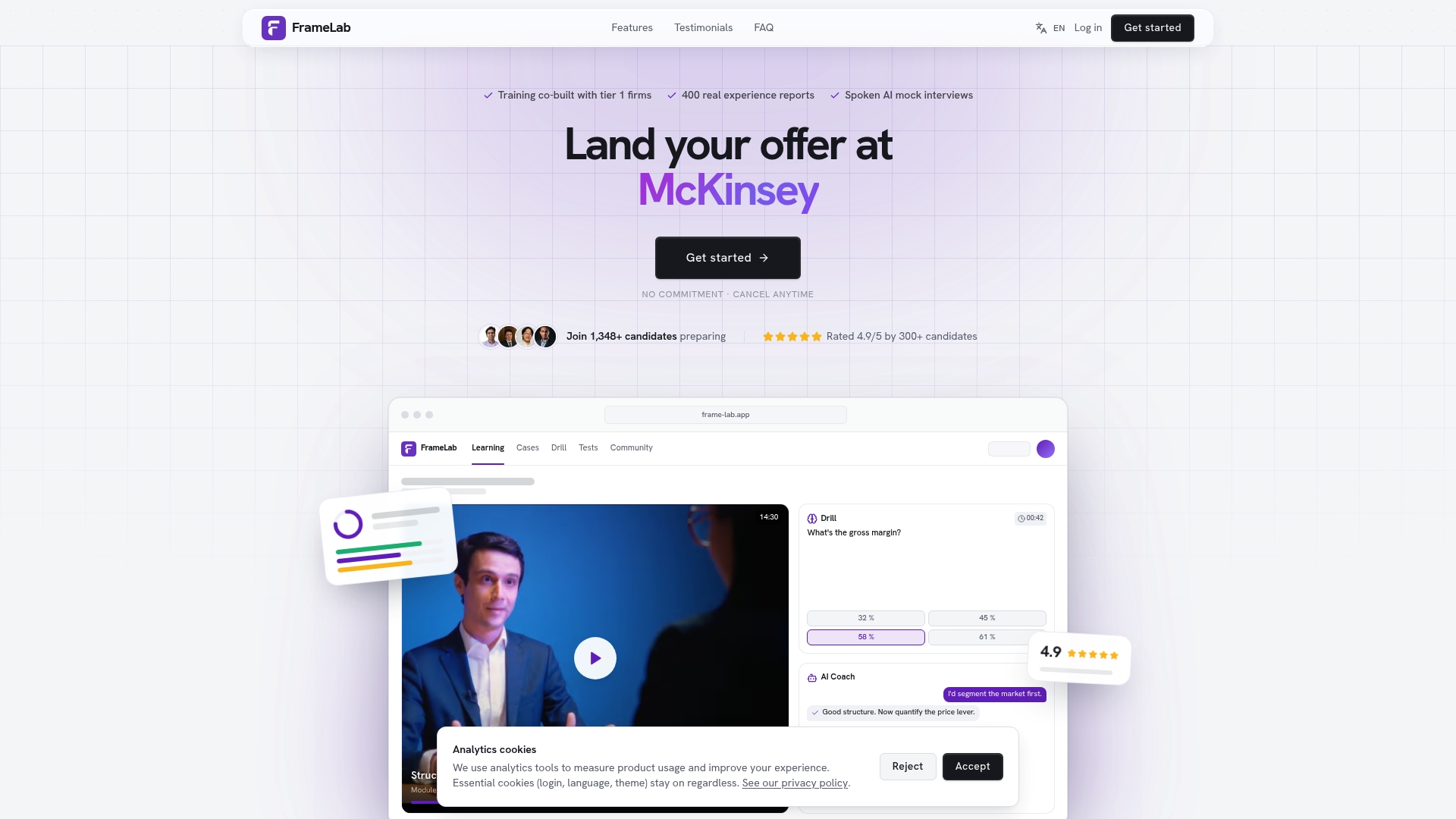
The platform combines AI-driven case simulations, targeted drill modules for math and structuring, and over 400 curated experience reports from real interviews. You can follow a structured learning track that mirrors the preparation stages in this article, from foundational cases through advanced frameworks and mock interviews. Frame-lab's feedback mechanisms show you exactly where your performance breaks down, so you fix the right thing at the right stage. If you are ready to move from preparation theory to measurable practice, start your prep on Frame-lab today.
FAQ
How many weeks does case interview preparation take?
The Yale Office of Career Strategy recommends a 4 - 6 week preparation timeline for most candidates. The exact duration depends on your starting skill level and how many hours per week you can commit.
What are the main case interview drill types?
The five core drill types are math drills, structuring drills, brainstorming drills, chart reading drills, and hypothesis drills. Each targets a specific skill that appears in full case interviews.
When should I start mock interviews?
Start mock interviews after completing at least 3 full cases in structured practice. Beginning too early means you spend the session learning mechanics rather than refining your thinking.
What is the MECE principle in case frameworks?
MECE stands for Mutually Exclusive, Collectively Exhaustive. It means your framework categories should not overlap and should together cover the entire problem. McKinsey and BCG interviewers evaluate this directly.
Do I need to prepare for behavioral questions alongside case practice?
Yes. At top consulting firms, behavioral or "FIT" questions carry equal weight with the case portion. Preparing both tracks from the start of your prep gives you a complete and competitive profile on interview day.