
Learn how to highlight transferable skills in consulting to stand out in interviews. Gain an edge with competency mapping techniques.
On this page▾
- How to identify your transferable skills for consulting roles
- How to structure and communicate your skills in consulting interviews
- What transferable skills do consulting firms value most?
- How to adapt your skills showcase across resume, cover letter, and interview
- Key takeaways
- What I have learned about showcasing transferable skills
- Frame-lab can sharpen how you present your skills
- FAQ
- What are transferable skills in consulting?
- How do I identify my transferable skills for a consulting role?
- What is the STAR method and why does it matter for consulting?
- How many skill stories should I prepare for a consulting interview?
- How do I adapt my transferable skills for a resume versus an interview?
- Recommended
Transferable skills in consulting are defined as competencies developed in one context that directly apply to consulting work, including structured problem-solving, analytical reasoning, communication clarity, and leadership. Candidates who can highlight transferable skills in consulting interviews gain a measurable edge, because firms like McKinsey and BCG evaluate these competencies explicitly during both case and behavioral rounds. Princeton's Center for Career Development recommends mapping your top skills to concrete contexts such as research, teaching, or community roles with specific examples. The standard industry term for this practice is "competency mapping," and it applies whether you are a recent graduate, a career changer, or a professional moving into strategy consulting for the first time.
How to identify your transferable skills for consulting roles
Identifying your transferable skills starts with a structured audit of your past experiences across academic, professional, and extracurricular settings. Most candidates underestimate how much relevant material they already have.

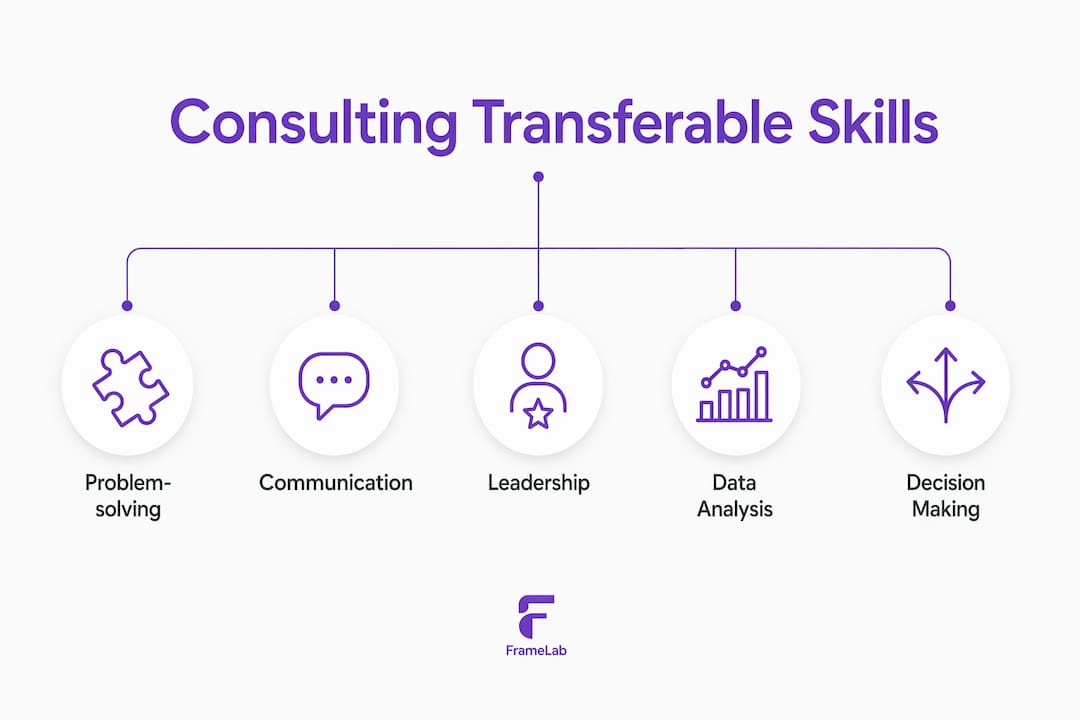
The four core competency areas consulting firms test are data analysis, communication, leadership, and problem-solving. Graduate students benefit most from listing each skill alongside the specific context where they used it, such as a thesis project, a student organization, or a part-time role. That context is what makes the skill credible to a recruiter.
Use this template to organize your audit before writing a single word on your resume:
| Competency | Context | Concrete Example | Measurable Outcome |
|---|---|---|---|
| Data analysis | Graduate research | Built regression model for thesis | Reduced prediction error by 18% |
| Communication | Teaching assistant role | Explained complex stats to 30 undergrads | Received highest TA rating in department |
| Leadership | Student club president | Led team of 12 through budget crisis | Secured alternative funding within 3 weeks |
| Problem-solving | Internship project | Redesigned client onboarding process | Cut onboarding time from 10 days to 6 |
Fill in every row with real examples before moving to the next step. Blank cells reveal gaps you need to address through new experiences or reframing existing ones.
When reflecting on your background, ask three questions for each experience:
- What problem did I solve, and how did I approach it?
- What process did I improve, and what was the measurable result?
- Who did I influence or lead, and what was the outcome?
These questions force specificity. Vague labels reduce credibility with recruiters, while concrete answers to these three questions build it. A candidate who says "I am a strong communicator" loses to one who says "I presented a 20-page market analysis to a client board and secured a $200,000 contract renewal."
Pro Tip: Aim for at least two strong examples per competency. Consulting interviewers probe deeply, and a single story rarely survives 15 minutes of follow-up questions.
How to structure and communicate your skills in consulting interviews
The STAR framework is the standard structure for presenting transferable skills in behavioral interviews. STAR stands for Situation, Task, Action, and Result. Competency-based interviews reward structured, evidence-backed answers because they predict on-the-job performance more reliably than unstructured responses.
Here is how to build a STAR story that holds up under pressure:
- Situation: Set the scene in two sentences. Name the organization, the challenge, and the stakes.
- Task: State your specific responsibility. Avoid describing what the team did. Focus on your role.
- Action: Spend the most time here. Explain the steps you took, the options you considered, and why you chose your approach.
- Result: Quantify the outcome. Use numbers, percentages, or time saved whenever possible.
The Action step is where most candidates lose points. Consulting firms want to see decision-making and tradeoffs, not just a list of tasks completed. Citing skills without illustrating decision-making limits your perceived consulting readiness. If your story does not include a moment where you chose one path over another and can explain why, revise it before your interview.
McKinsey's Personal Experience Interview (PEI) tests a single story intensively. A single story can be questioned for 15 - 20 minutes, covering your motivations, thought process, and the specific impact of your actions. That depth requirement means you need to know your examples well enough to answer follow-up questions you have not rehearsed.
Avoid these common pitfalls when communicating your skills:
- Describing group achievements without specifying your individual contribution
- Using adjectives like "passionate" or "driven" without evidence
- Giving results that are vague, such as "improved team morale," without a measurable indicator
- Switching stories mid-answer when a follow-up question feels hard
Pro Tip: Record yourself answering one STAR question out loud. Most candidates discover they spend 70% of their time on Situation and Task, leaving almost no time for Action and Result. Flip that ratio.
What transferable skills do consulting firms value most?
Consulting interview guides for 2026 identify four transferable skills as the core evaluative criteria across case and behavioral interviews: structured problem-solving, numerical reasoning, business judgment, and communication clarity.
Here is why each one matters in practice:
- Structured problem-solving: Consultants break ambiguous client problems into clear components. Candidates who demonstrate this skill show they can add value from day one, without needing months of on-the-job training.
- Numerical reasoning: Market sizing, financial modeling, and data interpretation appear in almost every case interview. A candidate who can perform quick, accurate mental math under pressure signals analytical readiness.
- Business judgment: Firms test whether you can prioritize the right issues and make reasonable assumptions. This skill separates candidates who understand business context from those who only know frameworks.
- Communication clarity: Consultants present findings to senior executives who have limited time. Clear, concise communication is not a soft skill in consulting. It is a core deliverable.
"Skills developed in consulting roles transfer across industries, including creating clear presentations, performing market and financial analysis, managing client relationships, and handling multiple priorities." - Indeed Career Advice
The practical implication is this: when you map your background to consulting roles, prioritize examples that show these four competencies over all others. A story about leading a student club matters less than one where you analyzed a dataset, identified a problem, proposed a solution, and measured the result.
How to adapt your skills showcase across resume, cover letter, and interview
Each application stage requires a different presentation format. Using the same language across all three stages signals a lack of preparation. Tailoring skill presentation to each phase increases persuasiveness and recruiter confidence.
| Stage | Format | Key Principle | Example |
|---|---|---|---|
| Resume | Concise, quantified bullets | Lead with action verb and metric | "Analyzed 5,000-row dataset to identify $120K cost savings" |
| Cover letter | Narrative paragraph | Link skill directly to role requirement | "My experience leading cross-functional teams maps directly to McKinsey's emphasis on collaborative problem-solving" |
| Interview | Full STAR story | Show depth, decision-making, and impact | 90-second structured answer with follow-up readiness |
On your resume, every bullet point describing a transferable skill should follow the formula: action verb plus context plus result. "Managed a project" becomes "Led a 6-person team to deliver a market entry report 2 weeks ahead of schedule, reducing client costs by 15%." The specificity does the work.
In your cover letter, connect each skill to a named consulting competency. Do not write "I am a strong analyst." Write "My two years of quantitative research at [University] gave me the ability to structure ambiguous problems and communicate findings to non-technical audiences, which aligns with the analytical demands of this role." That sentence does three things: names the skill, provides context, and links it to the firm's needs.
Pro Tip: Write your cover letter after you have completed your STAR stories. The best cover letter language comes directly from the clearest parts of your interview preparation, not the other way around.
The most common mistake across all three stages is failing to adapt the depth of your examples. Recruiters reading resumes spend seconds per bullet. Interviewers at firms like McKinsey and BCG spend minutes probing a single story. Match your depth to the format.
Key takeaways
Candidates who win consulting offers do not have more transferable skills than those who do not. They present the same skills with more specificity, better structure, and clearer evidence of impact.
| Point | Details |
|---|---|
| Map skills to competencies | Use a structured audit linking each skill to a concrete context and measurable outcome. |
| Use the STAR framework | Structure every behavioral answer with Situation, Task, Action, and Result, spending most time on Action. |
| Prioritize four core skills | Consulting firms evaluate structured problem-solving, numerical reasoning, business judgment, and communication clarity above all others. |
| Adapt by application stage | Use quantified bullets on resumes, narrative links in cover letters, and deep STAR stories in interviews. |
| Show decision-making | Stories without tradeoffs and choices made signal low consulting readiness, regardless of the outcome described. |
What I have learned about showcasing transferable skills
The biggest mistake I see candidates make is treating their skill stories as a list to check off. They prepare one leadership story, one problem-solving story, and one communication story, then move on. That approach fails the moment an interviewer asks a probing follow-up.
The candidates who perform best prepare fewer, deeper stories organized by competency theme. They know their three or four best examples so well that they can answer questions about motivations, alternatives considered, and lessons learned without hesitation. That depth is what separates a good answer from a great one.
The second trap is describing outcomes without explaining the choices that led to them. Saying "we increased revenue by 20%" is not impressive on its own. Saying "I recommended we exit the European market, which was counterintuitive given recent investment, because the margin data showed it was diluting overall profitability" is what consulting firms are actually listening for. The reasoning matters more than the result.
My honest advice: go back to your three strongest experiences and ask yourself whether you can explain every decision you made, every alternative you rejected, and every stakeholder you had to convince. If you cannot, you are not ready to present that story in a McKinsey PEI. Preparation at that level of depth is what reduces interview fear and builds genuine confidence.
Frame-lab can sharpen how you present your skills
Knowing the frameworks is one thing. Practicing them under real interview conditions is another. Frame-lab is built specifically for candidates preparing for consulting interviews at firms like McKinsey and BCG, with AI-driven mock interviews, over 400 curated experience reports, and personalized feedback on your STAR stories.
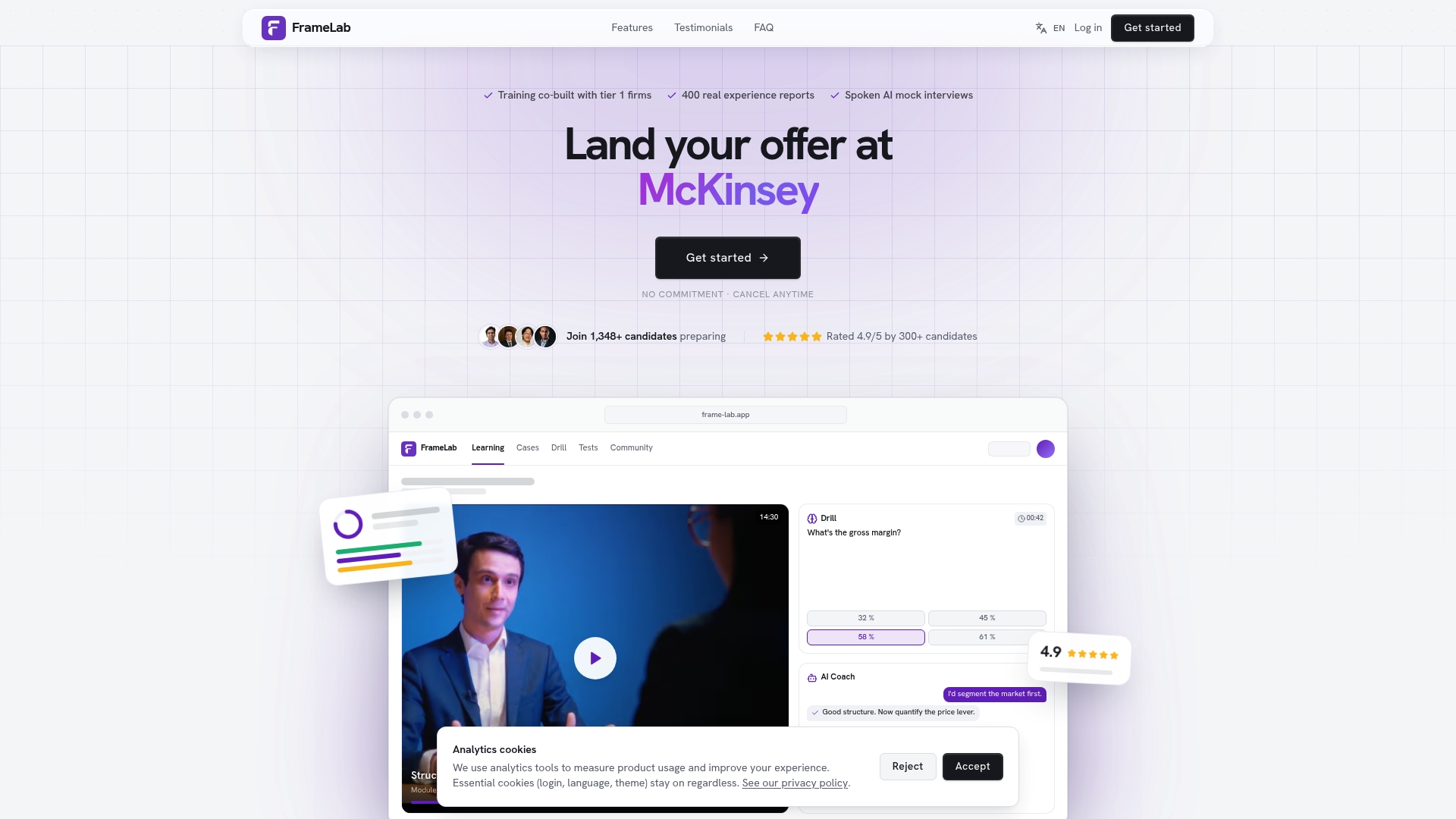
Frame-lab's FIT interview training focuses directly on behavioral and fit rounds, the exact stages where transferable skills are tested most intensively. The platform gives you structured feedback on your answers, helping you identify where your stories lack depth, specificity, or clear decision-making. If you are ready to move from knowing what to say to actually saying it well, Frame-lab's consulting program is the place to start.
FAQ
What are transferable skills in consulting?
Transferable skills in consulting are competencies developed outside consulting that apply directly to the work, including structured problem-solving, data analysis, communication clarity, and leadership. Consulting firms evaluate these skills explicitly during case and behavioral interviews.
How do I identify my transferable skills for a consulting role?
Audit your academic, professional, and extracurricular experiences using the four core consulting competencies as a filter: problem-solving, numerical reasoning, communication, and leadership. Princeton's Career Development Center recommends listing each skill alongside the specific context and a concrete example.
What is the STAR method and why does it matter for consulting?
STAR stands for Situation, Task, Action, and Result. It is the standard structure for behavioral interview answers and is particularly important in consulting because firms like McKinsey use it to evaluate decision-making depth and measurable impact over 15 - 20 minutes of questioning.
How many skill stories should I prepare for a consulting interview?
Prepare three to five deep, competency-themed stories rather than a larger number of shallow ones. Fewer, richer stories with quantified results and clear decision-making hold up better under intensive follow-up questioning than a long list of surface-level examples.
How do I adapt my transferable skills for a resume versus an interview?
On a resume, use concise action verb plus result bullets. In an interview, expand the same example into a full STAR story with decision-making context and measurable outcomes. The core skill stays the same. The depth and format change to match what each stage requires.