
Master how to practice interviewer-led case formats effectively. Gain confidence and outperform competitors in consulting interviews.
On this page▾
- What tools and frameworks do you need to practice interviewer-led cases?
- How to run effective practice sessions step by step
- What are the most common mistakes when practicing interviewer-led cases?
- How do you measure progress in interviewer-led case practice?
- Key Takeaways
- What I learned from getting the format wrong first
- Frame-lab's tools for interviewer-led case practice
- FAQ
- What is an interviewer-led case format?
- How many practice sessions do I need before a consulting interview?
- Why is verbal practice more effective than silent study?
- What is the calculation pipeline technique?
- How do I know if my practice is working?
- Recommended
Interviewer-led case formats are structured interviews where the interviewer controls the flow of analysis by presenting one prompt at a time, rather than handing the candidate a full problem to solve independently. This format is the standard at firms like McKinsey and is increasingly common across top-tier consulting recruiting. Candidates who practice interviewer-led case formats systematically outperform those who rely on unstructured self-study, because the format rewards specific verbal skills that only develop through repetition. Case interview stress is real, and the most direct way to reduce it is to make the format feel familiar before you walk into the room.
What tools and frameworks do you need to practice interviewer-led cases?
Effective case interview preparation starts with the right building blocks. Without them, practice sessions produce noise instead of progress.
Core consulting frameworks are the first requirement. You need fluency in profitability analysis, market entry structures, and break-even analysis before you attempt a live case. These frameworks give you a mental map when the interviewer's first prompt arrives. Core frameworks are not optional background knowledge. They are the vocabulary of every case conversation.

The calculation pipeline is the second tool you need to internalize. A mental calculation pipeline organizes and verbalizes math steps in interviewer-led case questions, improving both accuracy and flow. The technique works like this: state what you are calculating, name the formula or operation, declare the time horizon, then sanity-check the magnitude aloud before committing to a number. Interviewers evaluate how you think, not just whether you get the right answer. Verbalizing each step signals analytical clarity.
Practice aids complete your setup. A timer, a notebook for structuring answers, and a recording device are the three physical tools that matter most. Recording yourself is not optional at this stage. It is the only way to hear what the interviewer hears.
- Profitability framework: revenue versus cost drivers, broken into subcategories
- Market entry framework: market size, competitive dynamics, entry barriers, and fit with client capabilities
- Break-even analysis: fixed costs divided by margin per unit, compared against realistic market share
- Math for cases: mental math drills to build speed and confidence on quantitative prompts
- Timer: set to 2 minutes per sub-question to simulate real interviewer pacing
Pro Tip: Record your first three solo practice sessions without reviewing them immediately. Watch all three together at the end of the week. Patterns in your mistakes become obvious when you see them side by side.
How to run effective practice sessions step by step
The most common mistake in case interview preparation is treating it as a reading exercise. Cases are fundamentally verbal exercises. Silent study delays confidence gains and leaves candidates unprepared for the real-time pressure of an interviewer-led format.
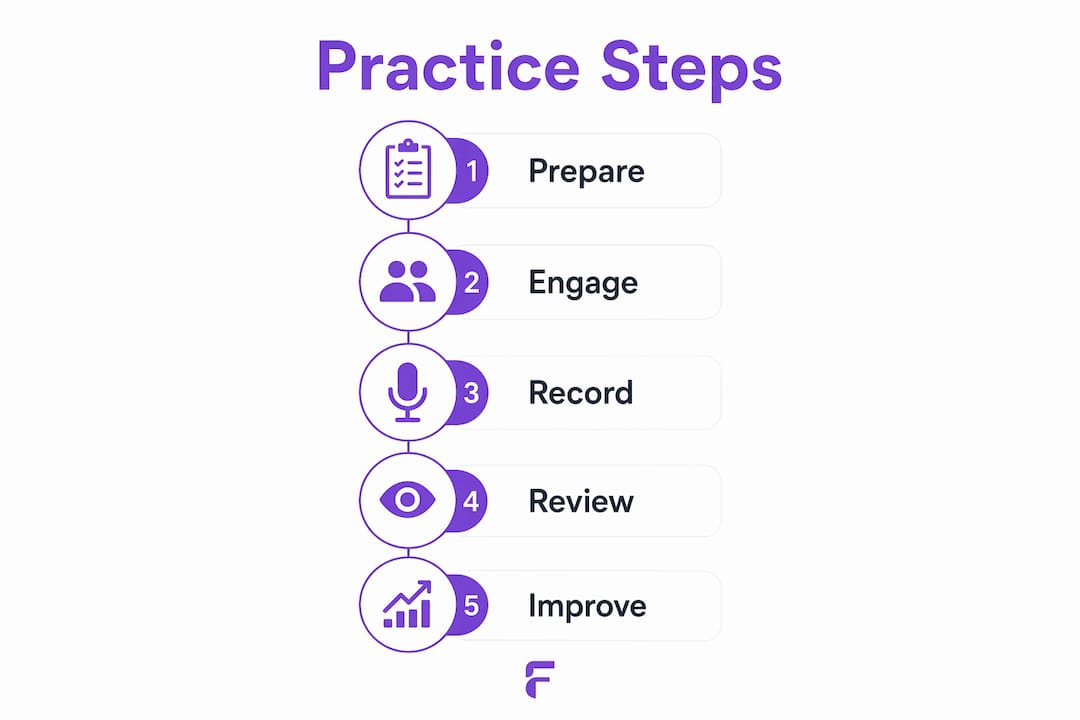
Follow this progression to build genuine readiness:
-
Read the prompt aloud, then pause. Do not write anything for the first 30 seconds. State your initial reaction verbally. This trains you to respond under pressure without going silent.
-
Structure your answer before you answer. Say "I want to look at this through a profitability lens, focusing first on revenue" before you dive into analysis. Interviewers reward candidates who signal their thinking before executing it.
-
Work through the calculation pipeline out loud. Break-even calculations in interviewer-led cases typically involve dividing fixed costs by margin per unit over a specific timeline, then comparing the result to market size share. State every step. Do not skip to the answer.
-
Interpret the data, then state what it means. If the interviewer gives you a chart showing declining margins, say "Margins dropped 8 points over three years. That tells me the cost structure changed faster than pricing could respond." Interpretation is what separates strong candidates from average ones.
-
Deliver a recommendation with a reason. End every sub-question with a clear position. "I recommend entering the market because the break-even volume is achievable within 18 months given current market growth" is a complete answer. "It depends" is not.
-
Progress to mock interviews with a partner or coach. Mock interviews with partners simulate real-time interviewer cues and help you refine timing, question interpretation, and immediate analysis. Solo practice builds the foundation. Partner practice tests it under fire.
Pro Tip: After each mock session, ask your partner one specific question: "Was there a moment where I lost you?" That single question surfaces communication gaps faster than general feedback.
What are the most common mistakes when practicing interviewer-led cases?
Most candidates make the same set of errors. Knowing them in advance lets you correct them before they cost you an offer.
-
Practicing silently. Verbal practice markedly improves confidence and communication skills. Reading case solutions without speaking them aloud builds zero interview muscle.
-
Skipping the sanity check. Candidates who rush to a number without verifying its magnitude regularly produce answers that are off by a factor of ten. Always ask yourself: "Does this number make sense in the real world?"
-
Misreading interviewer cues. In an interviewer-led format, the interviewer controls the problem flow to evaluate your ability to respond accurately under guidance. When an interviewer asks a follow-up question, it is usually a redirect. Treat it as a signal that your previous answer was incomplete or off-track.
-
Over-preparing frameworks without practicing transitions. Knowing a framework is not the same as knowing how to introduce it, apply it, and exit it cleanly in a live conversation. Practice the transitions explicitly.
-
Ignoring timing. Most sub-questions in an interviewer-led case have an implicit time budget of 90 seconds to 2 minutes. Candidates who run long on one question lose the opportunity to demonstrate breadth.
"The candidate who recovers quickly from a wrong turn impresses more than the one who never makes a mistake. Interviewers want to see how you think when you are under pressure, not just when everything goes smoothly."
Mental blocks during math are one of the most common sources of anxiety. The fix is to internalize structured verbal pipelines and practice timed calculations repeatedly until the process feels automatic.
How do you measure progress in interviewer-led case practice?
Tracking your development is not optional. Candidates who benchmark their progress and adjust their practice depth improve significantly on both communication and analysis over time.
Set clear benchmarks before each practice block. A useful benchmark is not "do more cases." It is "deliver a structured recommendation in under 90 seconds on every profitability sub-question this week." Specific targets produce specific improvements.
Use this table to track your weekly practice quality:
| Skill area | What to measure | Target benchmark |
|---|---|---|
| Structure | Does your opening frame cover the right dimensions? | Correct framework chosen in under 30 seconds |
| Math accuracy | Are your calculations correct and verbalized? | Zero magnitude errors per session |
| Communication | Does your partner follow your reasoning? | No "I lost you" moments per session |
| Timing | Do you finish each sub-question within the time budget? | Under 2 minutes per prompt |
| Recommendation | Is your final answer specific and supported? | One clear position with one supporting reason |
Review recordings from week one alongside recordings from week three. The gap will be visible. If it is not, your practice sessions lack enough real-time pressure. Add a timer, add a partner, or add a harder case type.
Consistent tracking and feedback incorporation leads to effective skill improvement over time. Candidates who skip this step plateau quickly because they repeat the same errors without recognizing them.
Pro Tip: Keep a one-sentence error log after every session. Write down the single biggest mistake you made. Review the log weekly. Patterns will tell you exactly where to focus next.
Balancing quantity and quality matters. Three high-quality sessions per week with full verbal practice and post-session review outperform seven rushed sessions done silently. Preparation reduces interview fear not through volume alone, but through deliberate repetition of the right behaviors.
Key Takeaways
Practicing interviewer-led case formats requires verbal repetition, structured frameworks, and consistent feedback to build real interview readiness.
| Point | Details |
|---|---|
| Verbal practice is non-negotiable | Speaking answers aloud builds the communication skills that silent study cannot replicate. |
| Use the calculation pipeline | Verbalize every math step, state the time horizon, and sanity-check the magnitude before committing to a number. |
| Progress from solo to mock interviews | Build your foundation alone, then test it under real-time pressure with a partner or coach. |
| Track specific benchmarks | Measure structure, math accuracy, timing, and recommendation quality every week. |
| Treat interviewer cues as redirects | When the interviewer asks a follow-up, treat it as a signal to adjust your analysis, not just continue it. |
What I learned from getting the format wrong first
I spent my first two weeks of case preparation reading solutions. I understood every framework on paper. I could explain profitability trees and market entry structures in writing. Then I sat down for my first mock interview and went completely silent for 12 seconds after the first prompt. That silence felt like a minute.
The problem was not knowledge. It was that I had never practiced thinking out loud under pressure. The interviewer-led format is unforgiving in that specific way. You cannot pause to gather your thoughts the way you can when writing. The words have to come, and they have to come in order.
What changed everything was committing to verbal practice from day one of each new week. I started recording myself answering prompts alone, with no partner, just a timer and a notebook. I watched the recordings and noticed I was hedging constantly. I said "I think" and "maybe" before every claim. Replacing those with direct statements like "The issue is" and "The data shows" changed how I came across entirely.
The calculation pipeline was the second turning point. I had been doing math in my head and announcing the answer. Interviewers could not follow my reasoning. Once I started narrating every step, the feedback shifted. Partners told me my analysis felt clearer even when the numbers were the same.
My honest advice: do not wait until you feel ready to speak out loud. You will never feel ready until you have done it badly a few times first. The discomfort of early verbal practice is exactly what builds the composure you need on interview day.
Frame-lab's tools for interviewer-led case practice
Preparing for interviewer-led cases requires more than reading guides. You need structured, repeatable practice that mirrors the real format.
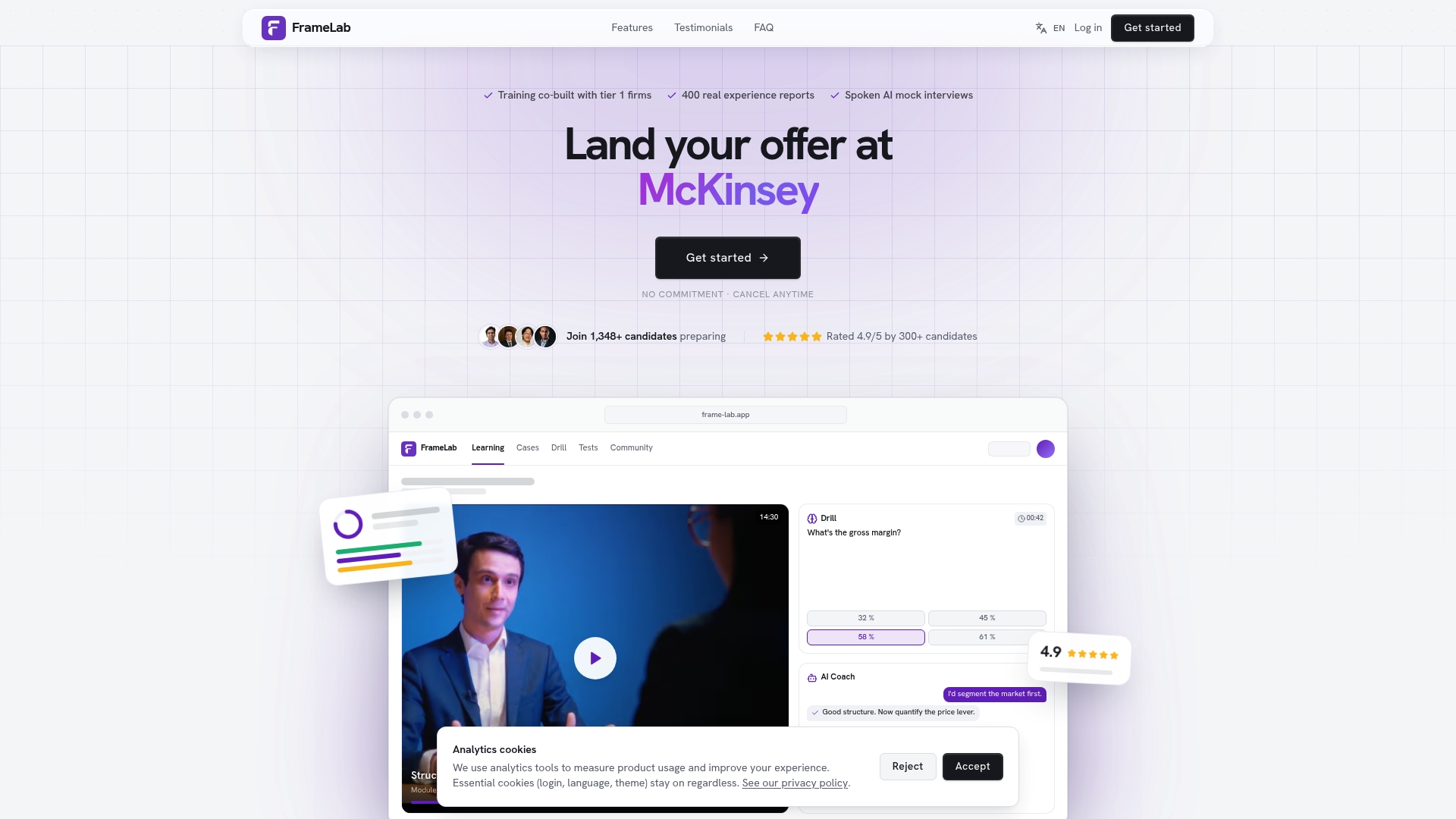
Frame-lab is built specifically for consulting candidates preparing for firms like McKinsey and BCG. The platform combines AI-driven mock interviews, over 400 curated experience reports, and interactive learning modules that cover core frameworks, mental math, and case structure. You can move from solo drills to full mock sessions within the same platform, with direct feedback at every stage. The FIT interview module and case library give you the format-specific repetition that generic prep tools do not offer. If you are serious about reducing anxiety and improving your performance before your next interview, Frame-lab gives you the structure to do it.
FAQ
What is an interviewer-led case format?
An interviewer-led case format is a structured interview where the interviewer presents one prompt at a time and controls the flow of analysis. The candidate responds to each prompt in sequence rather than solving a full problem independently.
How many practice sessions do I need before a consulting interview?
The number varies by starting point, but three high-quality verbal practice sessions per week with post-session review produces measurable improvement within two to three weeks. Quality and verbal execution matter more than raw volume.
Why is verbal practice more effective than silent study?
Cases are verbal exercises by design. Silent study builds knowledge but not the communication skills and composure that interviewers evaluate in real time. Speaking your answers aloud is the only way to develop those skills.
What is the calculation pipeline technique?
The calculation pipeline technique is a method where candidates verbalize each math step's formula and assumptions before committing to an answer. It improves accuracy and signals analytical clarity to the interviewer.
How do I know if my practice is working?
Track specific benchmarks each week: framework selection speed, math accuracy, timing per sub-question, and recommendation quality. If your error log shows the same mistakes repeating after two weeks, adjust your practice focus rather than increasing volume.