
Master the consulting interview process overview with our complete guide. Learn essential stages to ace your interviews and land your dream job.
On this page▾
- What are the main stages of the consulting interview process?
- How do different consulting firms structure their case interviews?
- What behavioral and fit interview components are essential?
- What are effective strategies for preparing for consulting interviews?
- How to find and evaluate case practice partners
- A four-step preparation routine
- How do quantitative questions appear in consulting interviews?
- Key Takeaways
- What most guides miss about the consulting interview process
- Frame-lab: your next step in consulting prep
- FAQ
- What is the consulting interview process?
- How long does the consulting interview process take?
- What is a case interview in consulting?
- How do I find good consulting interview practice partners?
- What is the difference between interviewer-led and candidate-led cases?
- Recommended
The consulting interview process is a multi-stage evaluation system designed to test your problem-solving ability, communication skills, and cultural fit with a firm. Top firms like McKinsey, BCG, Bain, and the Big 4 advisory practices each run structured sequences that move from application screening through case interviews to final-round offers. Understanding the full arc of this process before you start preparing is the single biggest advantage you can give yourself.
What are the main stages of the consulting interview process?
The consulting interview process follows a consistent sequence across most firms, though the complexity and speed vary significantly by tier.
The typical stages are:
- Application screening: Resume, cover letter, and GPA review. Top firms screen heavily here.
- Online assessment: Numerical reasoning, logical thinking, or firm-specific tests like McKinsey's Solve.
- First-round interview: One or two interviews combining a fit component and a case.
- Final-round interview: Two to four interviews, often with senior partners, with higher stakes on both fit and case performance.
- Offer decision: Usually communicated within days of the final round.
Timing matters more than most candidates expect. MBB firms open applications in august and september, with deadlines by december for the 2026 - 2027 internship cycle. Big 4 advisory firms run a wider window from august through march. Once interviews begin, the process can compress to as little as 2 - 3 weeks from first interview to offer. That speed means you cannot afford to start preparing after you apply.
| Stage | MBB firms | Big 4 advisory |
|---|---|---|
| Application window | August - September | August - March |
| Online assessment | Yes, firm-specific | Yes, varies by firm |
| Interview rounds | 2 rounds (4 - 6 interviews) | 1 - 2 rounds (2 - 4 interviews) |
| Time from first interview to offer | 2 - 3 weeks | 3 - 6 weeks |
| Case interview format | Interviewer-led or candidate-led | Typically candidate-led |
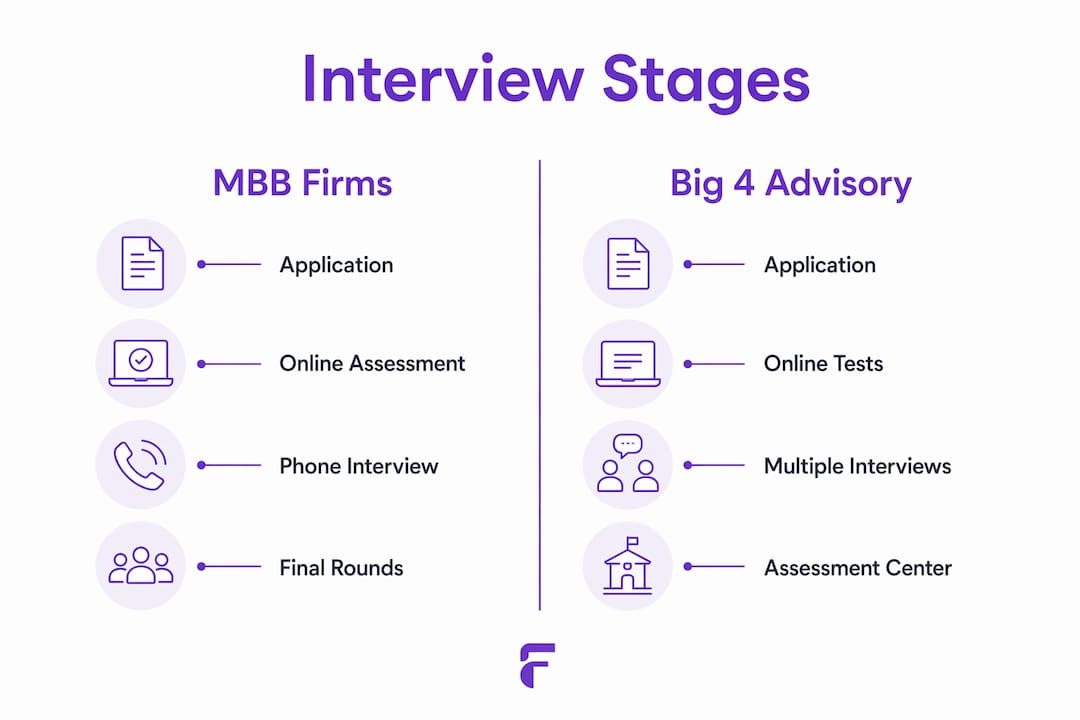
The table above shows that MBB timelines are compressed and demanding. Big 4 processes are longer but no less rigorous on case quality.
How do different consulting firms structure their case interviews?
Case interview formats differ by firm, and practicing only one style is one of the most common preparation mistakes candidates make.

McKinsey uses an interviewer-led format. The interviewer drives the structure, asking specific questions in sequence. Your job is to answer each question clearly and concisely, then synthesize your findings at the end. This format tests your ability to follow a logical thread under direction.
BCG and Bain use a candidate-led format. You receive a broad problem and must structure your own approach from the start. This tests your ability to build a framework, prioritize the right questions, and communicate your thinking as you go.
| Format | Firms | Key skills tested | Preparation focus |
|---|---|---|---|
| Interviewer-led | McKinsey | Precision, synthesis, responsiveness | Practice answering targeted sub-questions clearly |
| Candidate-led | BCG, Bain | Structure, creativity, communication | Practice building frameworks from scratch |
The practical consequence is clear. If you only practice candidate-led cases, you will struggle when McKinsey asks you a narrow, specific question and expects a direct answer. If you only practice interviewer-led cases, you will freeze when BCG asks you to take the wheel.
Pro Tip: Alternate between both formats in every week of your preparation. Use Frame-lab's guide on interviewer-led case practice to build fluency in the McKinsey style without sacrificing your candidate-led instincts.
Typical case interviews last 45 - 60 minutes, starting with fit questions, moving into the main case, and ending with your questions for the interviewer. That structure is consistent across firms, even when the case format differs.
What behavioral and fit interview components are essential?
Fit interviews are not a formality. They assess cultural alignment, motivation specific to the firm, and your potential to lead and work under ambiguity. Cultural fit tests your motivation and alignment with firm values, and your ability to work on diverse teams under pressure.
The STAR method (Situation, Task, Action, Result) is the most effective structure for answering behavioral questions. Candidates who use STAR produce stronger fit interviews and demonstrate the leadership impact that firms actively look for. Each story should be concise, specific, and tied to a real outcome.
Best practices for fit interview preparation:
- "Why consulting?" Answer with a specific experience that revealed your interest, not a generic statement about problem-solving.
- "Why this firm?" Reference a specific practice area, project type, or firm value. Generic answers signal low preparation.
- Leadership stories: Choose examples where you influenced others without formal authority.
- Failure stories: Pick a real setback, explain what you learned, and show how you applied that lesson.
- Coachability signals: Firms watch for candidates who adjust quickly when given feedback mid-interview.
Intellectual curiosity and coachability carry significant weight in final decisions. Coachability, shown by prompt adjustment to feedback mid-case, is valued as highly as analytical accuracy in final hiring decisions. That means how you respond to a correction matters as much as whether you got the answer right.
Pro Tip: Prepare five to seven core stories before your first interview. Each story should be adaptable to multiple question types. Frame-lab's fit interview module walks you through building and stress-testing each story.
What are effective strategies for preparing for consulting interviews?
Deliberate, structured practice beats passive reading every time. Reading case books builds familiarity, but it does not build the real-time thinking and communication skills that interviewers evaluate. You need to practice out loud, under time pressure, with feedback.
How to find and evaluate case practice partners
Strong case practice partners show up prepared, give specific feedback, and are close to your skill level. Rotating partners or maintaining a small consistent group accelerates progress more than practicing with the same person every session. Use Frame-lab's practice partner checklist to screen partners before committing to regular sessions.
A good partner does three things: they give specific feedback after each case (not just "that was good"), they push back when your structure is weak, and they hold you to time limits. A partner who lets you ramble is not helping you prepare.
A four-step preparation routine
- Build your framework library. Study the core frameworks: profitability trees, market entry structures, and growth strategy models. Practice applying them to new problems, not just memorizing them.
- Run daily mental math drills. Practice percentages, market sizing arithmetic, and unit conversions until they feel automatic. Speed and accuracy both matter.
- Complete two to three live case sessions per week. Alternate between interviewer-led and candidate-led formats. Record at least one session per week.
- Review recordings and diagnose weak spots. Continuous diagnosis of weak areas and focused repetition on those areas greatly improve performance. Watch your recordings and identify one specific thing to fix in the next session.
Pro Tip: Recording yourself is uncomfortable, but it is the fastest way to catch filler words, weak synthesis, and poor pacing. Most candidates who skip this step are surprised by what they hear the first time.
Preparation also reduces the anxiety that derails otherwise strong candidates. Structured preparation directly reduces interview fear, which means your practice sessions are doing double duty: building skill and building confidence.
How do quantitative questions appear in consulting interviews?
Quantitative reasoning is tested throughout the case, not just in dedicated math questions. You will encounter numerical challenges embedded in profitability analyses, market sizing estimates, and growth projections.
Common quantitative tasks in consulting interviews include:
- Market sizing: Estimate the size of a market using a logical, structured approach. The interviewer cares more about your method than your exact number.
- Profitability math: Calculate revenue, cost, and margin changes. Know how to work with percentages and ratios quickly.
- Break-even analysis: Determine when a new product or investment becomes profitable.
- Growth rate calculations: Apply compound growth or simple percentage changes to project future values.
- Sanity checks: After calculating a number, ask yourself whether it makes sense in the real world. Interviewers notice when candidates accept absurd results.
Market sizing questions focus on logical approach and clean assumptions rather than exact answers. That means you should state your assumptions clearly, show your math step by step, and round numbers to keep calculations manageable. Precision matters less than clarity.
Synthesis skills, like delivering a CEO-ready recommendation in under 60 seconds, separate top candidates in final rounds. After completing your quantitative analysis, you must be able to say: "Based on this, my recommendation is X, because Y and Z." That closing move is what interviewers remember.
Key Takeaways
The consulting interview process rewards candidates who prepare across all stages, practice both case formats, and treat fit interviews with the same rigor as case work.
| Point | Details |
|---|---|
| Multi-stage process | Applications, assessments, two interview rounds, and an offer decision follow a compressed timeline. |
| Two case formats | McKinsey uses interviewer-led cases; BCG and Bain use candidate-led formats. Practice both. |
| Fit interviews are evaluated rigorously | Use the STAR method and prepare five to seven adaptable stories before your first interview. |
| Coachability signals matter | Adjusting quickly to mid-case feedback is weighted as heavily as analytical accuracy. |
| Structured practice beats passive study | Record sessions, diagnose weak spots, and rotate practice partners to accelerate readiness. |
What most guides miss about the consulting interview process
The advice I see repeated most often is "practice more cases." That is not wrong, but it misses the real differentiator. In my experience working with candidates preparing for MBB and Big 4 interviews, the ones who get offers are not always the most analytically gifted. They are the ones who adjust fastest.
Coachability is the skill that firms are actually testing in the final round. When an interviewer pushes back on your framework or redirects your analysis, they are not just checking whether you got it right. They are watching how you respond to being wrong. Candidates who get defensive, or who ignore the hint and keep going, fail even when their math is correct.
The other thing most guides underestimate is the fit interview. Candidates spend 80% of their prep time on cases and show up to fit questions with vague, unstructured stories. That is a mistake. A weak fit interview can eliminate you even if your case performance is strong. Firms are hiring people they will work with on client engagements. Your stories need to show judgment, not just effort.
My honest advice: spend the first two weeks of your preparation building your story bank and your framework library in parallel. Do not wait until your cases feel "good enough" to start practicing fit. The two skills reinforce each other more than most candidates realize.
Frame-lab: your next step in consulting prep
Knowing the stages of the consulting interview process is the starting point. Executing under real interview pressure is a different challenge entirely.
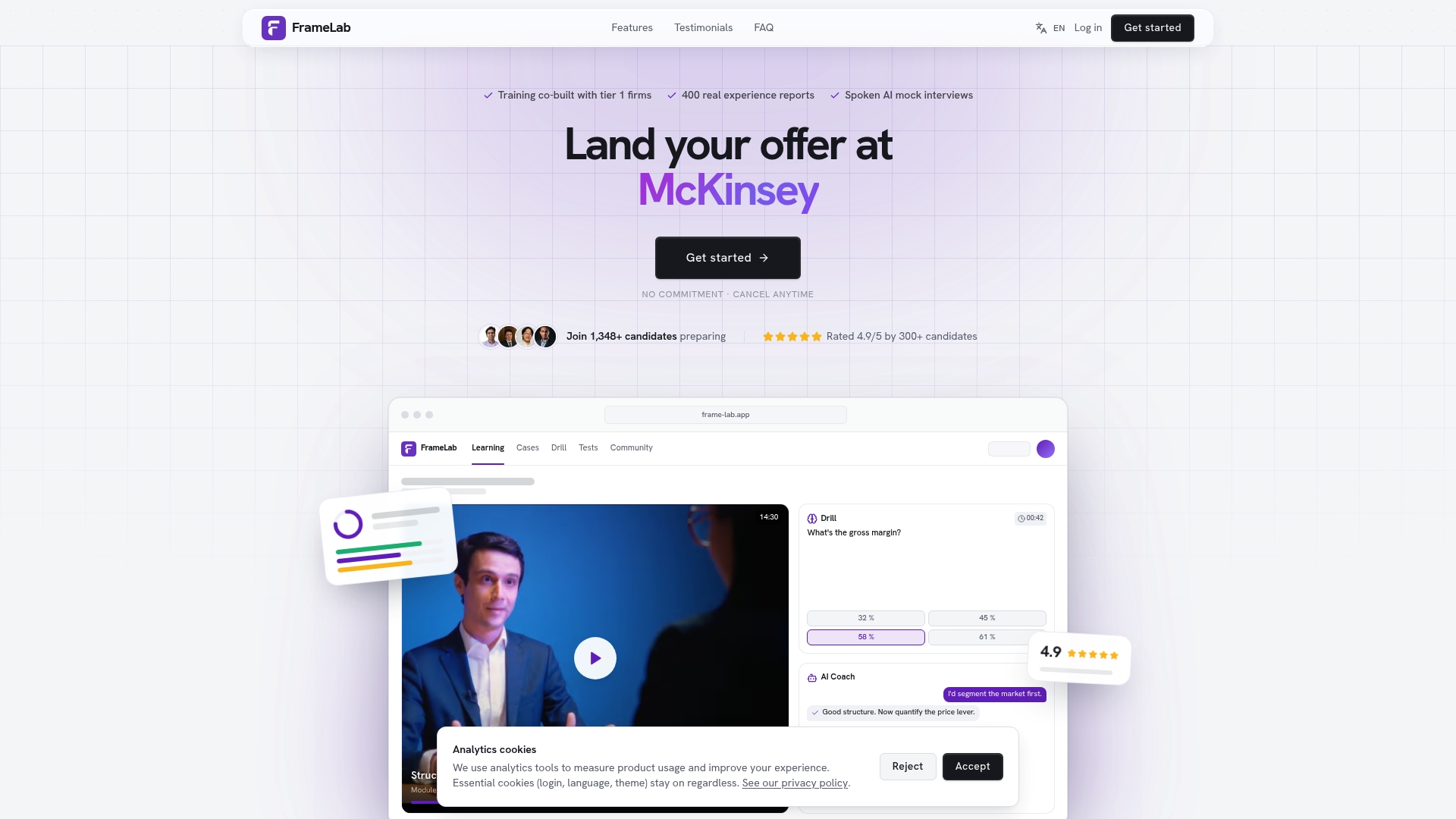
Frame-lab is built specifically for candidates targeting McKinsey, BCG, Bain, and Big 4 advisory roles. The platform combines AI-driven mock interviews, over 400 curated experience reports from real interviews, and a peer community for live case practice. You get personalized training paths that adapt to your weak spots, dedicated fit interview training, and case modules covering every major framework type. Whether you are starting from scratch or refining your final-round performance, Frame-lab gives you the structure and feedback that passive study cannot. Start your preparation and build the skills that actually get offers.
FAQ
What is the consulting interview process?
The consulting interview process is a multi-stage evaluation that moves from application screening and online assessments through two rounds of interviews combining fit and case components, ending with an offer decision.
How long does the consulting interview process take?
At MBB firms, the process can take as little as 2 - 3 weeks from first interview to offer. Big 4 advisory timelines are typically longer, running 3 - 6 weeks.
What is a case interview in consulting?
A case interview is a structured problem-solving exercise where you analyze a business scenario, build a framework, and deliver a recommendation. Case interviews last 45 - 60 minutes and test structured thinking, numerical reasoning, and communication.
How do I find good consulting interview practice partners?
Look for partners who are close to your skill level, give specific feedback, and show up prepared. Feedback-oriented practice sessions focused on concrete improvements accelerate readiness faster than unstructured practice.
What is the difference between interviewer-led and candidate-led cases?
Interviewer-led cases, used by McKinsey, have the interviewer directing the structure with specific questions. Candidate-led cases, used by BCG and Bain, require you to build and drive your own framework from the start.